
AML compliance in currency exchange offices is the set of regulatory and operational measures designed to detect and prevent money laundering and terrorist financing. Currency exchange businesses, classified as Money Services Businesses (MSBs) under U.S. law, face some of the most direct exposure to illicit financial flows of any financial sector. The role of AML compliance in exchange offices goes far beyond filing paperwork. It defines how your business identifies risk, trains staff, monitors transactions, and maintains the banking relationships that keep operations running. Regulatory bodies like FinCEN in the United States and FINTRAC in Canada enforce these obligations under frameworks including the Bank Secrecy Act (BSA) and Canada's Proceeds of Crime (Money Laundering) and Terrorist Financing Act (PCMLTFA). Every exchange office, regardless of size, must designate a compliance officer and operate a documented AML program.
What are the primary regulatory requirements for AML compliance in exchange offices?
Currency exchange offices operate under layered legal obligations that vary by jurisdiction but share a common core: register, report, and document.
MSB registration and reporting thresholds
In the United States, exchange offices must register with FinCEN as MSBs before conducting business. Registration alone does not satisfy compliance. The BSA requires exchange offices to file a Currency Transaction Report (CTR) for any transaction exceeding $10,000 in a single business day for the same customer. Reports must be submitted electronically within 15 calendar days. That deadline is strict, and missing it draws regulatory attention.
Suspicious activity carries its own reporting obligation. Exchange offices must file a SAR using FinCEN Form 111 when a transaction involves $2,000 or more and staff suspects money laundering, terrorist financing, or other illicit activity. The $2,000 threshold is notably low. It means front-line staff must be trained to recognize behavioral red flags, not just dollar amounts.
Canadian obligations under FINTRAC and PCMLTFA
In Canada, the PCMLTFA governs exchange office compliance. Foreign exchange bureaus must register with FINTRAC before operating, with registration renewal required every two years. Non-compliance triggers monetary penalties and enforcement actions, which can include business suspension.
Key reporting and control obligations for exchange offices include:
- Filing Large Cash Transaction Reports for cash transactions of CAD $10,000 or more
- Submitting Suspicious Transaction Reports when there are reasonable grounds to suspect money laundering
- Conducting customer identification and Know Your Customer (KYC) verification
- Maintaining records of all transactions for a minimum of five years
- Implementing a written AML compliance program reviewed and updated regularly
FINTRAC conducts periodic compliance examinations. Offices that cannot produce documented policies and training records face penalties regardless of whether any actual laundering occurred.
Internal controls and audit expectations
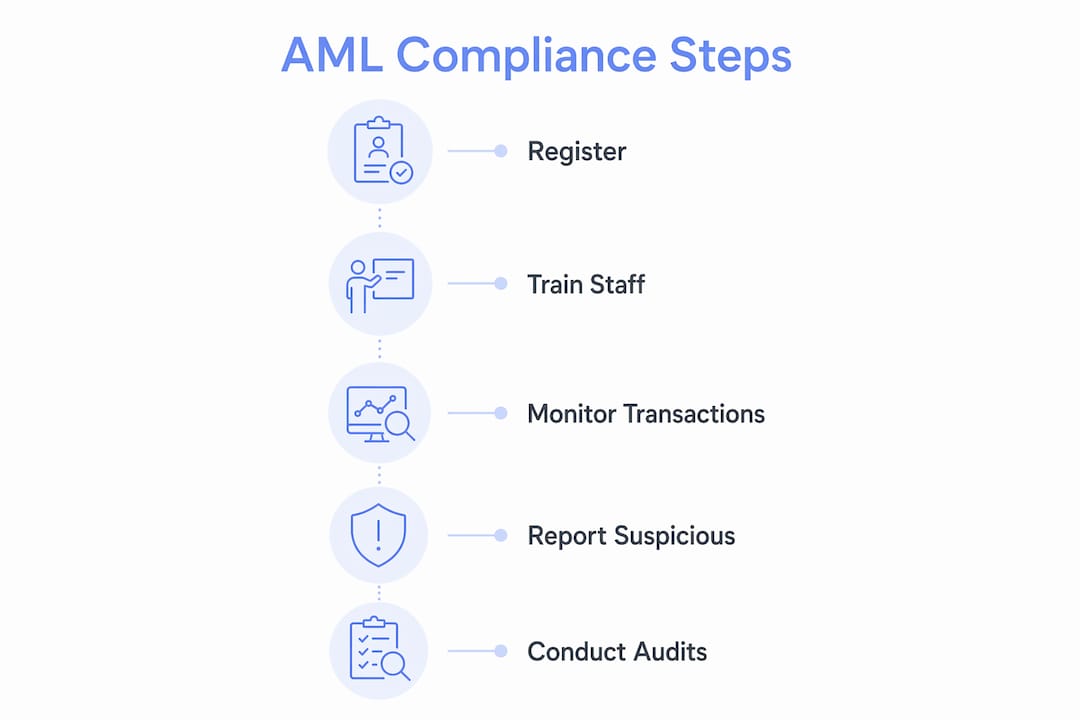
Regulators expect exchange offices to maintain internal controls that match their risk profile. A high-volume office near an international border faces different risks than a single-location urban bureau. Periodic independent audits test whether documented policies match actual practice. Regulators treat gaps between policy and practice as evidence of a deficient program, not just an administrative oversight.

What are the essential components of an effective AML compliance program?
An effective AML compliance program for exchange offices requires a designated compliance officer with decision-making authority, ongoing staff training, documented policies, and periodic independent audits. Each component depends on the others. A well-written policy manual means nothing if staff cannot identify a suspicious transaction in real time.
The compliance officer role
The compliance officer is the operational center of any AML program. This person must have genuine authority, not just a title. Compliance officers must have independence, direct board access, and adequate resources. Outsourcing the role or treating it as a part-time assignment triggers regulatory red flags during examinations. The compliance officer must report directly to senior management and have the budget to act on findings.
Staff training and transaction monitoring
Training is not a one-time event. Staff must receive initial training when hired and ongoing education as regulations and criminal tactics evolve. Effective training covers:
- How to identify structuring, where customers break large transactions into smaller ones to avoid reporting thresholds
- Red flags for third-party transactions, where someone exchanges currency on behalf of another person
- Document verification procedures for customer identification
- How and when to escalate concerns to the compliance officer without alerting the customer
Transaction monitoring systems add a layer of automated detection. These systems flag transactions that match known patterns of suspicious activity, such as repeated exchanges just below the $10,000 CTR threshold. Manual review alone cannot catch every pattern across a high-volume operation.
Pro Tip: Document every staff training session with attendance records and test scores. Regulators treat training documentation as direct evidence of program seriousness during examinations.
Independent audits
An independent audit tests the entire program, not just the documentation. The auditor must have no operational role in the compliance program. Audits should assess whether policies are current, whether staff can demonstrate their training, and whether transaction monitoring systems are functioning as designed. Audit findings must be reported to senior management with a written remediation plan.
How does AML compliance protect exchange offices beyond regulatory adherence?
AML compliance protects exchange offices by securing banking relationships, preserving reputation, and preventing use by criminal enterprises including fraud and terrorist financing. These benefits are operational, not just legal.
Banking relationships depend on documented compliance
Federal registration is the baseline, but banks require more before onboarding an exchange office as a client. Banks require documented internal AML controls before they will open accounts for exchange businesses. An exchange office without a documented, functioning AML program risks denial of banking services. Without a bank account, the business cannot operate. This is the most immediate practical consequence of inadequate compliance, and it affects offices that have never been accused of any wrongdoing.
Reputation and customer trust
"AML compliance acts as a defense to protect exchange offices' reputations and banking access, helping prevent fraud and terrorist financing on their platforms. A compliance failure, even one that results only in a regulatory warning, can permanently damage customer confidence and media standing."
Customers choose exchange offices based on trust. A public enforcement action, even a minor one, signals to customers that their transactions may not be handled with care. Reputation damage compounds quickly in local markets where word of mouth drives business.
Protection from criminal exploitation
Criminal enterprises actively seek out exchange offices with weak controls. An office without effective transaction monitoring becomes a tool for laundering proceeds from drug trafficking, fraud, or other crimes. The compliance officer's role is to make the office a difficult target. Strong KYC procedures, consistent record-keeping, and active SAR filing all raise the cost and risk for anyone attempting to use the office for illicit purposes.
What practical steps should compliance officers follow to implement AML procedures?
Implementing AML procedures in an exchange office requires a structured approach that connects risk assessment, technology, training, and reporting into a single operating framework.
-
Conduct a written risk assessment. Map every product, customer type, and geographic market your office serves. High-risk indicators include cash-intensive transactions, customers from high-risk jurisdictions, and frequent large exchanges by the same individual. The risk assessment drives every other element of the program.
-
Draft and approve written policies. Policies must cover customer identification, transaction monitoring, SAR and CTR filing, record retention, and staff training. Senior management must formally approve the policies. Undated or unsigned policy documents fail regulatory review.
-
Deploy transaction monitoring technology. Manual review cannot scale. Technology that flags transactions matching suspicious patterns gives compliance officers the visibility needed to act before a pattern becomes a regulatory problem. Currexchanger, for example, integrates transaction monitoring and suspicious activity alerts directly into the exchange office workflow.
-
Establish a direct reporting line. The compliance officer must report findings directly to the board or senior executive team, not through an operations manager. This independence protects the officer's ability to act on findings without internal pressure.
-
Coordinate AML and tax reporting. In Canada, AML and tax compliance must be integrated because FINTRAC and the Canada Revenue Agency coordinate enforcement. An AML failure can trigger a parallel tax audit. U.S. offices face similar coordination between FinCEN and the IRS.
-
Schedule annual independent audits. Set the audit date at the start of each year and treat it as a fixed deadline. Use audit findings to update policies and retrain staff within 60 days of the report.
Pro Tip: Treat your risk assessment as a living document. Update it whenever you add a new product, open a new location, or see a new typology in FinCEN or FINTRAC guidance.
AML compliance leadership: what most exchange offices get wrong
The most common failure I see in exchange office compliance programs is treating the compliance officer role as ceremonial. The title exists, the policy manual sits on a shelf, and training happens once a year as a checkbox. Regulators see through this immediately. AML programs require active enforcement, including training, audits, and empowered officers, to be effective. A compliance officer who cannot override an operations decision, or who lacks the budget to bring in an independent auditor, is not actually running a compliance program.
The second failure is treating AML and tax reporting as separate functions. They are not. In Canada especially, FINTRAC and CRA coordinate enforcement in ways that mean a gap in one area exposes you in the other. I have seen offices pass a FINTRAC examination only to face a CRA audit triggered by transaction data shared between agencies.
The offices that build genuine compliance cultures share one trait: the compliance officer has a seat at the table when business decisions are made, not just when something goes wrong. That structural change, more than any software or policy document, determines whether a program actually works.
— Bartas
How Currexchanger supports AML compliance for exchange offices
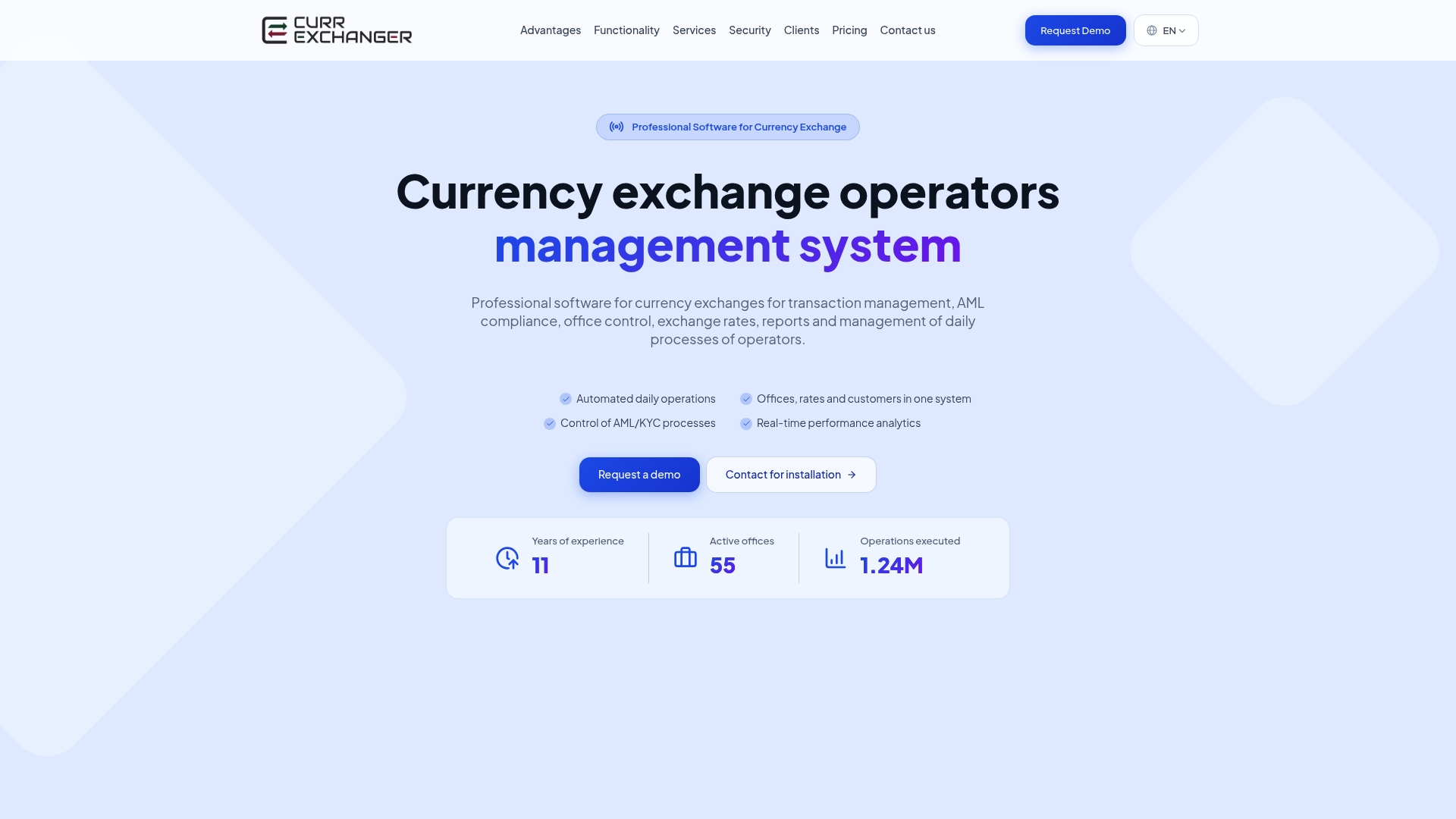
Currexchanger is built specifically for currency exchange operators who need AML compliance tools integrated into their daily workflow, not bolted on as an afterthought. The platform supports compliance officer workflows with built-in transaction monitoring, suspicious activity alerts, and automated reporting compatible with FinCEN and FINTRAC requirements. Document verification, KYC record management, and audit-ready activity logs are all centralized in one system. Compliance officers gain real-time visibility across single offices or multi-branch networks. Regulators and banking partners respond to documented, technology-supported programs with greater confidence. For exchange offices that need to demonstrate a functioning AML program, Currexchanger provides the operational foundation to do exactly that.
Key takeaways
AML compliance in exchange offices requires a documented program, an empowered compliance officer, and technology-supported monitoring to satisfy regulators and protect banking relationships.
| Point | Details |
|---|---|
| CTR and SAR filing thresholds | File CTRs for transactions over $10,000 and SARs for suspected illicit activity at $2,000 or more. |
| Compliance officer authority | The officer must have independence, board access, and a budget to act on findings. |
| Banking access depends on AML | Banks require documented internal AML controls before onboarding exchange offices as clients. |
| AML and tax coordination | In Canada, FINTRAC and CRA coordinate enforcement, making integrated compliance non-negotiable. |
| Technology supports monitoring | Automated transaction monitoring catches patterns that manual review misses at scale. |
FAQ
What is the role of AML compliance in exchange offices?
AML compliance in exchange offices is the set of regulatory and operational measures that detect and prevent money laundering and terrorist financing. It covers customer identification, transaction monitoring, suspicious activity reporting, and staff training.
What triggers a SAR filing for a currency exchange business?
Exchange offices must file a SAR using FinCEN Form 111 when a transaction involves $2,000 or more and staff suspects money laundering, terrorist financing, or other illicit activity.
How does FINTRAC regulate Canadian exchange offices?
Foreign exchange bureaus in Canada must register with FINTRAC before operating and renew registration every two years. Non-compliance results in monetary penalties and potential enforcement actions.
Why do banks deny services to exchange offices?
Banks require documented internal AML compliance programs before onboarding exchange offices as clients. Federal registration alone does not satisfy bank due diligence requirements.
How often should an exchange office conduct an AML audit?
Exchange offices should conduct an independent AML audit at least annually. The auditor must have no operational role in the compliance program, and findings must be reported to senior management with a written remediation plan.