
Accounting integration for currency exchange operations is defined as the automated connection between transaction management systems and accounting platforms to record, reconcile, and report multi-currency financial data without manual intervention. The currency exchange accounting integration benefits are concrete: automation eliminates data entry errors, exchange rate APIs enforce consistent foreign currency conversions, and audit trails satisfy IFRS and GAAP requirements. For currency exchange operators managing dozens of daily transactions across multiple branches, these gains are not incremental. They are structural. Currexchanger is built specifically for this environment, connecting transaction workflows directly to accounting outputs so operators spend less time reconciling and more time running their business.
1. How accounting integration cuts manual data entry
Manual data entry is the single largest source of accounting errors in currency exchange operations. 73% of small businesses lose more than 8 hours weekly to manual entry alone. Integration reduces that figure to near zero by automating the data flow from transaction capture to ledger posting.
The errors that manual entry produces are not random. They cluster around predictable failure points:
- Copy-paste mistakes between transaction records and accounting software
- Duplicate entries when the same transaction is logged in two systems
- Wrong currency conversions applied because rates are entered by hand
- Mismatched posting dates that distort period-end balances
Each of these errors compounds. A wrong rate on one transaction creates a reconciliation discrepancy that takes hours to trace. Integration removes the human step entirely by posting transactions directly from the source system.
Pro Tip: Start integration with live bank feeds, payment processors, and sales platforms first. These three sources account for the majority of transaction volume and deliver the fastest reduction in manual work.

2. Multi-currency accuracy and compliance through integration
Consistent exchange rate application is the foundation of accurate multi-currency accounting. Auditors require date-specific exchange rates sourced from reliable APIs to produce defensible audit trails. When rates are entered manually, operators introduce variability that creates audit risk and compliance exposure.
Integration enforces rate consistency automatically. The system pulls the exchange rate at the transaction date from a single API source and applies it uniformly across every entry. This matters for two distinct accounting events:
- Realized FX gains and losses: These occur when a foreign currency transaction is settled. The difference between the rate at transaction date and the rate at settlement date is recorded as income or expense.
- Unrealized FX gains and losses: These arise from open positions at month-end. Automating FX revaluations at period close prevents the manual reconciliation panic that hits finance teams every month.
IFRS (IAS 21) and US GAAP (ASC 830) both require that foreign currency transactions be recorded at the spot rate on the transaction date and that monetary items be retranslated at the closing rate. Integrated systems apply these rules automatically. Manual systems rely on the accountant remembering to apply them correctly every time.
"Using consistent exchange rate APIs enables audit preparedness and reduces the risk of compliance failures. Manual or default rates create audit risks that auditors flag immediately."
The compliance benefit extends beyond rate consistency. Integrated systems create a timestamped record of every transaction, the rate applied, the source of that rate, and the resulting accounting entry. That record is available instantly during an audit. Manual systems require reconstructing this history from spreadsheets and email threads.
3. Faster financial close and better reporting visibility
Integrated accounting systems reduce month-end closing from weeks to days by automating consolidations and intercompany eliminations. For currency exchange operators with multiple branches, this is the most visible operational benefit.
The mechanism is straightforward. When every branch posts transactions to a shared database in real time, the consolidation at month-end is already done. There is no need to collect spreadsheets from each location, reconcile conflicting figures, and manually eliminate intercompany transactions. The integrated system handles all of it continuously.
Pro Tip: Build a real-time dashboard that shows gross exchange position, unrealized FX exposure, and cash balances by currency. This gives management the information they need to make rate decisions during the month, not after it closes.
The reporting benefits extend beyond speed. A single source of truth eliminates the version-control problem that plagues multi-branch operations. When branch managers and head office accountants pull reports from the same system, they see the same numbers. Disagreements about figures disappear. Decisions get made faster.
| Reporting metric | Manual process | Integrated process |
|---|---|---|
| Month-end close time | 2–4 weeks | 2–5 days |
| Branch consolidation | Manual spreadsheet collection | Automated real-time aggregation |
| FX revaluation | Manual calculation at period end | Automated at transaction and period end |
| Audit trail availability | Reconstructed from records | Instantly accessible |
Finance teams freed from manual reconciliation shift their focus to analysis. Integration transforms finance teams from data-entry clerks into strategic partners who review exceptions and improve controls. That shift has real value. An accountant analyzing margin trends by currency pair delivers more to the business than one who spends the same hours entering transaction data.
4. What to look for in an integration solution
Choosing the right integration approach determines whether the benefits of accounting integration materialize or stall. The technical decision matters less than the operational preparation that precedes it.
Standardizing the chart of accounts before integration is the single most important preparatory step. Without a clean, consistent account structure, automated posting creates misclassifications. Those misclassifications multiply silently until month-end, when reconciliation work balloons. Operators who skip this step spend more time fixing integration errors than they saved by automating.
Transaction category mapping is the second critical decision. Every transaction type in the currency exchange system needs a defined mapping to an account code in the accounting platform. Buy transactions, sell transactions, commission income, FX gains, and FX losses each need their own mapping. Gaps in the mapping produce unclassified entries that require manual review.
The ROI inflection point for integration occurs after connecting three platforms. At that point, a unified API or middleware layer reduces total maintenance cost compared to managing point-to-point connections individually. Operators who plan for this from the start build a more cost-efficient architecture than those who add connections one at a time.
| Integration approach | Best for | Trade-off |
|---|---|---|
| Direct API connection | Single accounting platform | High maintenance if platforms change |
| Middleware or unified API | Multi-platform environments | Higher upfront setup cost |
| Native module integration | Purpose-built platforms like Currexchanger | Fastest deployment, least flexibility |
Integration is now product infrastructure, not an optional feature. Mid-market and enterprise finance operations treat connectivity as a gating criterion when selecting software. Operators who build integration capability into their core system from the start retain more flexibility as their business scales.
5. Currency conversion advantages that affect revenue
Multi-currency pricing accuracy has a direct revenue impact that most operators underestimate. Clear local currency pricing increases conversion rates by 35.26% and reduces bounce rates by 34%. That data comes from e-commerce, but the principle applies to any customer-facing currency exchange operation: customers respond to accurate, transparent pricing.
When the accounting system and the transaction system share the same rate data, the price a customer sees matches the rate that gets posted to the ledger. There is no gap between the quoted rate and the recorded rate. That consistency builds customer trust and eliminates the internal reconciliation work that gaps create.
Currency conversion advantages also show up in margin management. When operators can see realized FX gains and losses by currency pair in real time, they can adjust rates to protect margin. Without integration, this analysis requires manual extraction and calculation. With integration, it is available on a dashboard.
6. How does accounting integration help with AML and KYC compliance?
Currency exchange operators face AML and KYC obligations that create a second layer of compliance requirements beyond standard accounting standards. Integration connects transaction records to compliance workflows so that every transaction that triggers a reporting threshold is flagged automatically.
The connection between transaction data and compliance reporting is direct. When a transaction is recorded in the exchange system, the integrated platform checks it against AML thresholds, customer verification status, and geographic restrictions simultaneously. Manual processes require a separate compliance review step that creates delays and gaps.
Currexchanger integrates AML/KYC provider connections directly into its transaction workflow. This means compliance checks run at the point of transaction, not after the fact. The audit trail that results satisfies both accounting standards and regulatory reporting requirements in a single record.
Key Takeaways
Accounting integration for currency exchange operations delivers measurable gains in speed, accuracy, and compliance when the system is set up correctly from the start.
| Point | Details |
|---|---|
| Automation eliminates manual entry | Integration reduces 8+ hours of weekly manual data entry to near zero for most operations. |
| Rate consistency drives compliance | Exchange rate APIs enforce IFRS and GAAP-compliant rates at every transaction date automatically. |
| Close cycles shrink significantly | Integrated systems cut month-end closing from weeks to days through automated consolidation. |
| Chart of accounts must come first | Standardizing account structure before integration prevents misclassifications and silent errors. |
| ROI accelerates at three connections | Connecting three or more platforms through a unified API reduces maintenance cost and complexity. |
Why I think most operators underestimate the setup work
The operators who get the most from accounting integration are not the ones with the most sophisticated software. They are the ones who did the unglamorous preparation work before going live.
I have seen currency exchange businesses invest in integration and then spend months cleaning up misclassified transactions because nobody standardized the chart of accounts first. The integration ran perfectly. It just posted everything to the wrong accounts. The automation amplified the structural problem rather than fixing it.
The insight that most articles miss is this: integration does not fix bad data. It moves bad data faster. If your transaction categories are inconsistent, your rate sources are mixed, or your account codes are duplicated, integration will surface those problems at scale. The preparation phase is where the real work happens.
The second thing I would push back on is the idea that integration is primarily a cost-saving tool. The cost savings are real, but the strategic value is larger. When finance teams stop spending their time on manual reconciliation work and start spending it on margin analysis and rate strategy, the business makes better decisions. That is the outcome worth building toward.
Integration is not a feature you add to your accounting system. It is the foundation that determines how well your finance function scales. Operators who treat it as infrastructure from day one build businesses that can add branches, currencies, and products without rebuilding their back office every time.
— Bartas
Currexchanger connects your exchange operations to your accounting system
Currency exchange operators who manage multiple branches need more than a generic accounting connection. They need a system built for the specific transaction types, rate structures, and compliance requirements of the exchange industry.
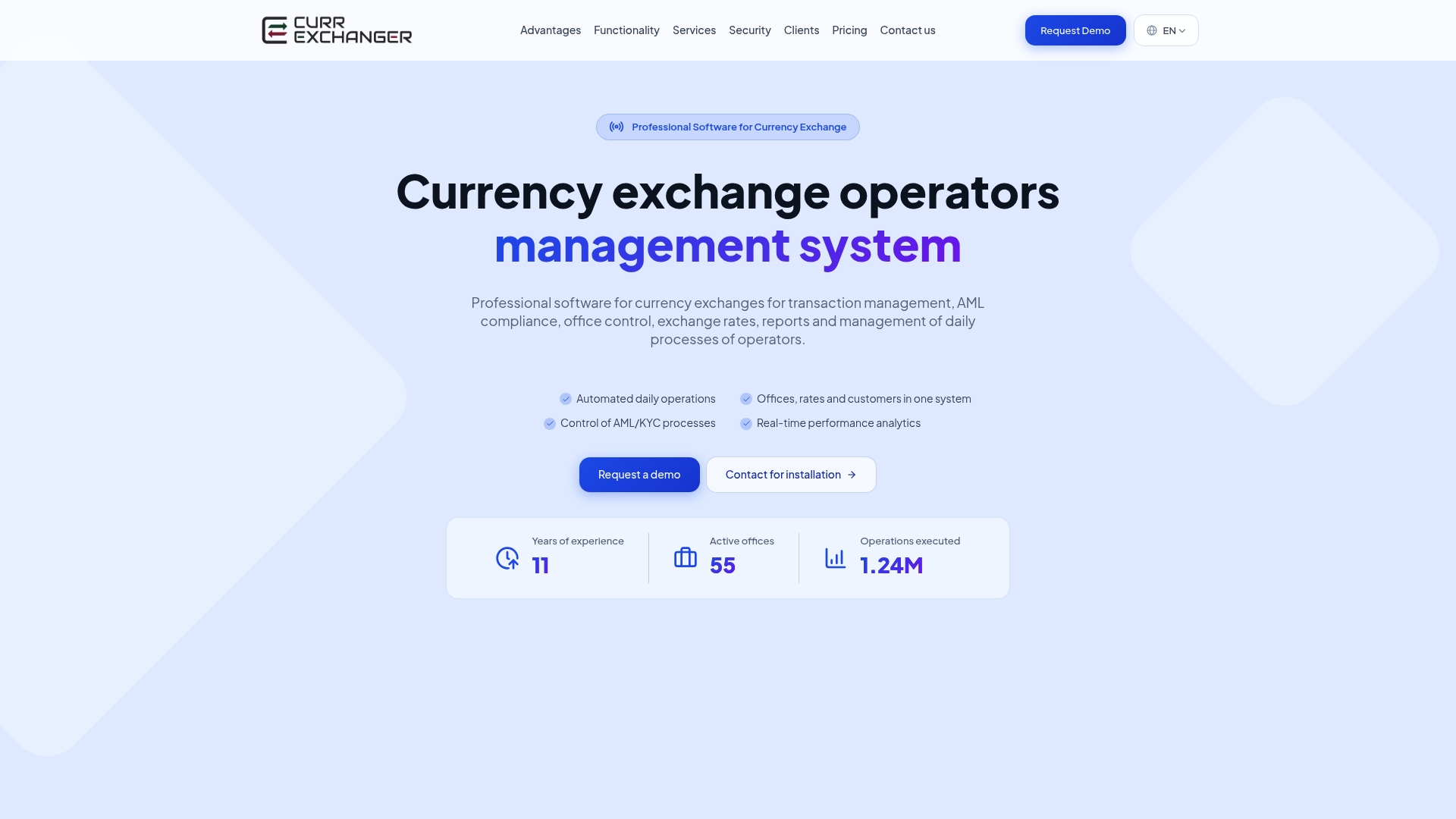
Currexchanger provides automated data sync between transaction records and accounting outputs, multi-currency support with API-driven rate management, and audit-ready records that satisfy both IFRS requirements and AML reporting obligations. The platform covers transaction management, cash and inventory monitoring, and user access controls in a single system. Operators can request a demo to see how the accounting integration module fits their specific branch structure and compliance environment.
FAQ
What are the main currency exchange accounting integration benefits?
The main benefits are automation of data entry, consistent exchange rate application, faster month-end close, and audit-ready compliance records. These gains apply directly to currency exchange operators managing multi-currency transactions across multiple locations.
How does accounting integration help with IFRS compliance?
Integration enforces IAS 21 requirements by applying the spot rate at the transaction date automatically and retranslating monetary items at the closing rate. This removes the manual calculation step that creates compliance gaps.
What is the difference between realized and unrealized FX gains and losses?
Realized FX gains and losses occur when a foreign currency transaction settles. Unrealized gains and losses arise from open positions at period end. Integrated systems handle both automatically, eliminating the manual revaluation step at month-end.
When does accounting integration deliver the best ROI?
The ROI inflection point occurs after connecting three platforms, where a unified API reduces total maintenance cost compared to managing separate point-to-point connections.
What should operators do before setting up accounting integration?
Standardize the chart of accounts and map every transaction category to a specific account code before activating the integration. Skipping this step causes misclassifications that multiply reconciliation work and undermine the accuracy benefits integration is meant to deliver.