
Exchange rate management is defined as the process of monitoring, controlling, and applying currency conversion rates to ensure accurate transactions and predictable financial outcomes. For currency exchange operators who manage exchange rates in a single office, the challenge is not complexity but consistency. Without structured processes, even a small rate error compounds across dozens of daily transactions. This guide covers the tools, step-by-step processes, hedging strategies, and governance practices that give single-office operators real control over their currency operations.
How to manage exchange rates in a single office
The foundation of effective office currency management is reliable rate data. Rates sourced directly from central banks or authoritative financial data providers carry far more accuracy than manually entered figures. A single miskeyed rate can distort every transaction processed until someone catches the error.
Automated exchange rate feeds from central banks significantly reduce errors compared to manual entry. Daily updates delivered via XML mapping to currency tables in your system keep rates current without requiring staff to check and type figures each morning. That shift alone removes one of the most common sources of financial error in single-office operations.

Understanding how your system quotes rates is equally critical. Direct quoting expresses the domestic currency per one unit of foreign currency. Indirect quoting does the reverse. Mixing these up when entering rates, even once, produces transactions that are off by a factor that no one notices until reconciliation. ERP systems with automated updates help single-office operations achieve accuracy and compliance without heavy manual work.
Pro Tip: Set your system to reject manual rate overrides unless a supervisor explicitly approves them. This single control prevents the majority of data entry errors before they reach a transaction.
| Method | Rate source | Update frequency | Error risk |
|---|---|---|---|
| Manual entry | Staff input | As needed | High |
| Automated XML feed | Central bank or provider | Daily or intraday | Low |
| ERP scheduled job | Integrated data service | Configurable | Very low |
What are the steps to implement structured rate management?
A structured approach to exchange rate management follows a clear sequence. Skipping any step creates gaps that surface as reconciliation problems or compliance failures later.
-
Define your objectives. Decide what you are managing for: transaction accuracy, reduced P&L volatility, regulatory compliance, or all three. Your objective determines which tools and policies you need.
-
Establish internal authority limits. Specify who can approve rate changes, execute currency conversions, and override system defaults. Clear internal governance, including defined execution rights and monthly reviews, is as important as any financial instrument in managing exchange rate risk.
-
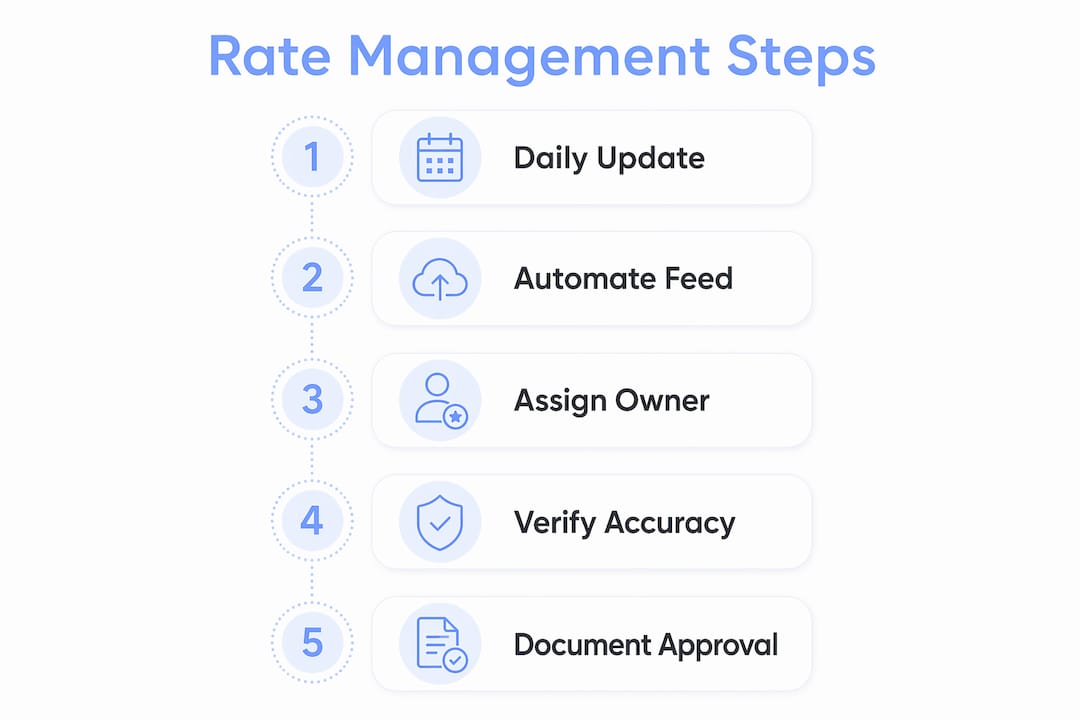
Schedule automated daily rate updates. Configure your system to pull rates each morning before the office opens. This removes the manual step and guarantees staff always work from current data.
-
Set a consistent internal rate policy. For accounting and reporting, choose one rate per period rather than applying the daily spot rate to every transaction. Using a single rate for a month stabilizes internal reporting and avoids excessive P&L volatility from daily spot fluctuations. Common choices include the prior month-end rate or a simple monthly average.
-
Document every conversion. Log the rate applied, the time of the transaction, the approving staff member, and the source of the rate. This documentation supports both internal audits and regulatory reviews.
-
Run monthly performance checks. Compare actual transaction rates against your target rates or benchmarks. A risk control framework that includes monthly performance checks prevents uncontrolled losses and confirms policy compliance.
-
Review and update your rate policy quarterly. Currency markets shift. A policy that worked in january may underperform by april. Scheduled reviews keep your approach aligned with current conditions.
Pro Tip: Treat your rate update job like a payroll run. Give it a fixed time, a responsible owner, and a written confirmation step. Consistency here prevents the most expensive surprises.
What hedging strategies work for a single office?
Hedging is the practice of reducing exposure to unfavorable rate movements. Single-office operators often assume hedging requires a treasury team or large trading volumes. It does not.
Effective foreign exchange exposure management employs four main strategies: natural hedging, multi-currency accounts, forward contracts, and timing of conversions. Each carries different costs and complexity levels.
Natural hedging means matching your currency inflows and outflows so that gains and losses offset each other. Natural hedging reduces costs without requiring derivative contracts. It is an underrated but effective first step before considering financial instruments. A single office that both buys and sells euros, for example, naturally offsets some of its exposure without any contract.
Forward contracts lock in a rate for a future transaction. They remove uncertainty from large or predictable currency needs. The tradeoff is that you lose the benefit if rates move in your favor after you lock in.
Limit orders automate execution when a rate hits your target. They require no active monitoring and execute at the price you set.
Here is a direct comparison of the three most practical options for single-office use:
- Natural hedging: No cost, no contract, limited to operations where inflows and outflows already overlap. Best first step.
- Forward contracts: Fixed cost built into the rate, removes uncertainty, requires a banking relationship. Best for large or predictable transactions.
- Limit orders: No upfront cost, automated, depends on market reaching your target price. Best for opportunistic conversions.
Managers benefit by understanding their currency's exchange rate system, whether fixed, floating, or managed float, to align their management approach effectively. A floating currency environment demands more active hedging than a fixed or managed one.
How do you avoid common errors in exchange rate handling?
Data accuracy errors in exchange rate handling fall into two categories: input errors and governance failures. Both are preventable.
Input errors most often come from misapplying quoting conventions. Misapplying rate input conventions can cause material financial miscalculations even with automated feeds if manual overrides are mishandled. Understanding whether your system expects a direct or indirect quote before entering any rate is non-negotiable.
Governance failures happen when staff override system rates without authorization or when no one reviews whether applied rates matched intended rates. The fix is structural, not behavioral. Build approval steps into your system so that overrides require a second set of eyes before they post.
Monthly reconciliation catches what daily checks miss. Compare the rates your system applied to transactions against the rates your policy required. Discrepancies signal either a process failure or a system configuration issue.
Choosing to use stable monthly rates internally rather than fluctuating daily spot rates reduces unnecessary volatility in financial reporting and operational complexity. This approach is standard practice in treasury management and directly applicable to single-office currency operations.
The most overlooked error source is the rate table itself. Rates entered in the wrong direction, for example, 1.08 when the system expects 0.926, produce transactions that are wrong by a factor rather than a rounding difference. Audit your rate table configuration when you first set up your system, and again after any software update.
Key Takeaways
Effective single-office exchange rate management requires automated rate feeds, clear internal governance, and a consistent monthly rate policy applied across all transactions.
| Point | Details |
|---|---|
| Automate rate feeds | Pull rates daily from central banks or authorized providers to eliminate manual entry errors. |
| Set internal authority limits | Define who approves rate changes and overrides before any transaction is processed. |
| Use a consistent monthly rate | Apply one internal rate per period to stabilize reporting and reduce P&L swings. |
| Reconcile monthly | Compare applied rates to policy targets each month to catch errors and governance gaps. |
| Start with natural hedging | Match currency inflows and outflows before adding forward contracts or limit orders. |
What I have learned about rate management in small offices
Exchange rate risk is now a fundamental strategic concern rather than just a short-term operational issue. That shift in thinking is what separates offices that manage rates well from those that react to problems after the fact.
The single biggest mistake I see in small offices is treating rate management as a back-office task with no strategic weight. Operators focus on transaction volume and customer service, which is correct, but they leave rate governance to whoever has time. That approach works until it does not, and when it fails, the losses are rarely small.
Automation changed this equation. Modern treasury software automates exposure analysis and compliance reporting, making FX risk management accessible to offices without large treasury teams. When I see an office move from manual rate entry to an automated feed, the error rate drops immediately and staff spend that recovered time on higher-value work.
The second lesson is that training matters as much as technology. A well-configured system still fails if the person handling an exception does not understand quoting conventions or approval workflows. Build short, practical training into your onboarding for every staff member who touches rate data. Review it annually.
— Bartas
Currexchanger: built for single-office rate control
Running a single office does not mean settling for generic financial tools. Currexchanger is purpose-built for currency exchange operators who need precise rate control, automated updates, and full transaction visibility without a large back-office team.
Currexchanger connects directly to banking feeds and integrates with accounting systems via API, so your rate tables stay current without manual intervention. Every rate change is logged, every override requires authorization, and every transaction ties back to the rate that was active at the time. The platform's exchange rate management tools give single-office operators the same governance controls that larger networks rely on, without the complexity. If you manage currency conversions daily and want fewer errors and cleaner reporting, Currexchanger is worth a close look.
FAQ
What does exchange rate management mean for a single office?
Exchange rate management is the process of sourcing, applying, and controlling currency conversion rates across all transactions. For a single office, it means setting up automated rate feeds, defining who can change rates, and reconciling applied rates against policy each month.
How often should a single office update its exchange rates?
Daily updates are the standard practice. Automated feeds from central banks or authorized providers deliver current rates each morning before transactions begin, removing the need for manual checks.
What is the simplest hedging strategy for a small currency exchange office?
Natural hedging is the lowest-cost starting point. Matching your currency inflows and outflows offsets exposure without requiring contracts or banking relationships, making it the practical first step for single-office operators.
Why does a consistent monthly rate matter for internal reporting?
Applying one internal rate per period prevents daily spot rate swings from creating artificial P&L volatility. Prior month-end rates or simple monthly averages are both widely used approaches in treasury practice.
What causes the most common exchange rate errors in small offices?
Misapplying quoting conventions during manual overrides is the leading cause. Direct and indirect quotes are easily confused, and a single input error in the wrong direction produces transactions that are off by a factor rather than a rounding amount.