
Scaling currency exchange operations means expanding client volume and transaction throughput while keeping compliance, liquidity, and operational efficiency intact. Operators who grow without addressing infrastructure first face reconciliation failures, compliance gaps, and payment delays that compound at every new client tier. The Financial Action Task Force (FATF) and MiFID II set the regulatory floor, but the real ceiling is your technology stack. Aligning infrastructure, liquidity architecture, and compliance automation before you hit growth pressure is the difference between controlled expansion and operational breakdown.
What does scaling currency exchange operations actually require?
The foundation of any scalable currency exchange operation is infrastructure that handles failure gracefully. A single payment service provider (PSP) or liquidity provider (LP) creates a single point of failure. At 1,000 active clients, one PSP relationship is the minimum for redundancy. That ratio changes fast as volume grows.
Recovery time objectives (RTO) and recovery point objectives (RPO) define how quickly your systems must recover after an outage. For trading systems, a sub-30-minute RTO is the institutional standard. Without defined RTO and RPO targets, your team has no clear benchmark to test against, and failover drills become theater rather than preparation.
Enterprise FX systems benefit from a messaging bus architecture that decouples critical modules and prevents cascading failures. Channel adapters should isolate protocol translation from business logic. This lets you scale or maintain individual components without taking down the entire system.
| Infrastructure component | Scaling threshold | Recommendation |
|---|---|---|
| PSP relationships | 1,000 clients = 1 PSP | Add one PSP per 1,000 active clients |
| Liquidity providers | 5,000 clients = 2 LPs | Scale to 4–6 aggregated LPs at 20,000 clients |
| Failover testing | Weekly at 20,000 clients | Automate failover tests; log every result |
| Disaster recovery rehearsals | Every 60 days | Full runbook rehearsal, not just tabletop review |
| RTO target | Sub-30 minutes for trading systems | Define in writing; test against it quarterly |
Pro Tip: Run a full disaster recovery rehearsal every 60 days, not just a tabletop review. Operators who only review runbooks on paper consistently miss the latency gaps that appear under real load conditions.
How do you architect liquidity and payment workflows for growth?
Liquidity provider architecture is not a set-and-forget decision. At 5,000 clients, two LPs with basic failover is adequate. At 20,000 clients, 4–6 aggregated LPs with weekly-tested formal failover is the minimum standard. Each LP tier adds redundancy and price competition, which reduces spread costs during volatility.

Cross-border payment delays are widely misattributed to messaging standards. Despite 90% of cross-border payments reaching destination banks within an hour, less than 50% credit end customers' accounts in that timeframe. The bottleneck sits inside the receiving institution's internal processing queue, not in the network itself.
Redesigning correspondent banking relationships is the real lever for improving funds release timing. Operators who consolidate clearing partners and prioritize local settlement rails reduce the number of internal queues their payments must pass through. Fewer hops mean faster credits and fewer reconciliation exceptions.
Steps to build a payment and liquidity workflow that scales:
- Audit your current LP and PSP relationships. Map every failover dependency and identify gaps.
- Add a second LP before you hit 5,000 clients. Do not wait for a liquidity event to force the decision.
- Test formal failover weekly once you pass 10,000 clients. Document every test result in a shared runbook.
- Map your correspondent banking chain. Identify which relationships add processing hops without adding value.
- Consolidate clearing partners where possible. Prioritize partners with local settlement rails in your key corridors.
- Establish SLA agreements with each LP and PSP. Define maximum acceptable latency and credit delay in writing.
| Architecture type | Strengths | Weaknesses |
|---|---|---|
| Single LP, single PSP | Low cost, simple setup | No redundancy; one failure halts operations |
| Dual LP, dual PSP | Basic failover coverage | Limited price competition; manual failover risk |
| Aggregated multi-LP, multi-PSP | Price optimization, automated failover | Higher integration complexity and cost |
| Local rail-first with global backup | Fast domestic credits, lower fees | Requires corridor-specific partnerships |
Pro Tip: Local settlement rails cut credit delays significantly in high-volume corridors. Identify your top three payment corridors by volume and build direct local rail access for each before expanding to new markets.
What automation strategies increase currency exchange efficiency at scale?
Compliance throughput is the operational constraint most operators underestimate. Onboarding and ongoing KYC refresh capacity must grow with your client base. Automating onboarding throughput, KYC refreshes, transaction monitoring, case management, and trade reconstruction removes the manual bottlenecks that slow growth at every client tier.
A compliance accountability layer requires more than software. It requires defined RTO and RPO targets applied specifically to compliance workflows. Successful operators who grow beyond 20,000 clients build institutional-grade compliance layers with clear ownership, escalation paths, and measurable recovery benchmarks.
FX rate inconsistency across ERP, treasury, and consolidation systems creates expensive reconciliation friction. Centralizing rate ingestion into one master system that pushes uniform, timestamped rate data downstream eliminates the version conflicts that cause restatements. Every system downstream receives the same rate at the same timestamp.
- Automated KYC document verification with real-time AML screening
- Centralized FX rate ingestion with timestamped distribution to all downstream systems
- Transaction monitoring with automated case escalation thresholds
- Trade reconstruction logs that satisfy audit requirements without manual assembly
- Automated balance tracking and cash inventory alerts across all branches
- Scheduled compliance reporting with no manual data aggregation
Pro Tip: Align your internal audit schedule with your automation deployment calendar. Auditors who review automated workflows catch configuration errors early. Manual audits of automated systems are far cheaper than post-incident remediation.
How do you troubleshoot common currency exchange operational bottlenecks?
The most common mistake operators make when growing is focusing on retail trade sizing rather than infrastructure economics. Adding client volume without adding PSP relationships, LP redundancy, or compliance capacity creates compounding friction. Each new client tier amplifies existing weaknesses.
Failover testing frequency is the most underestimated operational risk. Runbooks should be tested quarterly and disaster recovery rehearsals performed every 60 days to maintain a sub-30-minute RTO for trading systems. Operators who test annually discover their runbooks are outdated only when a real incident occurs.
The true bottleneck in global currency exchange lies in liquidity custody and release mechanisms, not in messaging standards like SWIFT. Fixing the wrong layer wastes time and budget while the real friction compounds. Systemic redesign of correspondent banking relationships delivers results that protocol-level fixes cannot.
FX rate inconsistency is a growth-phase risk that appears gradually. As you add systems, each one may pull rates from a different source at a different time. Centralizing and timestamping FX rate ingestion into a master system prevents the restatements and reconciliation costs that accelerate with volume.
Troubleshooting steps for systemic bottlenecks:
- Map every system that consumes FX rate data. Identify which ones pull from independent sources.
- Audit your PSP and LP failover logs. Confirm that automated failover actually triggered in the last 90 days.
- Review your correspondent banking chain for processing hops that add latency without adding value.
- Test your compliance workflow under peak load. Identify where manual review creates a queue.
- Check your RTO and RPO definitions. Confirm they are documented, tested, and owned by a named team member.
The transition to T+1 settlement cycles adds pressure to every step above. T+1 settlement reduces post-trade operation time by 83% while increasing FX costs by 4–5 basis points. Operators without automated post-trade workflows absorb that cost in manual labor and error correction.
Key Takeaways
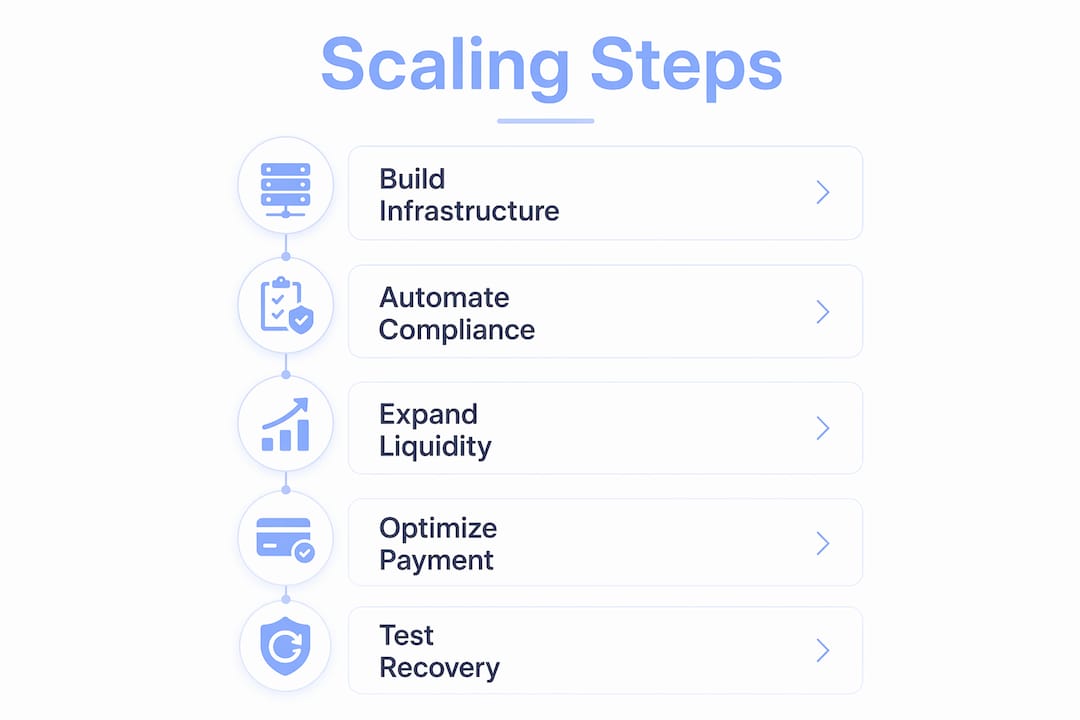
Scaling currency exchange operations requires building redundant infrastructure, automating compliance workflows, and redesigning payment architecture before volume growth exposes the gaps.
| Point | Details |
|---|---|
| PSP and LP ratios matter | Add one PSP per 1,000 clients; scale to 4–6 LPs at 20,000 clients with weekly failover tests. |
| Test recovery, not just plans | Run full disaster recovery rehearsals every 60 days to maintain a sub-30-minute RTO. |
| The bottleneck is not SWIFT | Internal processing queues at receiving institutions cause most cross-border payment delays. |
| Centralize FX rate ingestion | One master system with timestamped rate distribution eliminates reconciliation friction across all downstream tools. |
| Automate compliance early | KYC refresh, transaction monitoring, and trade reconstruction must scale with client volume, not lag behind it. |
Why I think most operators scale in the wrong order
The conventional advice is to grow your client base first and fix infrastructure later. Every operator I have seen follow that path ends up rebuilding systems under live load, which is the most expensive and risky way to do it. The operators who scale cleanly build the compliance and automation layers before they need them.
The shift toward specialist clearing institutions is real and accelerating. Operators who consolidate clearing partners and build local rail access early gain a structural cost advantage that compounds over time. Those who stay with legacy correspondent chains absorb delays and fees that their competitors have already eliminated.
Runbooks and failover mechanisms are not one-time projects. They degrade. A runbook written 18 months ago reflects a system that no longer exists in the same form. The operators with the best incident response times are the ones who treat runbooks as living documents and rehearse them on a fixed schedule.
The metric that separates institutional-grade operations from everyone else is not transaction volume. It is mean time to recovery. Build toward that number from day one, and the growth will follow the infrastructure rather than outrun it.
— Bartas
Currexchanger: built for operators who are growing
Currency exchange operators managing multiple branches face the exact infrastructure, compliance, and rate management challenges covered above. Currexchanger is built specifically for that environment.
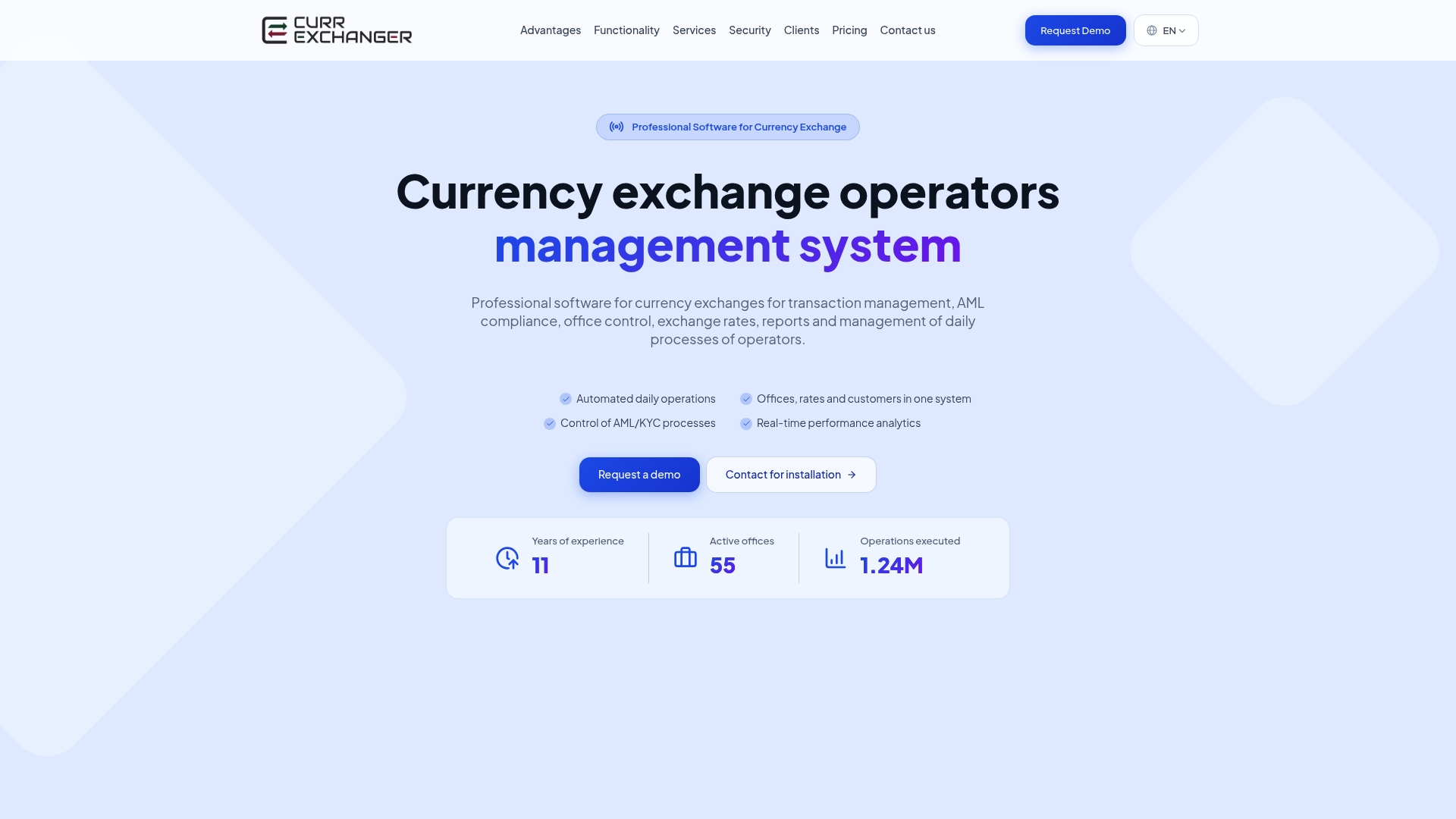
Currexchanger provides centralized exchange rate control with real-time distribution across all branches, automated AML/KYC compliance with external provider integrations, and transaction monitoring with detailed audit logs. The platform supports multi-branch cash and inventory tracking, API connectivity to accounting and payment systems, and multi-factor authentication with geographic access controls. For operators building toward institutional-grade operations, Currexchanger's architecture supports growth from a single office to a full branch network without rebuilding core workflows at each stage.
FAQ
What is the minimum number of PSPs needed to scale currency exchange?
At 1,000 active clients, one PSP is the minimum for basic redundancy. At 20,000 clients, five PSPs with automated failover tested weekly is the institutional standard.
Why do cross-border payments still arrive late even with fast networks?
Less than 50% of cross-border payments credit end customers within an hour of reaching the destination bank. The delay comes from internal processing queues at receiving institutions, not from the messaging network.
How often should disaster recovery runbooks be tested?
Runbooks should be tested quarterly and full disaster recovery rehearsals performed every 60 days to maintain a sub-30-minute RTO for trading systems.
What causes FX reconciliation errors during rapid growth?
FX rate inconsistency across ERP, treasury, and consolidation systems is the primary cause. Centralizing rate ingestion into one master system with timestamped distribution eliminates version conflicts downstream.
When should compliance automation be built into a scaling plan?
Compliance automation should be built before client volume makes manual KYC refresh and transaction monitoring unmanageable. Operators who automate early avoid the compounding backlog that forms when compliance capacity lags behind growth.