
Tracking liquidity across currencies is defined as the continuous, automated monitoring of separate currency balances, exposures, and conversion thresholds across multiple denominations in real time. Financial managers who treat this as a periodic task rather than a live process expose their organizations to margin erosion, mistimed conversions, and inaccurate risk assessments. Global liquidity reached $5.90 trillion at the system level as of June 2026, representing 38% of global GDP. That scale means even small inefficiencies in how treasury teams monitor foreign exchange positions translate into material financial risk.
How to track liquidity across currencies: prerequisites and tools
The first requirement is a multi-currency ledger that maintains separate balance states per currency, including pending, available, and settled amounts. A single aggregated balance figure tells you nothing useful. It hides whether a shortfall is in EUR, JPY, or GBP, and it obscures which funds are still in transit versus cleared and available.
Beyond the ledger, you need real-time data feeds from your banking partners and FX providers, delivered via APIs. Webhook endpoints capture inbound and outbound flow events as they happen, feeding the ledger without manual entry. The combination of API connectivity and webhook reconciliation is what separates a live monitoring system from a spreadsheet updated at end of day.

Exposure limits and conversion thresholds must be defined in policy before any system goes live. Without written thresholds, automated alerts have no trigger conditions. The table below summarizes the core components every treasury team needs before attempting multi-currency liquidity monitoring at scale.
| Component | Function | Why it matters |
|---|---|---|
| Multi-currency ledger | Tracks pending, available, and settled balances per currency | Prevents aggregation errors that hide currency-specific risk |
| Real-time API feeds | Pulls live balance and rate data from banks and FX providers | Eliminates lag between market movement and treasury awareness |
| Webhook endpoints | Captures inbound and outbound flow events automatically | Removes manual reconciliation and reduces entry errors |
| Exposure limit policy | Defines maximum tolerable positions per currency | Gives automated alerts a clear trigger condition |
| FX conversion thresholds | Sets balance floors and ceilings that trigger conversions | Prevents over-hedging or under-hedging by automating decisions |
What does a step-by-step workflow for multi-currency liquidity management look like?
A five-step treasury workflow covers authentication, currency identification, wallet creation, webhook configuration, and threshold settings. Each step builds on the last. Skipping wallet creation before configuring webhooks, for example, means your event triggers have nowhere to write data.
Step 1: Authenticate your systems. Connect your treasury management system to your banking APIs and FX provider APIs using secure credentials. Multi-factor authentication is non-negotiable at this stage.
Step 2: Identify your currency exposures. List every currency your business holds, receives, or pays out. Include currencies tied to supplier contracts, payroll, and customer receipts, not just your primary operating currency.
Step 3: Create dedicated currency wallets. Each currency gets its own wallet or ledger account. This is the structural foundation that makes per-currency balance tracking possible.
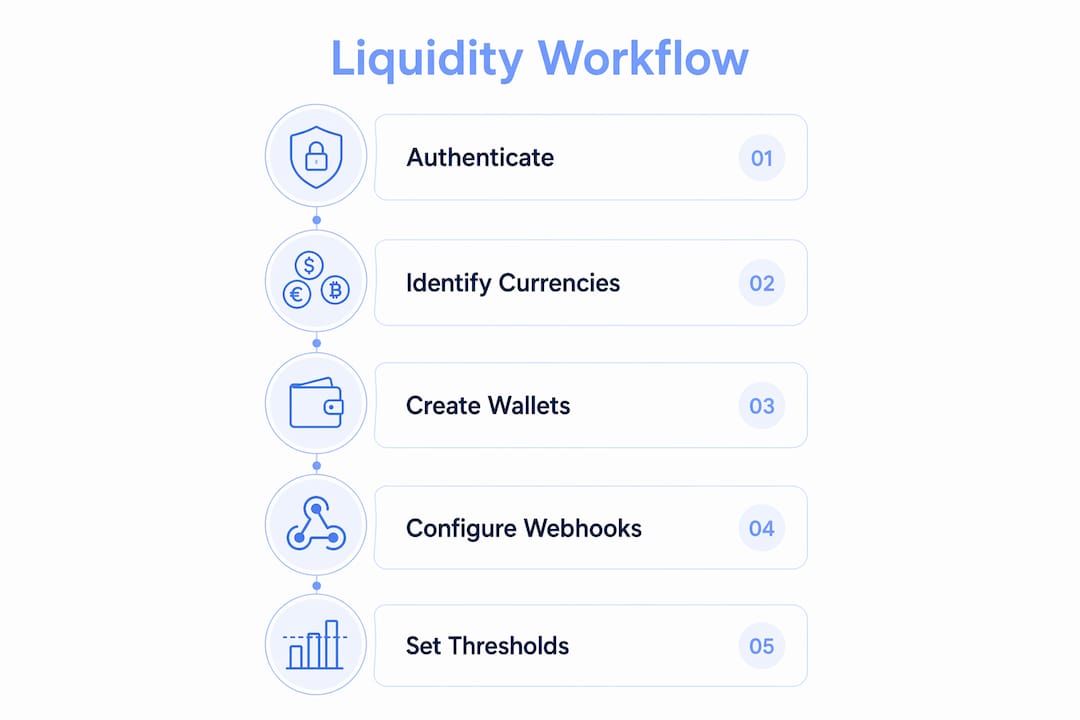
Step 4: Configure webhook endpoints. Set up endpoints to receive real-time notifications for deposits, withdrawals, conversions, and settlement events. Each event updates the relevant currency wallet immediately.
Step 5: Set balancing thresholds and conversion triggers. Define the minimum and maximum balance levels for each currency. When a balance breaches a threshold, the system flags it and, where policy allows, triggers an automatic FX conversion.
Continuous reconciliation runs alongside all five steps. Every inbound and outbound flow gets matched against the ledger in real time, not at end of day. This is what keeps your available balance figures accurate enough to act on.
Pro Tip: Reconcile trades before settlement, not after. Pre-settlement reconciliation catches mismatches while you still have time to correct them without incurring penalty fees or failed transaction costs.
The five-step structure is not just a technical checklist. It is an operational discipline. Treasury teams that follow it consistently report fewer surprise shortfalls and faster response times when currency positions move against them.
Which metrics best measure and compare liquidity between currencies?
Bid-ask spread is the most commonly cited liquidity metric, but it is also the most misleading when used alone. Market depth and order book volume are better predictors of execution cost, particularly for large corporate transfers where a narrow spread can still produce significant slippage if the order book is thin.
The key signals to monitor when analyzing liquidity between currencies are:
- Bid-ask spread: Measures the cost of immediate conversion. Useful as a baseline but insufficient on its own.
- Market depth: Shows how much volume sits at each price level. A deep order book absorbs large orders without moving the price.
- Trade volume: High volume confirms active participation and reduces the risk of price gaps during execution.
- Order-flow stability: Consistent two-way flow indicates a healthy market. Sudden one-directional flow signals stress.
- Slippage history: Past execution records reveal how often actual fill prices deviated from quoted prices.
Liquidity follows predictable daily cycles, peaking during the London-New York session overlap. Scheduling large conversions during this window produces tighter spreads and lower slippage. Executing the same conversion during the Asian session close or early Sydney open can cost meaningfully more.
| Metric | Strength | Limitation |
|---|---|---|
| Bid-ask spread | Easy to observe in real time | Ignores depth; misleads on large orders |
| Market depth | Reveals true execution capacity | Requires order book data access |
| Trade volume | Confirms market activity level | Does not show price impact of your specific order |
| Slippage history | Reflects real execution quality | Backward-looking; past data may not reflect current conditions |
The practical takeaway is to use spread as a screening tool and depth as your execution decision metric. When you need to move a large position, pull the order book before committing.
What common pitfalls should financial managers avoid?
The most damaging mistake is aggregating currency balances into a single total. A combined balance of $2 million looks healthy until you realize $1.8 million of it is in a currency you cannot convert quickly due to settlement delays or thin market depth. Separate ledger accounts per currency prevent this blind spot entirely.
Other common pitfalls include:
- Relying on spread alone. A narrow bid-ask spread does not guarantee low execution costs. Thin depth on the order book means large orders move the price against you before they fill.
- Manual monitoring with periodic checks. Switching from manual daily checks to automated, event-driven alerts collapses the detection window from hours to seconds. A position that breaches a threshold at 2 a.m. cannot wait until the morning review.
- Mis-timing large conversions. Executing during low-liquidity hours, such as the period between the New York close and the Tokyo open, increases slippage and widens effective costs.
- Undefined thresholds. Without documented exposure limits, automated systems have no trigger conditions. Alerts fire on everything or nothing, both of which are useless.
- Ignoring pending states. Treating in-transit funds as available distorts your real liquidity position. A multi-currency ledger that tracks pending separately from settled prevents this error.
Pro Tip: Run continuous real-time exposure monitoring rather than weekly reviews. Margin erosion from small, repeated mispricings compounds faster than most treasury teams expect.
The pattern behind most of these pitfalls is the same: treating liquidity monitoring as a reporting function rather than an operational one. Reporting tells you what happened. Monitoring tells you what is happening right now, which is the only timeframe where you can act.
Key takeaways
Effective multi-currency liquidity tracking requires separate ledger accounts per currency, real-time automated alerts, and execution decisions grounded in market depth rather than spread alone.
| Point | Details |
|---|---|
| Use separate currency ledgers | Aggregated balances hide currency-specific risks; maintain pending, available, and settled states per currency. |
| Automate monitoring with event-driven alerts | Manual daily checks create dangerous detection gaps; automated alerts respond in seconds. |
| Measure depth, not just spread | Bid-ask spread is a screening tool; market depth determines actual execution cost for large orders. |
| Time conversions to peak liquidity | The London-New York overlap delivers the tightest spreads and lowest slippage for large FX transactions. |
| Define thresholds before going live | Exposure limits and conversion triggers must be documented in policy before automated systems can function correctly. |
What I have learned from watching treasury teams get this wrong
The most consistent mistake I see is not a technology failure. It is a governance failure. Teams invest in real-time data feeds and multi-currency ledgers, then continue running weekly liquidity reviews as if the infrastructure did not exist. The system flags a threshold breach at 3 a.m. and nobody acts on it until the Monday morning meeting. By then, the position has moved further against them.
The 2026 shift toward always-on policy monitoring is not just a technology upgrade. It is a change in how treasury teams think about their role. You are not a reporting function. You are a real-time risk function. That distinction matters when a currency pair moves 1.5% in 40 minutes.
I also think the industry underestimates how much damage comes from the pending state problem. A treasury manager sees $3 million in the EUR wallet and approves a large outbound payment. What they did not check is that $900,000 of that balance is still in transit from a wire that has not settled. The multi-currency ledger solves this structurally, but only if the team actually reads the available balance column, not the total balance column.
The practical advice I give every treasury team is this: build the workflow first, then automate it. If you cannot describe your five steps on a whiteboard, no software will save you. Automation accelerates a process. It does not replace one that does not exist yet.
— Bartas
Currexchanger and multi-currency liquidity management
Financial managers who have built the workflow described here still need a platform that executes it reliably across multiple offices and currency pairs.
Currexchanger is built specifically for currency exchange operators and financial businesses managing multi-branch operations. The platform supports dedicated currency wallet structures, real-time balance tracking, automated transaction alerts, and AML/KYC compliance in a single system. It connects via API to external verification services and accounting platforms, which means your ledger stays current without manual reconciliation. For treasury teams moving from periodic reviews to continuous monitoring, Currexchanger provides the operational infrastructure to make that transition without rebuilding your entire tech stack.
FAQ
What is multi-currency liquidity tracking?
Multi-currency liquidity tracking is the continuous monitoring of separate currency balances, including pending, available, and settled states, across all denominations a business holds or transacts in. It differs from standard cash management by maintaining distinct ledger accounts per currency rather than a single aggregated total.
Why is bid-ask spread not enough to measure currency liquidity?
Bid-ask spread measures the cost of immediate conversion but ignores order book depth. For large corporate transfers, market depth is a better proxy for execution cost because thin depth causes slippage even when the spread appears narrow.
When is the best time to execute large FX conversions?
The London-New York session overlap produces peak liquidity, the tightest spreads, and the lowest slippage for major currency pairs. Executing large conversions outside this window, particularly during the Asian session close, increases effective transaction costs.
How often should treasury teams review currency liquidity positions?
Continuous, automated monitoring is the current industry standard. Event-driven alerts that fire on threshold breaches replace periodic manual checks, collapsing the detection window from hours to seconds.
What is the risk of aggregating currency balances into one total?
Aggregating balances hides currency-specific shortfalls and pending state differences. A combined total may appear sufficient while one individual currency position is critically low or locked in unsettled transactions, leading to failed payments or forced conversions at unfavorable rates.