
Activity logs are the foundational evidence organizations use to prove regulatory compliance, capturing who performed what action, when, and from where in a tamper-proof record. In financial services, the role of activity logs in compliance is not optional. Regulators under frameworks like HIPAA, GDPR, SOC 2, and SEC rules treat these records as primary audit evidence. Without them, a compliance officer cannot demonstrate that access controls worked, that data was handled correctly, or that suspicious activity was investigated. Logs are the difference between passing an audit and facing a fine.
What key data elements must a compliance-grade activity log capture?
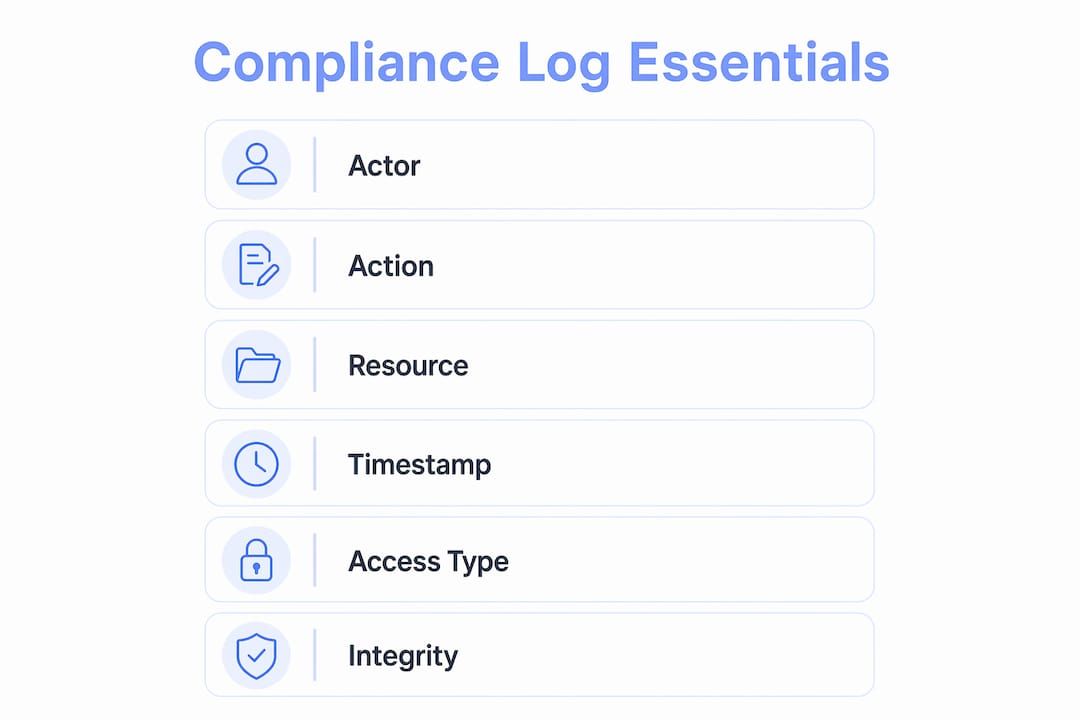
A compliance-grade activity log must capture six critical data points for every recorded event. Missing even one of these fields can cause an audit failure.
The six required elements are:
- Actor identity and role. Record the user ID, name, and assigned role. This proves who acted and whether they had authorization.
- Specific action performed. Log the exact operation: VIEW, CREATE, UPDATE, DELETE, or EXPORT. Logging only write actions is a common and costly mistake.
- Resource accessed with precise identifiers. Name the specific record, file, or object touched. A vague reference to "customer data" does not satisfy auditors.
- Accurate UTC timestamp with millisecond precision. Local time zones create ambiguity across multi-branch operations. UTC eliminates that problem.
- Source information. Capture the IP address, device type, and session ID. This data supports fraud investigations and access control verification.
- Before and after state snapshots. For any modification, record what the record looked like before and after the change. This is the only way to reconstruct what actually happened.
Pro Tip: Store UTC timestamps at millisecond precision from day one. Retrofitting timestamp granularity into an existing log system is expensive and often incomplete.
These six fields are not suggestions. They are the minimum standard for any log that will be presented as compliance evidence in a financial services audit.
How do activity logs ensure regulatory compliance in financial services?
Activity logs serve as direct proof that security, privacy, and data protection controls are functioning as required. Auditors do not take an organization's word for it. They examine logs.

One of the most misunderstood requirements is the obligation to log read access, not just changes. HIPAA fines start at $50,000 per incident for inadequate access tracking. That penalty applies even when no data was altered, because viewing protected information without authorization is itself a violation.
Retention is equally non-negotiable. Audit trails must be retained for at least 7 years and remain queryable within 60 seconds to pass regulatory inspections in financial contexts. That 60-second threshold is not arbitrary. It reflects the practical reality of an auditor sitting across the table expecting an immediate answer.
| Compliance requirement | What logs must demonstrate |
|---|---|
| Access control enforcement | Who accessed which records and when |
| Separation of duties | No single user performed conflicting actions |
| Data integrity | Before and after states for all modifications |
| Incident response | Full timeline reconstruction of any event |
| Retention compliance | Records available for the required period |
Tamper-proof audit logs require append-only storage, access controls on the log data itself, and continuous integrity verification. Append-only means no record can be edited or deleted after it is written. This property, called non-repudiation, is what makes a log legally defensible. Without it, any record in the log is potentially suspect.
What challenges arise when balancing activity logs and data privacy?
The tension between thorough logging and data minimization is real. GDPR requires organizations to collect only the personal data necessary for a stated purpose. Detailed audit logs, by definition, contain personal data about user behavior. GDPR audit log compliance requires alignment with Articles 5, 15, and 17, which govern data minimization, subject access rights, and the right to erasure.
The resolution is not to log less. The resolution is to log smarter. Compliance officers should apply these practices:
- Pseudonymize actor identities in log entries. Store a user ID or hash rather than a full name. Maintain a separate, access-controlled identity resolution table.
- Minimize PII in log payloads. Log that a record was accessed, not the full content of that record. The log proves the action occurred without reproducing the sensitive data.
- Document and enforce retention policies. Indefinite retention of logs without legal justification violates data privacy law. Set a defined retention window, automate deletion at expiry, and document the legal basis for the retention period chosen.
- Prepare for Subject Access Requests. Under GDPR Article 15, individuals can request access to personal data held about them, including log entries. Build a process to identify and respond to these requests without exposing other users' data.
Pro Tip: Treat your log access controls as seriously as your production database controls. A log that anyone can read or delete is not a compliance asset. It is a liability.
Maintaining activity log records that satisfy both accountability requirements and privacy law is achievable. The key is treating log design as a legal and technical discipline, not an afterthought.
What best practices and common pitfalls should compliance officers watch for?
The single most common pitfall is using operational or error logs as audit trails. Compliance logs must be stored separately in immutable, append-only databases. Application error logs serve a different purpose. They are designed to be rotated, overwritten, and deleted. Using them as compliance evidence is a structural failure waiting to surface during an audit.
Compliance officers should follow this implementation sequence:
- Create a dedicated audit log store. Physically separate it from application databases. Use append-only WORM storage or an append-only PostgreSQL schema with triggers that prevent updates and deletes.
- Log read and view events, not just writes. Read access logging is where most organizations fall short. Every VIEW event on a sensitive record must be captured.
- Use structured JSON format for all log entries. Structured JSON logs enable sub-60-second query responses during audits. Free-text logs require grep-based searches that cannot meet that threshold at scale.
- Monitor logs proactively. Set automated alerts for anomalous patterns: a user accessing hundreds of records in minutes, logins from unexpected geographies, or privilege escalations outside business hours. Logs are not just reactive evidence. They are a live security signal.
- Align retention and deletion with regulatory requirements. Document the legal basis for every retention period. Automate archival and deletion so human error does not create either premature deletion or indefinite storage.
Pro Tip: Run a quarterly log audit query drill. Pick a random past event and time how long it takes your team to reconstruct the full action timeline. If it takes more than 60 seconds, your query infrastructure needs work before a real auditor tests it.
The significance of compliance logs comes from their design, not their existence. A poorly structured log that cannot be queried quickly is nearly as problematic as no log at all.
How can financial services firms implement compliance-grade activity logs?
Building a log system that meets 2026 regulatory standards requires deliberate design across five dimensions.
Define scope before writing a single line of configuration. Map every system that touches regulated data. Identify which user actions in each system carry compliance risk. Logging everything indiscriminately creates noise and storage costs. Logging too little creates gaps. The scope definition should be driven by your compliance frameworks, whether that is GDPR, HIPAA, SOC 2, or AML/KYC obligations.
Build the log schema around the six required fields from the start. Retrofitting schema changes into a live log system is disruptive and introduces gaps in the historical record. Define actor, action, resource, timestamp, source, and state snapshot fields before go-live.
The following checklist covers the core implementation requirements:
- Append-only storage with cryptographic integrity checks
- Structured JSON schema capturing all six required fields
- Retention policy documented, automated, and legally justified
- Query interface capable of sub-60-second responses to auditor requests
- Access controls on the log store itself, separate from application permissions
- Staff training on both the compliance purpose and operational use of logs
| Implementation area | Minimum standard |
|---|---|
| Storage architecture | Append-only, physically separate from application DB |
| Log format | Structured JSON with all six required fields |
| Retention period | 7 years minimum for financial services |
| Query performance | Results within 60 seconds for any date range |
| Access controls | Role-based, with log access itself being logged |
Well-built, queryable activity logs can also reduce sales cycle time by replacing lengthy PDF evidence packages with direct URL access for security questionnaires. That is a concrete business benefit beyond regulatory compliance. Logs built to compliance standards become a trust signal to enterprise clients and partners.
Key Takeaways
Activity logs built to compliance standards are the single most defensible evidence an organization can present during a regulatory audit, provided they capture all six required fields in immutable, queryable storage.
| Point | Details |
|---|---|
| Six required fields | Every log entry must capture actor, action, resource, timestamp, source, and state snapshots. |
| Log read events too | Failing to log VIEW actions causes HIPAA audit failures and fines starting at $50,000 per incident. |
| Immutable storage is mandatory | Append-only storage with integrity checks prevents tampering and ensures non-repudiation. |
| Retention and privacy must align | Retain logs for at least 7 years in financial services, but document and enforce deletion policies to satisfy GDPR. |
| Structured format enables speed | JSON-formatted logs support sub-60-second audit queries; free-text logs cannot meet that standard at scale. |
Logs as assets, not just obligations
I have reviewed compliance programs at currency exchange operators and fintech firms where the audit log was treated as a checkbox. The team knew they needed one, so they pointed a monitoring tool at the application database and called it done. That approach fails in practice, and it fails expensively.
The organizations that handle audits well treat their logs as a first-class data product. They design the schema with the same care they give to their transaction database. They test query performance quarterly. They train their compliance staff to read log output, not just export it. When a regulator asks for a full reconstruction of a user's activity on a specific date, those teams answer in under a minute.
The dual role of logs as reactive audit evidence and proactive security tools is where most compliance programs leave value on the table. A well-monitored log catches a compromised account before it becomes a reportable incident. That is not a security team benefit. That is a compliance benefit, because a prevented incident is one you never have to disclose.
My honest advice: treat your log infrastructure as a legal document system, not an IT project. The decisions made at design time determine whether your logs protect you or expose you when an auditor arrives.
— Bartas
Currexchanger and compliance-grade activity logging
Currency exchange operators face a specific compliance burden. AML/KYC obligations, multi-branch operations, and real-time transaction monitoring all generate the kind of user activity that regulators scrutinize closely.

Currexchanger is built for exactly this environment. The platform captures detailed activity logs across all user actions, stores them in append-only format, and provides export-ready reports that compliance officers can present directly to auditors. Configurable retention settings let your team align log storage with your specific regulatory obligations. The data compliance controls built into the platform address both AML/KYC requirements and privacy law obligations, so you are not choosing between accountability and GDPR. You get both.
FAQ
What is the role of activity logs in compliance?
Activity logs provide tamper-proof, timestamped records of every user action, serving as primary evidence that an organization's access controls and data protection policies are functioning as required by regulators.
How long must activity logs be retained in financial services?
Financial services firms must typically retain audit logs for at least 7 years, and those logs must remain queryable within 60 seconds to satisfy regulatory inspection requirements.
Why must compliance logs capture read access, not just changes?
Regulators like HIPAA treat unauthorized viewing of protected data as a violation even when no data is altered. Failing to log read events causes audit failures and fines starting at $50,000 per incident.
How does GDPR affect activity log design?
GDPR requires that logs containing personal data align with Articles 5, 15, and 17, meaning organizations must pseudonymize actor identities, minimize PII in log payloads, and enforce documented retention and deletion policies.
What format should compliance logs use for efficient auditing?
Structured JSON format is the standard for compliance-grade logs. JSON schemas support sub-60-second query responses during audits, while free-text logs cannot meet that performance threshold at scale.