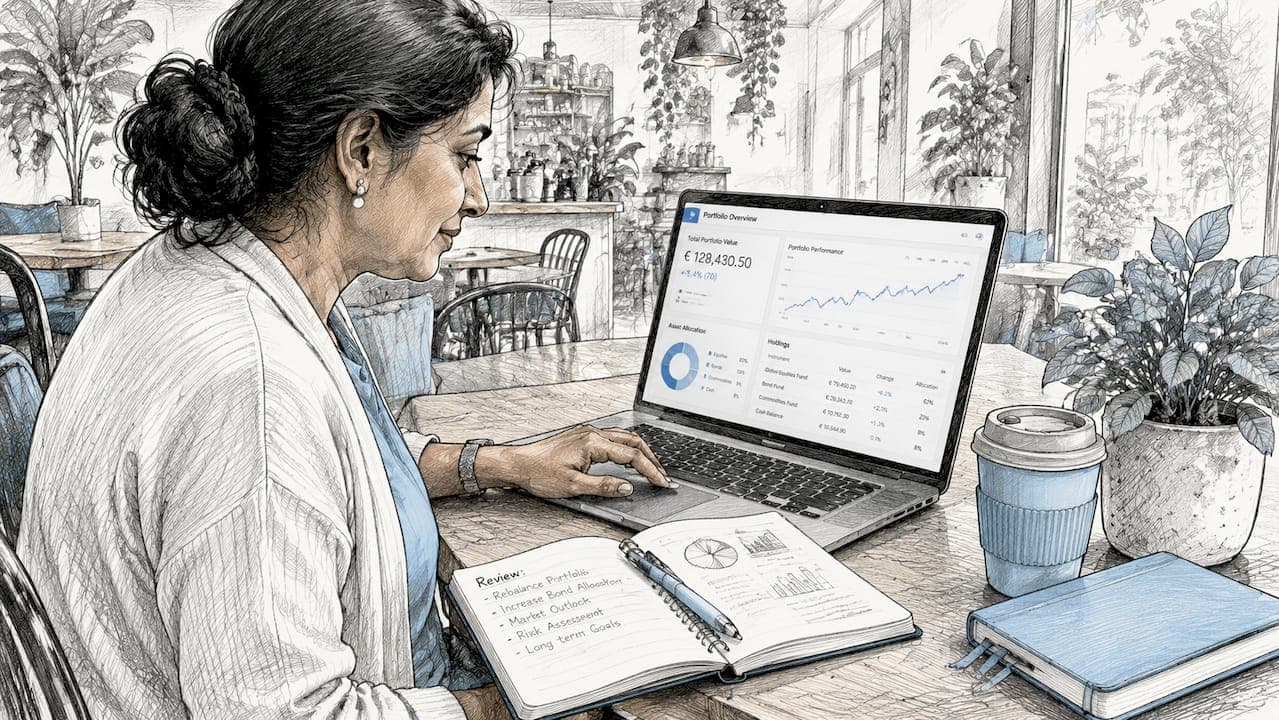
Real-time financial reporting is defined as the practice of accessing, analyzing, and acting on current financial data as it is generated, rather than waiting for period-end summaries. This capability transforms finance from a backward-looking record-keeping function into an active management tool. Companies in the top quartile for real-time capabilities achieve 62% higher revenue growth and 97% higher profit margins than bottom-quartile firms. That gap is not a technology story. It is a decision-speed story. Understanding why real-time reporting matters in finance starts with recognizing that the value is not in the data itself, but in the time you reclaim between a change happening and a decision being made.
Why real-time reporting matters in finance: the business performance case
The business case for live financial data is concrete and measurable. Organizations with top-quartile real-time capabilities also perform 20% better on innovation and 22% better on operational efficiency compared to slower-moving peers. Those are not marginal gains. They reflect a structural advantage that compounds over time.
The core mechanism is simple. When finance teams see cash positions, revenue trends, and cost variances as they happen, they can act before problems become crises. A currency exchange operator who spots a cash imbalance at 10:00 AM can rebalance before the afternoon rush. A business owner who sees a margin drop in real time can investigate the cause the same day, not three weeks later when the month-end report lands.
"The greatest competitive advantage comes from the time regained between data change and decision, not just the data speed itself."
Real-time financial reporting also changes the role of the finance team. Instead of producing reports that describe what already happened, finance professionals become advisors who flag what is happening now. That shift raises the function's value inside any organization. It also raises the bar for the quality of data feeding those reports.
The benefits of real-time reporting extend beyond finance departments. Department heads gain visibility into their own budgets without waiting for a finance team to run a report. Operations managers can track cash flow against targets daily. That distributed visibility reduces bottlenecks and speeds up every layer of decision-making across the business.

What is a decision window, and why does it determine reporting frequency?
Not every financial decision needs data updated to the second. The concept of a decision window defines how quickly a decision must be made after a data change occurs. Matching your reporting frequency to the decision window is the most important design choice in any real-time finance initiative.
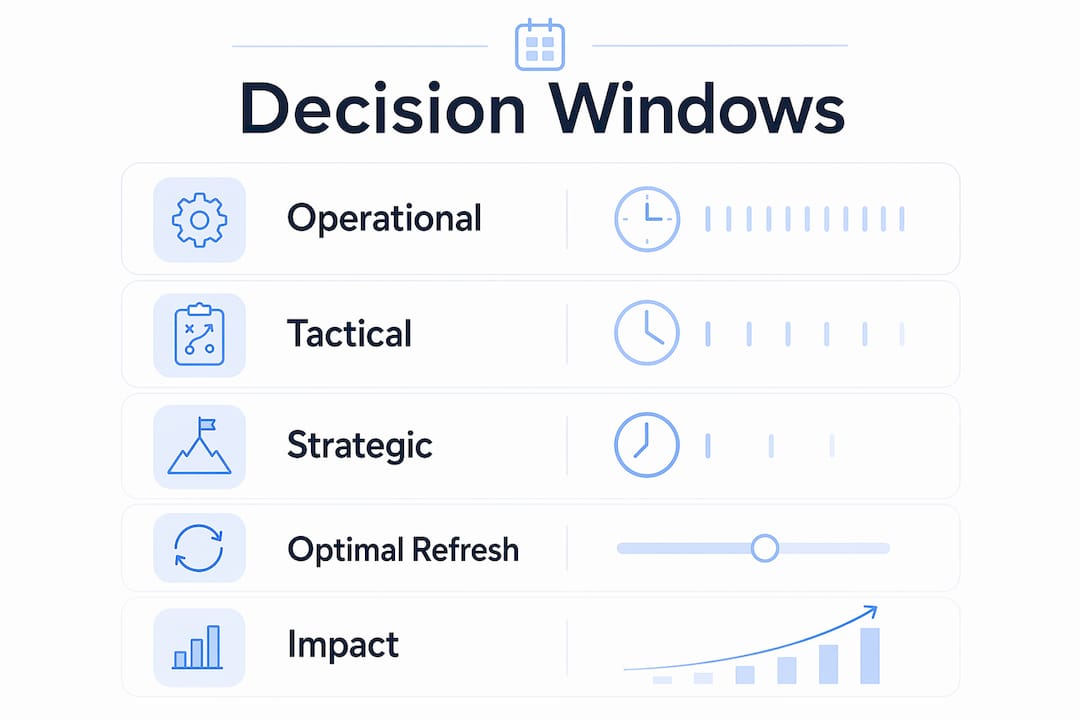
Operational decisions, such as approving a large transaction or adjusting an exchange rate, often have windows measured in minutes or hours. Tactical decisions, such as reallocating budget between departments, typically have windows of days. Strategic decisions, such as entering a new market, have windows measured in weeks or months. Feeding a strategic decision with second-by-second data adds no value. It adds noise.
| Decision type | Typical window | Optimal data refresh |
|---|---|---|
| Operational (e.g., transaction approval) | Minutes to hours | Near real-time or live |
| Tactical (e.g., budget reallocation) | Days | Daily automated refresh |
| Strategic (e.g., market expansion) | Weeks to months | Weekly or period-end |
The value of real-time reporting depends entirely on whether the decision can wait. If it can, high-frequency data adds complexity without benefit. This is the reason many real-time finance projects fail to deliver on their promise. Teams invest in streaming data infrastructure for decisions that could be served perfectly well by a daily automated refresh.
Pro Tip: Before investing in live data streaming, map your top ten financial decisions and assign each a decision window. If fewer than three require minute-level data, a daily refresh architecture will serve you better and cost significantly less.
Process latency is a separate problem from data latency, and it is usually the bigger one. The typical mid-market financial close cycle runs 10–15 days. Reducing that to 5 days delivers more practical data freshness than any streaming technology upgrade applied to a slow, manual close process. Speeding the pipe does not help if the source is still batched.
What organizational shifts does real-time finance actually require?
Real-time reporting is fundamentally a process and culture challenge. Technology is the enabler, not the solution. Organizations that treat it as a software purchase consistently underdeliver on the benefits of real-time reporting.
The first shift is moving from batch reporting to continuous data engagement. Most finance teams are trained to produce reports at month-end, quarter-end, or year-end. That rhythm is deeply embedded in workflows, approval chains, and management habits. Shifting to continuous engagement requires retraining teams to monitor data throughout the month, not just summarize it at the end.
The second shift involves data ownership. Real-time finance works only when the data entering the system is clean from the start. That means:
- Structured data entry at the point of transaction, not corrected later in a spreadsheet.
- Automated approval workflows that enforce coding rules before a transaction posts.
- Clear accountability for each data owner, so errors are caught upstream rather than during reconciliation.
- Reduced reliance on manual journal entries, which are the single largest source of close-cycle delays.
- Regular data quality reviews, not just end-of-period audits.
Finance must treat budgets as guardrails used continuously throughout the month, not scorecards reviewed after month-end. That requires department heads to own their numbers in near real-time, which disrupts traditional hierarchies where finance controlled all reporting. The disruption is worth it. Empowered budget owners make faster, better-informed spending decisions without waiting for a finance team to run a report.
Pro Tip: Start by automating reconciliation for your three highest-volume transaction types. Manual reconciliation is the single biggest driver of report staleness in mid-market finance. Fixing it costs less than new infrastructure and delivers faster results.
The third shift is accepting that without process improvements, technology upgrades to real-time data streaming deliver little freshness. A live dashboard fed by a slow, manual close process still shows stale data. The dashboard just shows it faster.
How do you implement real-time financial reporting in practice?
Implementation works best when it follows a clear sequence. Chasing a live dashboard before fixing the close process is the most common and costly mistake in real-time finance projects.
Start with the close cycle, not the dashboard
Reduce your financial close cycle from 10–15 days to 5 days before investing in streaming data technology. Daily or near-real-time updates provide sufficient data freshness for most tactical and operational decisions. They also cost far less than full streaming architectures and introduce less operational complexity.
Prioritize data quality over data speed
Real-time data without rigorous validation creates noise that leads to poor decisions. A daily automated refresh with strong validation controls outperforms a live feed with unverified entries. Build validation rules into your data entry points before you increase reporting frequency.
The practical implementation checklist looks like this:
- Automate bank reconciliation using direct API feeds from your banking provider.
- Replace manual journal entries with system-generated postings wherever possible.
- Set up daily automated reports for cash position, accounts receivable aging, and budget variance.
- Establish data quality alerts that flag anomalies before they reach the dashboard.
- Train department heads to read and act on daily financial summaries, not just month-end reports.
Balance near-real-time against full streaming
For most mid-market businesses and currency exchange operators, continuous data automation and AI support proactive liquidity and risk management without requiring full streaming infrastructure. A well-configured daily refresh with automated alerts covers the majority of operational and tactical decision windows at a fraction of the cost. Reserve live streaming for the specific use cases where the decision window is genuinely measured in minutes.
Key Takeaways
Real-time financial reporting delivers its greatest value when data freshness is matched to decision windows, supported by clean upstream processes, and embedded in a culture of continuous data engagement rather than periodic review.
| Point | Details |
|---|---|
| Revenue and margin impact | Top-quartile real-time firms achieve 62% higher revenue growth and 97% higher profit margins. |
| Match data speed to decisions | Align reporting frequency with decision windows; daily refresh covers most tactical needs. |
| Fix the close cycle first | Reducing close time from 10–15 days to 5 days delivers more freshness than streaming tech alone. |
| Data quality before data speed | Unvalidated fast data creates noise; build validation controls before increasing refresh frequency. |
| Culture drives adoption | Empowering department heads with continuous budget visibility is as important as the technology. |
Real-time finance is a process bet, not a technology bet
I have watched finance teams spend significant budget on live dashboards and streaming data infrastructure, then wonder why their reporting still feels stale six months later. The answer is almost always the same: the close process was never fixed. The dashboard just made the staleness more visible.
The organizations that actually benefit from real-time finance capabilities are the ones that treated it as an operational transformation, not a software purchase. They started by mapping their decision windows. They automated reconciliation before they built dashboards. They trained budget owners to engage with data daily, not monthly.
The uncomfortable truth is that most businesses do not need second-by-second data. They need trustworthy data that is updated continuously throughout the month, available without waiting for a finance team to run a report. That is a much more achievable goal, and it delivers most of the competitive advantage that real-time finance promises. The technology to support it already exists. The harder work is changing how your team relates to financial data every single day.
— Bartas
Currexchanger and the case for live financial visibility
Currency exchange businesses operate in an environment where rates shift by the minute and cash positions change with every transaction. Delayed reporting is not just inconvenient in that context. It is a direct operational risk.
Currexchanger is built for exactly this environment. The platform delivers real-time transaction management and cash monitoring across single offices or multi-branch networks, giving operators a live view of balances, exchange rate performance, and compliance status without waiting for a manual report. Automated reconciliation, AML/KYC controls, and customizable dashboards put the financial data you need in front of you when decisions actually need to be made. For currency exchange operators who want the operational benefits of live financial reporting without building custom infrastructure, Currexchanger provides the foundation.
FAQ
What is real-time financial reporting?
Real-time financial reporting is the practice of accessing and analyzing current financial data as it is generated, rather than waiting for period-end summaries. It moves the general ledger from a monthly reference document to an active operational tool.
How does real-time reporting improve business performance?
Companies with top-quartile real-time capabilities achieve 62% higher revenue growth and 97% higher profit margins than bottom-quartile firms, according to MIT CISR research. The advantage comes from faster decisions, not just faster data.
Does every business need live streaming financial data?
No. Daily automated refresh covers most tactical and operational decision windows at far lower cost and complexity than full streaming architectures. Reserve live streaming for decisions with genuine minute-level time windows.
What is the biggest barrier to real-time finance?
The biggest barrier is process maturity, not technology. Manual reconciliation and slow close cycles, typically 10–15 days in mid-market firms, create staleness that no dashboard can fix. Reducing the close cycle to 5 days is usually the highest-value first step.
Why does data quality matter more than data speed?
Unvalidated fast data introduces noise that leads to reactive, poor-quality decisions. Speed without accuracy in financial data is worse than a slower, validated daily report because it creates false signals that erode trust in the entire reporting system.