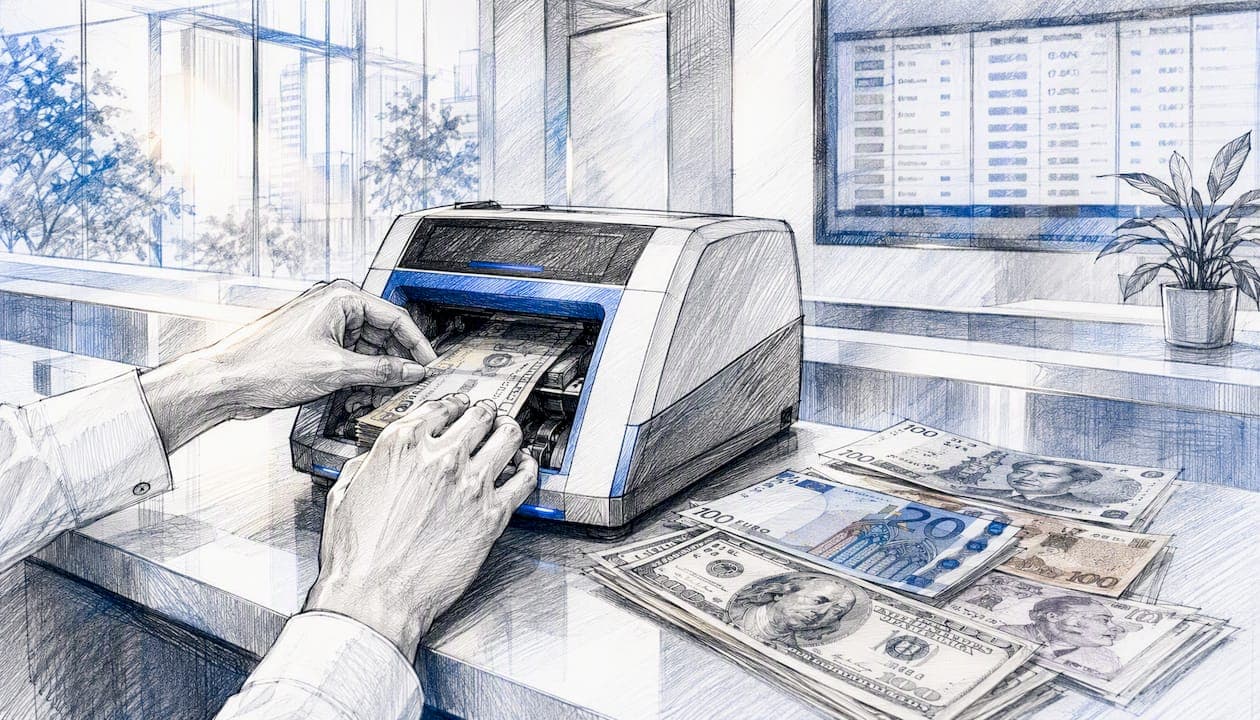
The most effective high-volume teller workflows at currency exchange counters combine automated, rule-based transaction flows with banknote verification hardware and enforced AML/KYC controls to cut manual touchpoints and reconciliation time. Here is the core checklist every operator should have running before scaling volume:
- Transaction intake: capture customer ID, purpose, and amount in the software before quoting a rate
- Rate quote and confirmation: pull from a live rate engine; lock the rate on customer acceptance
- ID/KYC capture: scan or photograph identity documents; trigger sanctions screening automatically
- Banknote verification and cash count: run notes through a certified counter/detector; log the result to the transaction record
- Settlement and receipt: print or send a digital receipt with a unique transaction ID
- End-of-day reconciliation: auto-match physical cash to system totals; flag variances for supervisor review
- Exception handling: route holds, EDD triggers, and suspicious-note events to a compliance queue with a timed SLA
Lithuania-licensed operators must align these steps with the Republic of Lithuania Law on the Prevention of Money Laundering and Terrorist Financing, which mandates KYC and risk-based transaction monitoring. Integrated FX platforms with straight-through processing automate most of these stages, reducing the manual work that causes errors.
Key Takeaways
Automated, rule-based teller workflows with enforced AML/KYC controls and banknote verification are the foundation of a high-volume FX counter that scales without proportionally scaling errors.
| Point | Details |
|---|---|
| Automate intake controls | Enforce field validation, live sanctions screening, and KYC capture before any rate is locked. |
| Embed verifier logs | Write banknote counter results to the transaction record so every suspicious-note event is auditable. |
| Separate staff roles | Divide intake, cashier, and compliance functions to reduce collusion risk and single points of failure. |
| Centralize liquidity | A real-time multi-branch inventory dashboard prevents emergency sourcing and inter-branch mismatches. |
| Currexchanger | Provides rule-based workflows, AML/KYC integrations, verifier API logging, and a centralized branch dashboard in one platform. |
Table of Contents
- What does a high-volume teller workflow best practices setup look like in practice?
- What AML/KYC controls must you enforce at each workflow stage?
- How should you handle cash counting and counterfeit detection at high volume?
- How do you design queues and window layouts for maximum throughput?
- How do you automate exception handling and reduce human error?
- How do you manage liquidity and reconciliation across multiple branches?
- What staff roles, training, and KPIs should you track?
- What does a realistic implementation rollout look like?
- How do you evaluate and select a software vendor?
- What should you actually fix first?
- Currexchanger covers the full workflow from intake to reconciliation
- Sources
- FAQ
What does a high-volume teller workflow best practices setup look like in practice?
Each workflow stage has a minimum software requirement. Skipping even one creates a gap that shows up as a cash variance or a compliance finding.
- Transaction intake: field validation (currency pair, amount, customer reference) with mandatory fields enforced before the rate is displayed
- Rate quote and confirmation: real-time rate engine with configurable spread rules; rate locked on customer sign-off
- ID/KYC capture: camera or document-scanner integration; ID data parsed and stored against the transaction record
- Banknote verification: API connection to a certified banknote verifier; result (pass/suspect/reject) written to the transaction log
- Settlement and receipt: auto-generated receipt with transaction ID, operator ID, rate, and timestamp
- End-of-day reconciliation: automated audit trail that matches physical denomination counts to system totals
A single-customer example: A walk-in customer wants to buy €500 with GBP. The teller opens a new transaction, selects the currency pair, and the system pulls the live rate. The customer's passport is scanned, the system checks sanctions in real time, and the teller confirms the amount. The customer hands over GBP notes; the teller runs them through the counter, the verifier logs a clean result, and the system settles the transaction and prints a receipt. Total teller time: under two minutes when no exception fires.
Rules-driven FX platforms let operators configure this logic once and apply it across every branch, removing the fragile custom workarounds that slow high-volume counters.
What AML/KYC controls must you enforce at each workflow stage?
Embed KYC identity capture and risk-based transaction monitoring at intake, with Enhanced Due Diligence (EDD) triggers firing automatically for high-risk profiles. The Republic of Lithuania Law on the Prevention of Money Laundering and Terrorist Financing requires currency exchange operators to maintain internal control systems covering all of the following:
- ID capture: passport or national ID for every customer; data retained per statutory retention periods
- Beneficial ownership: for corporate clients, verify and document the ultimate beneficial owner before executing any transaction
- Purpose of transaction: capture stated purpose at intake; flag inconsistencies against customer profile
- Sanctions screening: automated check against EU, UN, and OFAC lists before deal capture, not after
- EDD triggers: high-risk country of origin, politically exposed person (PEP) status, or transaction amount above internal thresholds routes the transaction to a compliance reviewer
- Source-of-funds evidence: for EDD cases, request and retain supporting documents (bank statements, payslips, contracts)
- Transaction monitoring rules: configurable velocity rules (e.g., multiple transactions in a session) that auto-flag structuring patterns
- Record retention: transaction records, ID copies, and monitoring decisions retained for the period the law specifies
MSB best-practice guidance recommends filing Currency Transaction Reports (CTRs) when daily currency transactions exceed $10,000 (a U.S. threshold; verify the equivalent obligation under Lithuanian law with local counsel). Automate regulatory compliance reporting wherever possible so tellers are never the last line of defense against a filing deadline.
How should you handle cash counting and counterfeit detection at high volume?
Require certified banknote detectors and dual-count procedures at every cash handover point. No exceptions for "small" amounts: a single undetected counterfeit note costs more in investigation time than the note's face value.
Recommended equipment:
- Note sorter/counter with integrated counterfeit detection (UV, magnetic, infrared)
- Standalone UV/magnetic detector as a backup at each window
- Tamper-proof cash trays with denomination separators
- Secure drop safe accessible only to the cashier and branch manager
- CCTV covering the cash handover area with footage retained for the period your compliance policy requires
Operational controls:
- Two operators count large-denomination notes independently before the transaction settles
- Suspicious notes are quarantined immediately in a sealed envelope, labeled with the transaction ID, and reported per your internal escalation procedure
- Daily reconciliation compares physical denomination counts to system totals before the branch closes
Pro Tip: Embed the banknote verifier's pass/fail log directly into the transaction record. When an auditor or regulator asks about a specific note event six months later, you can pull the full chain: customer ID, transaction ID, verifier result, and operator ID in one query.
How do you design queues and window layouts for maximum throughput?
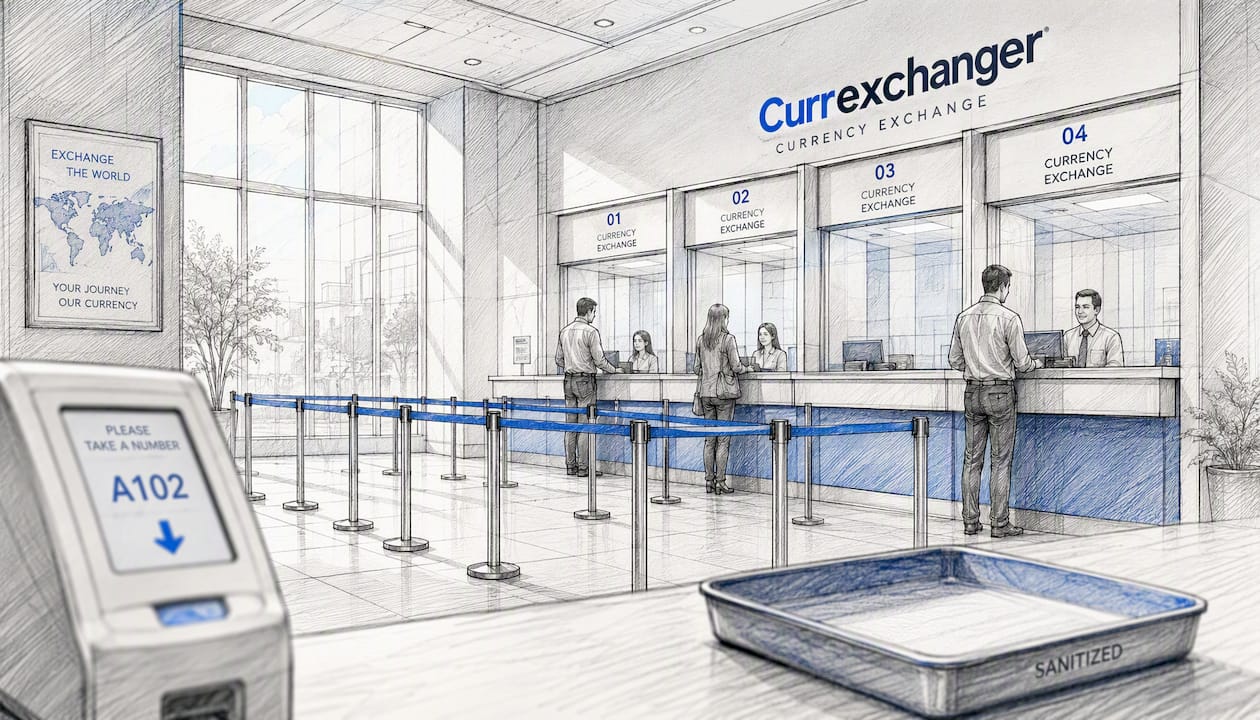
Separate fast-track transactions from full-KYC flows. Pre-verified reservation customers and small FX amounts should never wait behind a first-time corporate client completing EDD paperwork.
Queue models that work at high volume:
- Token/number system: customers take a number on arrival; the display shows estimated wait time based on live transaction timestamps from the software
- Reservation lane: customers who pre-book online or via a mobile app arrive pre-verified; the teller confirms identity and executes in under 90 seconds
- Express window: reserved for repeat customers with a clean compliance history and transactions below your fast-track threshold
- Digital pre-check-in: customers submit ID and transaction details via a mobile form before arriving; the teller receives a pre-populated transaction draft
Operational targets to measure:
- Average service time per transaction: set a target and track it via software timestamps
- Maximum acceptable queue length: define a threshold that triggers a second window to open
- Throughput per hour per teller: baseline this in the first week after go-live, then review weekly
Ergonomics matter more than most operators admit. Position the banknote counter so the teller can run notes without turning away from the customer. Place the ID scanner within arm's reach of the keyboard. A poorly arranged workstation adds additional seconds per transaction, which compounds quickly at high transaction volumes.
How do you automate exception handling and reduce human error?
Automate routine, low-risk decisions. Create short, auditable exception paths for everything else. Tellers who improvise under pressure make mistakes; tellers who follow a clear on-screen prompt do not.
Rule examples:
- Auto-accept: customer is pre-verified + amount is below the fast-track threshold + sanctions screen is clean
- Auto-hold: sanctions fuzzy-match fires; transaction is frozen and routed to the compliance queue automatically
- EDD route: customer profile flags as high-risk; system prompts for additional documents before the rate is locked
- Supervisor approval: transaction exceeds a branch-level limit; approval request sent to the supervisor's dashboard with a 15-minute SLA
Exception flow example (sanctions fuzzy-match):
- Teller submits transaction; system runs sanctions check
- Fuzzy match detected; transaction auto-holds and teller sees a "Pending Compliance Review" status
- Compliance reviewer receives an alert with the match details and a resolution timer
- Reviewer clears or escalates within the SLA; system logs the decision with reviewer ID and timestamp
- Transaction resumes or is declined; teller is notified on screen
Every manual override must be logged with a reason code and the operator's ID. Long approval chains kill throughput; keep the exception path to two steps maximum. Straight-through processing handles the clean majority, so your compliance team focuses only on genuine exceptions.
How do you manage liquidity and reconciliation across multiple branches?
Centralized, real-time inventory visibility cuts multi-branch mismatch time and prevents branches from running dry on high-demand currencies during peak hours.
Required capabilities:
- Centralized currency inventory dashboard showing live positions by branch and denomination
- Auto-suggested inter-branch transfers when a branch's position falls below a configured threshold
- Aggregated P&L by branch, updated at each transaction
- Automated settlement entries pushed to your accounting system via API
Daily liquidity cycle:
- Morning: system generates a currency position report for each branch; branch managers review and request transfers if needed
- Intraday: dashboard alerts fire when any branch crosses a low-inventory threshold
- End of day: automated reconciliation matches physical counts to system totals; variances above tolerance are escalated to the network manager
For foreign currency inventory management across a network, the escalation ladder matters: branch manager resolves minor variances, network manager handles inter-branch transfers, and treasury handles emergency currency sourcing. Define each threshold in writing before go-live.
What staff roles, training, and KPIs should you track?
Staff separation between intake, cashier, and supervisor functions reduces both collusion risk and error rates. A teller who also controls the cash drawer and approves their own exceptions is a single point of failure.
Role definitions:
- Front-line teller: customer intake, rate quote, ID capture, transaction initiation
- Cashier: physical cash handling, note verification, receipt of funds, cash drawer custody
- Compliance reviewer: EDD and exception queue management, sanctions escalations
- Branch manager: daily reconciliation sign-off, variance escalation, staff oversight
- Network/treasury manager: inter-branch transfers, liquidity sourcing, network-level KPI review
KPI framework:
- Transaction throughput per hour: baseline per teller; target improvement after workflow automation
- Exception rate: percentage of transactions routed to manual review; high rates signal rule misconfiguration
- Reconciliation time: time from branch close to signed-off reconciliation; target under 20 minutes with automation
- Cash variance rate: value of unresolved variances as a percentage of daily volume; near-zero is the target
- Hold resolution time: average time from exception trigger to resolution; set a maximum SLA and track breaches
Training cadence:
- AML/KYC refresher: every six months, covering current sanctions lists, EDD triggers, and reporting requirements
- Counterfeit recognition: quarterly, using current-issue notes and known forgery examples
- System drills: monthly, simulating exception scenarios so tellers know the on-screen prompts before a real event fires
- Competency audit: annual, with a written scenario test and a supervised live-transaction observation
What does a realistic implementation rollout look like?
A staged rollout minimizes disruption. Trying to go network-wide on day one is how operators end up with half the branches on the old process and half on the new one, with no clean reconciliation between them.
- Discovery and requirements (1–2 weeks): map current workflows, identify integration points (ID scanners, banknote verifiers, accounting system), and define rule logic
- Hardware procurement (2–4 weeks): order and test note counters, ID scanners, and CCTV; confirm API compatibility with the software platform
- Integration and configuration (2–4 weeks): connect AML/KYC provider, banknote verifier API, and accounting system; configure workflow rules and exception paths
- Pilot (2–4 weeks): run one branch on the new system; measure throughput, exception rate, and reconciliation time against baseline
- Staff training (1–2 weeks per cohort): role-specific training before each branch goes live
- Compliance testing (1 week): verify that KYC gating, sanctions screening, and EDD routing fire correctly under test scenarios
- Branch rollouts (1–2 weeks per branch): sequential go-live with a support resource on-site for the first week
- Post-go-live optimization (4–8 weeks): review KPIs weekly; adjust rule thresholds and exception SLAs based on real data
Cost factors: software license (per module or per branch), hardware per window (counter, scanner, CCTV), integration and custom development, and training hours. AI-driven scheduling for conversion timing is worth piloting after the core workflow is stable, not before.
Common blockers: legacy point-of-sale systems with no API, staff availability for training during peak season, and liquidity sourcing delays for new currency pairs. Mitigate each with a written contingency in the project plan before procurement starts.
How do you evaluate and select a software vendor?
Prioritize vendors that offer rule-based workflow engines, banknote-verifier integrations, AML/KYC toolchains, multi-branch inventory, and clean audit logs. A vendor who cannot show you a live demo of the exception queue and the reconciliation report in the first meeting is not ready for high-volume operations.
Technical and commercial questions to ask:
- Does the workflow engine support configurable rules without custom code?
- Which banknote verifier brands does the API support?
- What AML/KYC providers are pre-integrated?
- What is the uptime SLA, and what is the remediation process for downtime?
- Can transaction data be exported in standard formats (CSV, XML, API)?
- Is pricing per module, per branch, or bundled?
- What security certifications does the platform hold (ISO 27001, SOC 2)?
Operational must-haves:
- Sandbox environment for testing rule changes before production
- Staged rollout support with a named implementation contact
- Evidence of local regulation support (e.g., Lithuania AML law compliance, data retention configuration)
- Documented training program and ongoing maintenance SLA
Buyer scoring matrix (apply during demos):
Score each vendor during the demo. Any vendor scoring below 3 on functional or compliance fit should be eliminated regardless of price.
What should you actually fix first?
Most operators who come to us with throughput problems have the same root cause: they are trying to move volume through a workflow that was designed for a fraction of it, with manual steps that made sense at 20 transactions a day and break at 200.
The priority order is not complicated, but it is specific. Fix cash loss and regulatory exposure before you fix speed. A fast counter that misses a counterfeit note or skips a sanctions check is a liability, not an asset. Start with banknote verification and KYC gating at intake. Those two controls, properly automated, remove the most expensive failure modes: undetected counterfeits and compliance findings.
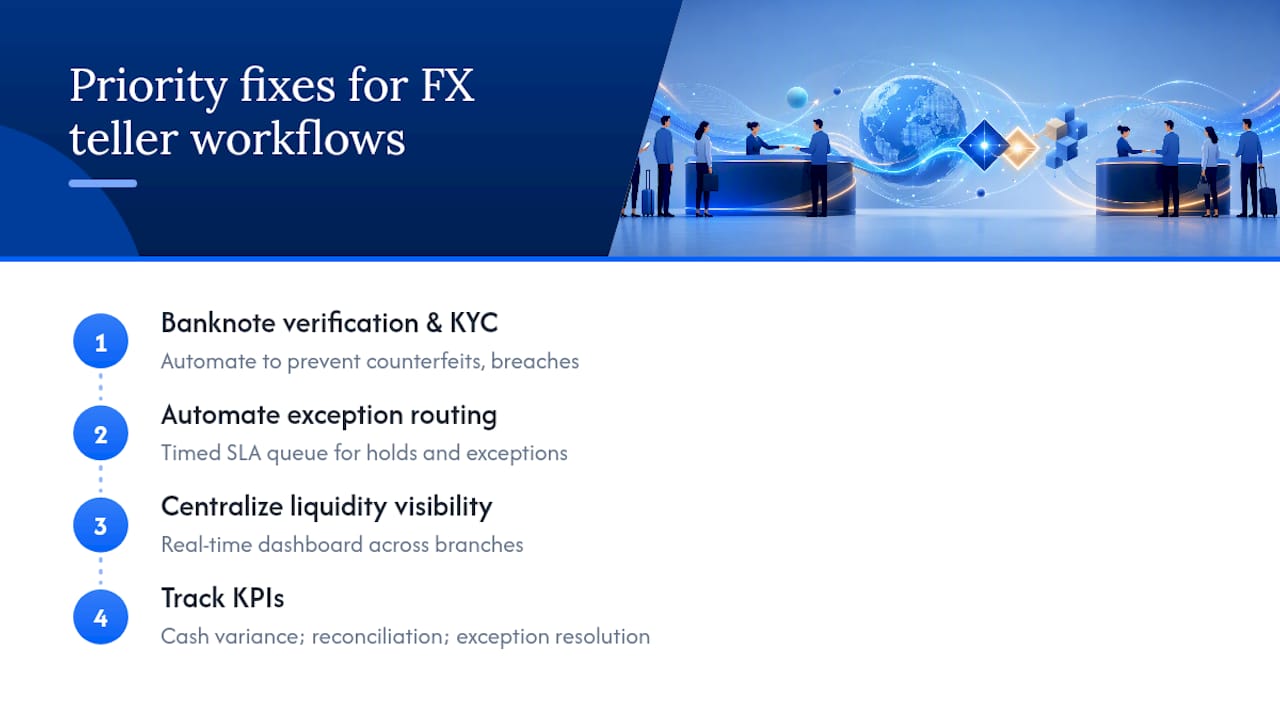
Once those are running, automate the routing of holds and exceptions. The compliance queue with a timed SLA is the single change that most visibly reduces the friction tellers feel during peak hours, because it removes the "what do I do now?" moment from the teller's hands and puts it in a defined process.
Third, centralize liquidity visibility. Operators who run multiple branches without a real-time inventory dashboard are making transfer decisions on phone calls and spreadsheets. That is where inter-branch mismatches and emergency sourcing costs come from.
Measure early wins in three numbers: cash variance rate, reconciliation time, and exception resolution time. If those three move in the right direction in the first 30 days, the workflow is working. Currexchanger's dashboard surfaces all three in real time, which means you are not waiting for a weekly report to know whether the pilot is succeeding.
Currexchanger covers the full workflow from intake to reconciliation
Running a high-volume FX counter without purpose-built software means your tellers are the system. Currexchanger replaces that dependency with a platform built specifically for currency exchange operators: rule-based transaction workflows, a live rate engine, AML/KYC integrations, banknote-verifier API logging, a compliance exception queue with SLA tracking, and a centralized multi-branch inventory dashboard.
Every feature maps directly to the workflow stages covered above. The reservation module handles pre-verified customer lanes. The compliance queue routes EDD and sanctions holds automatically. The reconciliation engine matches physical counts to system totals and flags variances before your branch manager leaves for the night. Operators running networks across multiple locations use the same instance for every branch, with role-based permissions controlling what each staff member can see and do.
Currexchanger to see the exception queue, the multi-branch dashboard, and the verifier log in a live environment. The platform is configurable to your rule logic before go-live, not after.
Sources
The following sources underpin the compliance and operational guidance in this article. Jurisdictional figures (such as CTR thresholds) apply to the regulation that states them; confirm the equivalent obligation under your own jurisdiction with local legal counsel.
This article provides general operational and compliance information. It is not legal advice. Confirm current regulatory requirements with the relevant authority or a qualified legal professional in your jurisdiction.
FAQ
What is the most important step in a high-volume teller workflow?
Automated KYC and sanctions screening at intake is the highest-priority control. It prevents compliance failures before a transaction settles, which is far less costly than remediation after the fact.
How long does a software rollout typically take for an FX counter network?
A staged rollout covering discovery, integration, pilot, and branch-by-branch go-live typically runs 10–20 weeks for a multi-branch network, depending on the number of branches and the complexity of existing system integrations.
What KPIs should I track to know if the workflow is improving?
Track cash variance rate, reconciliation time, exception resolution time, and transaction throughput per teller per hour. Movement in all four within the first 30 days after go-live confirms the workflow is functioning correctly.
Does Lithuanian law require EDD for all currency exchange customers?
No. EDD is triggered for high-risk profiles, including politically exposed persons and customers from high-risk jurisdictions, per the Republic of Lithuania Law on the Prevention of Money Laundering and Terrorist Financing. Standard customers require ID capture and risk-based monitoring.
Can Currexchanger handle multi-branch reconciliation automatically?
Yes. Currexchanger's centralized dashboard aggregates real-time currency positions across branches, auto-suggests inter-branch transfers, and generates reconciliation reports that match physical counts to system totals at end of day.