
Foreign currency inventory management is the discipline of tracking, valuing, replenishing, and reconciling physical banknote stock at the denomination level across every branch in your network, while maintaining the compliance records that AML auditors and NCB inspectors expect to find. For a multi-branch exchange operator, this is not an accounting concept — it is a daily operational control system.
Three reasons it matters more than most operators realize:
- Reduced unexplained variances at branch level, because denomination-level movement records make shortfalls traceable to a specific transaction or handler
- Faster NCB and AML inspections, because reconciliation evidence, machine logs, and traceability records are pre-organized rather than assembled under pressure
- Optimized inter-branch transfers, because real-time stock positions let you redistribute excess denominations before you order new supply
Key Takeaways
Foreign currency inventory management requires denomination-level tracking, separate authenticity and fitness gates, daily reconciliation, and machine version logging to satisfy NCB inspectors and AML auditors.
| Point | Details |
|---|---|
| Separate authenticity and fitness | Treat them as two distinct system gates; recirculation eligibility depends on both checks being documented. |
| Daily denomination reconciliation | Reconcile till, vault, and inter-branch transfers every business day; unexplained variances are an AML red flag. |
| Log machine firmware and settings | Record machine ID, firmware version, and factory-setting ID alongside every processed batch for inspection traceability. |
| Automate quarantine routing | Configure your system to block suspected-counterfeit and unfit notes from recirculation automatically, with a hand-over workflow. |
| Currexchanger as your platform | Currexchanger provides the multi-branch ledger, machine integration, configurable reconciliation rules, and audit exports this model requires. |
Table of Contents
- What components make up a foreign currency inventory management system?
- What Eurosystem and Central European rules govern banknote handling?
- How should you model the operational workflow across branches?
- What daily controls reduce AML risk and inspection findings?
- Which system features and integrations actually reduce risk?
- What KPIs and reports should you monitor?
- What do inspectors look for during an audit?
- Step-by-step checklist to implement or upgrade your system
- The mistakes operators keep making — and three fixes
- Currexchanger covers the full model from day one
- Sources
- FAQ
What components make up a foreign currency inventory management system?
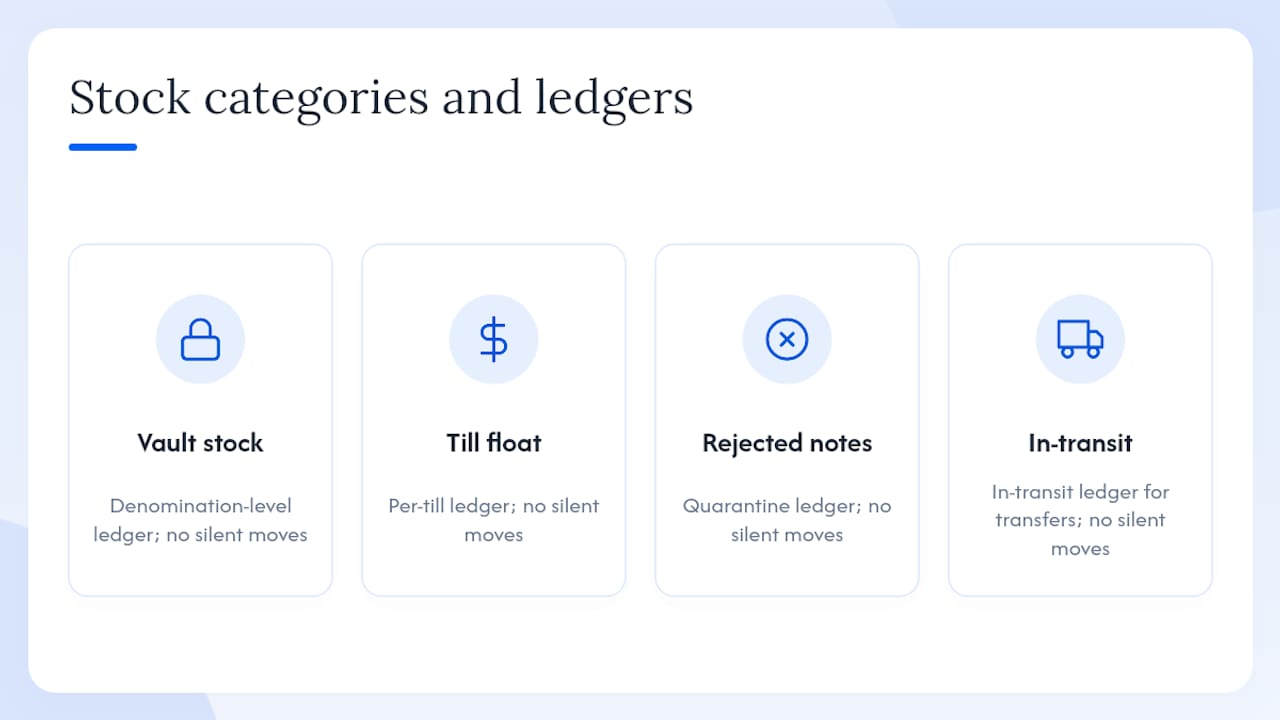
The physical side has four stock categories you must track separately: vault stock (denomination-level), till/float, rejected or unfit notes awaiting disposition, and in-transit stock during inter-branch transfers. Each category needs its own ledger state so notes cannot silently move between them.
Every movement or stock record should carry these fields: currency code, denomination, piece count, source type (customer deposit, inter-branch transfer, supplier delivery), handler ID, machine ID and firmware version, timestamp, branch, and disposition outcome. That field set is what lets you reconstruct a transaction during an inspection.
Operational records must link to transactions. A deposit slip ID, a customer reference where KYC applies, and a pickup or drop-off log entry should all point back to the same movement record. Currency exchange offices typically source stock from banks, wholesalers, and other exchange offices, so supplier details belong in the record too.
What Eurosystem and Central European rules govern banknote handling?
The binding framework is ECB Decision ECB/2010/14, which requires all cash handlers to check euro banknotes for both authenticity and fitness before recirculation. The recirculation right depends on how the check was performed:
- Machine-checked notes (by an NCB-listed machine at factory settings): may be recirculated via customer-operated devices such as ATMs or cash recyclers
- Manually checked notes (by trained staff): may only be disbursed over the counter, not via automated devices
The ECB's recirculation guidance covers machine categories — BPMs, BAMs, CRMs, TARMs, and CCMs — and requires that processed volumes be reported aggregated by denomination. Machines must appear on the NCB-tested list and must run standard factory settings unless a stricter configuration has been agreed with the NCB.
For notes that cannot be authenticated as genuine, the ECB Decision sets a 20-working-day maximum for handing them over to the competent national authority. That window is an operational deadline, not a guideline.
For foreign banknotes specifically, the Hungarian National Bank (MNB) requires that authenticity and fitness examination be completed before recycling, and that fitness sorting follow the issuing country's standards, not Hungarian ones. Most Central European NCBs apply equivalent logic.
Pro Tip: Verify your machines appear on your NCB's current tested-machine list before each inspection cycle, and log the firmware version and factory-setting ID in the same record as every processed batch.
How should you model the operational workflow across branches?
The workflow runs in one direction: receipt → authenticity check → fitness check → classification → disposition. Notes that skip a step must not advance to the next state.
Encode five inventory states in your system:
- Inbound-unchecked — received but not yet processed
- Authenticated-fit — passed both gates; eligible for recirculation per check method
- Authenticated-unfit — genuine but below fitness threshold; withdraw from circulation
- Suspected-counterfeit — failed authenticity; quarantine immediately, initiate hand-over workflow
- Quarantined — blocked from any recirculation pending investigation or hand-over
Permitted transitions are one-way. A note in "suspected-counterfeit" state cannot be reclassified as usable at branch level without a documented override by a compliance officer.
Where the check occurs affects recirculation rights. Frontline over-the-counter checks by trained staff produce manually-checked notes, restricted to counter disbursement. Back-office banknote processing machines produce machine-checked notes with broader recirculation rights — provided the machine is NCB-listed and running approved settings.
Every movement ledger entry should include handler ID, machine type and version, branch, and destination. That combination is what the Bank of Italy inspection guide describes as the minimum for traceability to the depositor.
Pro Tip: Configure your system so that any note failing authenticity automatically moves to a blocked stock state and triggers a hand-over workflow — never leave that routing to manual judgment.
What daily controls reduce AML risk and inspection findings?
HMRC MSB guidance is direct: poor daily record keeping and stock reconciliation increase AML risk. Records must be sufficient to reconstruct individual transactions, including cash-ups and reconciliations. The same principle applies across Central European jurisdictions.
Daily controls to run at every branch:
- Denomination-level cash-up: physical count by currency and denomination against system closing stock
- Till-to-vault reconciliation: confirm that transfers between till and vault are logged and match physical movement
- Inter-branch transfer matching: every transfer out must have a corresponding receipt confirmation at the receiving branch before the sending branch closes its ledger
- Discrepancy log: any variance, however small, gets a written explanation before end-of-day close
Segregation of duties matters here. The person handling notes should not be the same person reconciling the ledger. System authorizations should enforce this, not rely on policy alone.
Keep these records for inspection: deposit traceability files, pickup and drop-off logs, machine processing logs, discrepancy investigation files with corrective actions, and staff competency records for manual checks. Set a conservative variance threshold for escalation — any denomination-level discrepancy that cannot be explained within the same business day should go to the compliance lead.
Which system features and integrations actually reduce risk?
Critical software capabilities for this workflow:
- Denomination-level real-time stock across all branches in a single view
- Movement ledger with handler ID, machine ID/firmware, branch, and disposition fields
- Machine integration for BPMs, BAMs, CRMs, and TARMs with firmware and factory-setting version tracking
- Automated routing of failed notes to quarantine states with hand-over workflow triggers
- Configurable business rules per currency, so foreign-banknote fitness rulesets reflect issuing-country standards
- Role-based access with MFA, activity logs, and IP/geolocation restrictions
Integrations worth prioritizing: banknote verifier APIs, accounting system export for reconciliation, AML/KYC providers, and transport/logistics partners for inter-branch transfer confirmation.
Currexchanger maps directly to this model: centralized multi-branch ledger, denomination tracking, configurable reconciliation rules, machine integration, audit-ready exports, and API-first connections to verification and AML services.
Pro Tip: Store machine software version and factory-setting ID in the same database record as the processed batch — inspectors will ask to map a specific batch to the machine version that processed it.
What KPIs and reports should you monitor?
Daily KPIs: denomination-level opening/closing stock variance, count discrepancy rate by branch, machine reject rate by denomination, number of notes in quarantine or unfit state.
Weekly/monthly KPIs: inter-branch transfer accuracy rate, average time-to-resolution for discrepancies, volume recirculated versus handed over to authorities, liquidity position by currency.
Build these four reports: daily cash-up summary, branch variance drilldown, machine processing volume by denomination, and a suspicious-activity lead list that flags rapid turnover of high-risk currencies or repeated discrepancies at the same branch. Configure alerts when any denomination variance exceeds your threshold or when a quarantine queue has not been cleared within five working days.
What do inspectors look for during an audit?
The Bank of Italy inspection framework is the most detailed published guide for Central European operators. Inspectors check:
- Traceability to the depositor for every note in the vault
- Correctness of reconciliation checks and whether discrepancies were investigated
- Physical separation of fit, unfit, and quarantined stock
- Machine compliance: listed models, approved settings, and current firmware
- Staff training records and competency evidence for manual checks
Have these ready before any inspection: movement ledger exports by date range and branch, machine processing logs with firmware versions, discrepancy investigation files with corrective actions, staff competence records, and machine maintenance or service contracts.
A simple folder structure works: one folder per branch, subfolders by month, with standardized file names (branch code, date, report type). Digital exports from your system should match physical counts in the same folder.
Step-by-step checklist to implement or upgrade your system
- Discover (weeks 1–2, Ops lead): Audit all machines against the NCB-tested list; map every denomination you handle; document current stock categories and gaps.
- Design (weeks 3–4, Compliance + IT lead): Define your five inventory states and permitted transitions; draft per-currency fitness rulesets; assign system roles and access levels.
- Build (weeks 5–8, IT/Integration lead): Deploy movement ledger with required fields; integrate banknote verifiers and accounting export; configure automated quarantine routing and hand-over workflows.
- Pilot (weeks 9–10, Ops lead): Run one currency and one branch or a small cluster; validate that physical counts match system records daily; confirm machine version logging is working.
- Roll out (weeks 11–16, Ops lead): Extend to full network branch by branch; run parallel counts for two weeks per branch before going live.
- Measure (ongoing, Compliance lead): Activate KPI dashboards and alerting rules; schedule monthly variance reviews; file first NCB reporting cycle using system exports.
The mistakes operators keep making — and three fixes
Most reconciliation failures trace back to three habits: treating reconciliation as a monthly accounting task rather than a daily operational control, failing to log machine firmware and factory settings alongside processed batches, and storing quarantined or unfit notes in the same physical location as usable stock.
Three fixes you can implement this week. First, enforce the movement ledger as a mandatory field in every transaction — no movement closes without a handler ID and disposition code. Second, automate the quarantine state so that any note flagged by a machine or staff member cannot be reclassified without a compliance-officer override. Third, add machine firmware version as a required field in your processing records, even if you have to enter it manually until your integration is live.
One caution: automation handles the routine. Trained staff still handle the exceptions — a machine that flags an unusual note, a denomination that doesn't match the declared currency, a customer who disputes a fitness rejection. Systems reduce errors; they don't replace judgment.
Currexchanger covers the full model from day one

Currexchanger gives multi-branch exchange operators a single platform that implements everything in this guide: denomination-level ledger across all branches, configurable inventory states with automated quarantine routing, machine integration with firmware version tracking, daily reconciliation rules, audit-ready exports, and role-based access with MFA and activity logs. The API-first architecture connects directly to banknote verifiers, AML/KYC providers, and accounting systems without custom development.
The fastest way to validate the fit is a single-currency pilot on one branch or a small cluster. Configure one currency's fitness ruleset, run the movement ledger for two weeks, and check whether your physical counts reconcile to the system daily. That test surfaces any data-flow gaps before you roll out to the full network.
Book a technical demo focused on reconciliation and regulatory reporting to see the configuration in your own context.
Sources
- Consolidated TEXT: 32010D0014 — EN — 09.01.2020
- Banknote recirculation by credit institutions and other cash handlers
- GUIDE TO CONTROLS ON CASH HANDLERS
- MNB banknote and coin decrees
FAQ
What is foreign currency inventory management for exchange operators?
It is the process of tracking physical banknote stock at the denomination level across branches, including authenticity and fitness checks, reconciliation, and compliance records. It is distinct from multi-currency accounting for goods.
How does the 20-working-day rule apply to suspect banknotes?
Under ECB Decision ECB/2010/14, banknotes that cannot be authenticated as genuine must be handed over to the competent national authority within 20 working days of detection. Your system should trigger this workflow automatically.
Can manually checked banknotes be loaded into ATMs or cash recyclers?
No. Only notes checked by an NCB-listed machine at approved factory settings may be recirculated via customer-operated devices. Manually checked notes are restricted to over-the-counter disbursement.
What records do inspectors most commonly request?
Movement ledger exports, machine processing logs with firmware versions, discrepancy investigation files, staff competency records, and physical separation evidence for fit, unfit, and quarantined stock.
How does Currexchanger support NCB inspection readiness?
Currexchanger provides denomination-level movement ledgers, machine integration with firmware tracking, configurable reconciliation rules, and audit-ready exports that map directly to the evidence inspectors request.