
For multi-branch currency exchange operators in Central Europe, Currexchanger is the platform that covers the full operational stack: transaction processing, centralized rate control, AML/KYC compliance exports, and real-time cash monitoring across every branch. It meets the three requirements that matter most right now: automated compliance reporting ahead of the 2027 EU AML package deadlines, per-branch liquidity visibility, and audit-ready documentation retrieval. The immediate next step is to request a demo and run it against the procurement checklist in Section 8.
Table of Contents
- What must currency exchange management software actually do?
- What do EU regulations require from your software by 2027?
- How do you maintain cash and liquidity control across branches?
- What integrations and technical specs should you require?
- What security and data-protection controls are non-negotiable?
- What does implementation actually cost and how long does it take?
- How do you evaluate vendors with an RFP checklist?
- How does Currexchanger map to this checklist?
- What licensing and certification do software vendors need in Central Europe?
- What training and support should vendors provide?
- How much can the software grow with your business?
- Key Takeaways
- Why compliance-first software selection matters more than most operators realize
- Currexchanger: built for the compliance demands Central Europe operators face now
- Useful sources and references
- FAQ
What must currency exchange management software actually do?
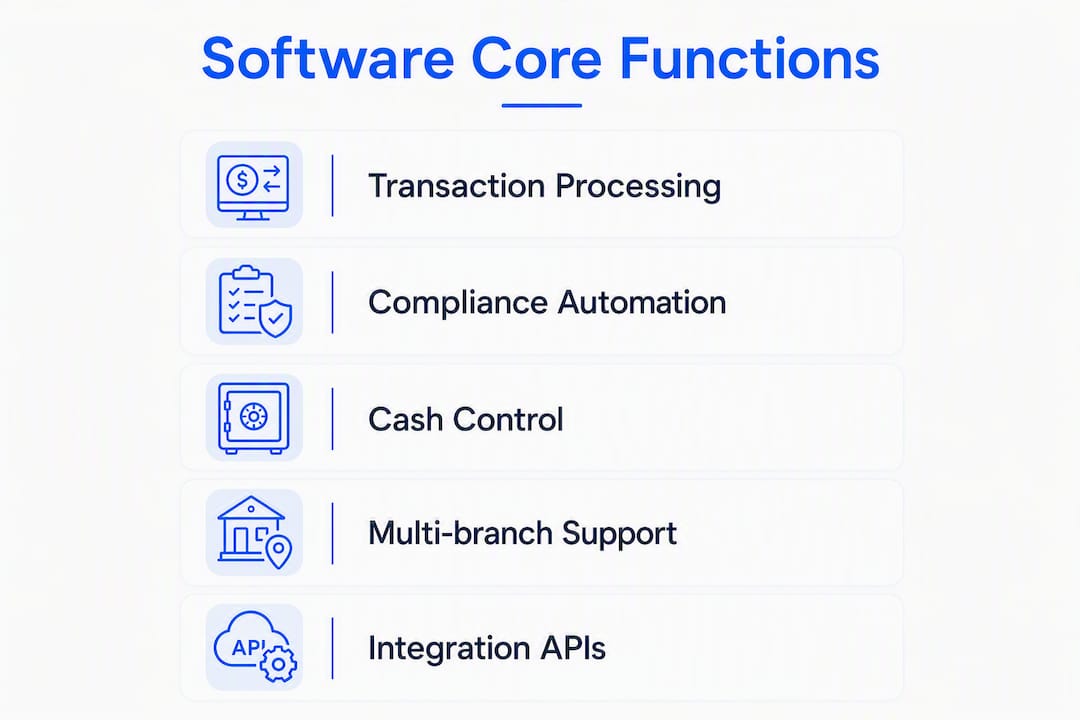
Every serious evaluation starts with the same question: does this system cover operations, compliance, and audit readiness without requiring three separate tools? Here is the feature set to score every candidate against.
Core transaction and rate features:
- Real-time transaction engine with multi-currency support and configurable rate spreads
- Centralized rate control pushed to all branches simultaneously
- Multi-branch POS with till and vault management
- Cash inventory tracking, float transfers, and automated reconciliation
- Settlement processing and bank statement imports (IBAN/SEPA)
Compliance features:
- KYC onboarding with document capture and verification
- Sanctions screening against current lists
- Automated transaction monitoring with configurable thresholds
- Fit-and-proper documentation storage and fast retrieval
- Immutable audit logs with full activity history
Operational and security features:
- Role-based access with least-privilege policies and MFA
- Real-time dashboards and multi-currency accounting
- Hardware integrations (banknote validators, receipt printers, POS terminals)
- API connectivity for accounting, payments, and AML/KYC providers
A system that handles all three layers reduces the manual overhead that causes reconciliation errors and compliance gaps.
What do EU regulations require from your software by 2027?
The short answer: your platform must produce automated, audit-ready reports and allow fast retrieval of fit-and-proper documentation for every manager and beneficial owner.
Directive (EU) 2024/1640 (the sixth Anti-Money Laundering Directive, AMLD6) requires supervisors to verify that managers and beneficial owners of currency exchange offices demonstrate good repute, honesty, integrity, and documented knowledge. That evidence must be stored, searchable, and exportable on demand. By 2027, centralized automated mechanisms and registers will be required across Member States to identify accounts and obliged entities, with FIU.net interconnection for cross-border intelligence exchange.
What that means for software procurement: sanctions screening must run against live lists, transaction monitoring must flag behavior against custom thresholds, and the system must export audit packages in formats national supervisors can actually use. Currency exchange reporting requirements are already specific about the data fields and file structures regulators expect.
Compliance outputs every vendor must demonstrate:
- Exportable transaction reports in supervisor-requested schemas
- Searchable fit-and-proper documentation with timestamp provenance
- Sanctions screening logs with match/no-match records
- Automated threshold alerts with case notes attached
- Immutable audit trail covering every user action
Pro Tip: Build and test your audit export templates before a supervisor requests them. Reworking export formats under inspection pressure costs far more than configuring them during onboarding.
How do you maintain cash and liquidity control across branches?
Real-time visibility into till balances, vault positions, and inter-branch transfers is the operational baseline for any network running more than one location.
The workflow is straightforward in principle but breaks down without the right tooling. A teller completes a sale; the system immediately updates the branch till balance, flags the transaction against the vault position, and feeds the data into central reporting. Without automation, that chain relies on manual entries that accumulate errors by end of day. Reconciliation controls and float risk management become exponentially harder as branch count grows.
Alerts and KPIs to configure from day one:
- Low-cash alerts per currency per branch
- Unexpected variance alerts triggered against daily baselines
- Daily reconciliation completion status by branch
- Branch liquidity ratios (available float vs. average daily volume)
- AR/AP exceptions flagged for manager review
Cash pooling across branches and automated settlement processing cut the time managers spend chasing end-of-day discrepancies. The monitoring cadence that works for most networks: real-time alerts for threshold breaches, hourly dashboard reviews during peak hours, and a full reconciliation report at close of business.
What integrations and technical specs should you require?
Evaluate vendors on the breadth and depth of their integration stack, not just the feature list. A platform with strong transaction management but weak bank API connectivity creates manual workarounds that erode the efficiency gains.

| Integration Type | What to Require | Why It Matters |
|---|---|---|
| KYC/ID verification | API connection to at least one EU-recognized provider | Automates onboarding and document checks |
| Sanctions screening | Live list updates, configurable frequency | Meets AMLD6 real-time monitoring expectations |
| Bank/payment imports | IBAN/SEPA statement import, automated matching | Eliminates manual reconciliation |
| Accounting ERP | Connector or export to standard ledger formats | Keeps books in sync without double entry |
| Banknote validators | Driver support for major hardware brands | Flags counterfeits at the point of transaction |
| POS/printer hardware | Certified drivers for receipt and label printers | Reduces setup time per branch |
On the technical side, require REST APIs with webhook support, a sandbox environment for pre-production testing, and documented secure file transfer for batch reconciliation. Transaction management system architecture determines how cleanly these integrations hold up under load. SaaS deployment suits most operators for its lower maintenance burden; on-premises remains relevant where national data-localization rules apply or where latency to a cloud host is a concern.
What security and data-protection controls are non-negotiable?
A vendor must provide strong access controls, encryption, and immutable audit logs as the baseline. Anything less creates both operational and regulatory exposure.
Minimum controls to require in writing:
- MFA for all user accounts, including branch staff
- Role-based access with least-privilege enforcement
- Session logging with IP and geolocation records
- IP/geofencing options to restrict access by location
- Encryption at rest and in transit (AES-256 and TLS 1.2+ as minimums)
- Automated backups with documented and tested recovery procedures
For data protection under GDPR-aligned rules across Central Europe, confirm the vendor supports configurable data-retention periods, handles data subject access requests, and can anonymize PII in analytics exports. Trust signals to request during procurement: ISO 27001 certification or equivalent evidence, SOC2-style control documentation, penetration-test reports from the past 12 months, and a written SLA covering security incident notification timelines.
What does implementation actually cost and how long does it take?
Standard deployments typically run several weeks. Heavy customization, on-premises installs, or complex multi-branch data migrations push that timeline out.
| Phase | Typical Duration | Key Activities |
|---|---|---|
| Discovery and scoping | 1–2 weeks | Requirements mapping, integration inventory |
| Configuration | 2–4 weeks | Rate rules, user roles, compliance templates |
| Integrations | 2–4 weeks | Bank APIs, KYC providers, hardware drivers |
| Testing and UAT | 1–3 weeks | Sandbox validation, compliance export testing |
| Training | 1–2 weeks | Teller, manager, and admin sessions |
| Go-live and stabilization | 1 week | Parallel run, issue resolution |
Primary cost drivers: branch count, number of hardware integrations, custom regulatory-reporting templates, data migration complexity, and the support/SLA tier selected. Staff training is a line item operators frequently underbudget. For procurement, request fixed-scope and time estimates for each integration separately, and confirm sandbox access before signing.
How do you evaluate vendors with an RFP checklist?
Weight your RFP highest on compliance outputs, multi-branch controls, and integration depth. A vendor that scores well on UI but cannot produce a supervisor-ready audit export is the wrong choice for a regulated operator.
Suggested scoring weights:
- Compliance outputs and AML/KYC: 30%
- Multi-branch operations and cash controls: 25%
- Integrations and API depth: 20%
- Security and certifications: 15%
- Total cost of ownership and support: 10%
Flag any gap in compliance outputs or security as an automatic disqualifier regardless of score.
12 questions to ask during vendor demos:
- Show us a live audit export in the format our national supervisor uses.
- How frequently are sanctions lists updated, and how is a match escalated?
- Can we configure custom transaction monitoring thresholds per branch?
- How does the system handle inter-branch cash transfers and reconciliation?
- Which banknote validator brands have certified drivers?
- What data export formats are supported for accounting and bank imports?
- What is your documented incident response and notification timeline?
- How are software upgrades managed, and what is the rollback procedure?
- Can you show fit-and-proper documentation retrieval from a live environment?
- What is the SLA for critical support issues during business hours?
- How does the system handle multi-currency accounting across branches?
- What does onboarding and ongoing training look like for a 5-branch network?
Franchise and delegated-control models add governance complexity; ask specifically how the vendor supports network-level oversight alongside branch-level autonomy.
How does Currexchanger map to this checklist?
Currexchanger meets the full checklist with centralized rate control, audit-ready exports, multi-branch cash monitoring, and integration adapters for the key provider categories.
Feature-to-checklist mapping:
- Transaction engine with multi-currency support and configurable rate spreads ✓
- Centralized rate control pushed to all branches simultaneously ✓
- AML/KYC compliance exports and fit-and-proper documentation retrieval ✓
- Immutable audit logs covering every user action ✓
- Banknote validator and POS hardware integrations ✓
- Real-time dashboards and branch-level liquidity monitoring ✓
- MFA, role-based access, IP restrictions, and session logging ✓
- API connectivity for accounting, payments, and AML/KYC providers ✓
Operators using the platform report fewer end-of-day reconciliation exceptions, faster responses to supervisor inquiries, and centralized oversight that reduces cash shortage incidents across branches.
What licensing and certification do software vendors need in Central Europe?
Currency exchange software vendors operating in Central Europe do not typically require a financial services license themselves, but the operators using the software do. Under AMLD6 and national transpositions, currency exchange offices must be licensed or registered with the competent national authority, and the software they use must support the compliance obligations that license carries.
What this means for vendor selection: the platform must be capable of producing outputs that satisfy national supervisor requirements, even if the vendor itself holds no license. Vendors should be able to demonstrate familiarity with the reporting schemas used by regulators in the Czech Republic, Poland, Hungary, Slovakia, and Austria, the core Central European markets. Ask for named references from operators in your specific country, not just the region generally.
Data localization rules vary by Member State. Some national regulators expect transaction data to remain within the country or the EU. Confirm the vendor's data-residency options in writing before signing.
What training and support should vendors provide?
Onboarding training is not optional for a regulated platform. A teller who misconfigures a transaction type or skips a KYC step creates compliance exposure that no software feature can retroactively fix.
Expect vendors to offer role-specific training: separate tracks for tellers, branch managers, compliance officers, and system administrators. Initial training delivered during go-live is the floor, not the ceiling. Ongoing support should include refresher sessions when regulations change, a knowledge base with searchable documentation, and a named support contact for compliance-related questions.
Support tiers matter. A basic email-only SLA is inadequate for a live exchange operation. Require a defined response time for critical issues (system down, compliance export failure) and confirm whether that SLA covers weekends and public holidays, when exchange offices often run peak volume.
How much can the software grow with your business?
A platform that handles one branch cleanly but requires a new implementation project for each additional location is not a scalable choice. The architecture should support adding branches through configuration, not custom development.
Currexchanger's subscription model scales by module, branch count, and integration set, so operators pay for what they use and expand without re-platforming. Custom module development is available for operators with workflows that fall outside the standard feature set, including bespoke regulatory-reporting templates for specific national supervisors.
For networks planning significant growth, confirm the vendor's largest current deployment by branch count and ask about performance benchmarks at that scale. API-first architecture is the clearest signal that a platform was built to integrate and grow rather than to stay isolated.
Key Takeaways
Currency exchange management software for Central Europe must deliver compliance automation, multi-branch liquidity control, and audit-ready reporting as a single integrated system, not three separate tools.
| Point | Details |
|---|---|
| Compliance outputs first | Prioritize vendors that can produce supervisor-ready audit exports and searchable fit-and-proper records before evaluating UI. |
| 2027 deadline is real | AMLD6 requires centralized automated mechanisms and FIU interconnection; your software must support machine-readable exports by then. |
| Multi-branch liquidity | Real-time till and vault monitoring with automated reconciliation is the operational baseline for any network above one location. |
| Security is a disqualifier | MFA, immutable logs, ISO 27001 evidence, and a written incident-response SLA are pass/fail items, not nice-to-haves. |
| Currexchanger covers the checklist | Currexchanger maps to every RFP item above: rate control, AML/KYC exports, audit logs, hardware integrations, and branch-level cash monitoring. |
Why compliance-first software selection matters more than most operators realize
The conventional wisdom in this space is to evaluate currency exchange software on ease of use and price. Both matter, but they are the wrong primary filters for a regulated operator in Central Europe right now.
The 2027 AMLD6 implementation deadline is not a distant abstraction. National supervisors are already asking operators how they plan to meet automated reporting and FIU interconnection requirements. An operator who selects a platform based on a clean interface and a low monthly fee, then discovers two years later that it cannot produce the required export formats, faces a costly migration under regulatory pressure. That is a worse outcome than paying more upfront for a compliance-capable system.
The other underestimated factor is the fit-and-proper documentation requirement. Most operators have the documents. Few have them stored in a system that allows fast, auditable retrieval with timestamp provenance. A supervisor who requests evidence of a manager's qualifications and integrity during an inspection does not want to wait three days while staff search email archives.
Software selection in this category is a compliance decision first and an operational decision second. The UI can be learned. The audit trail cannot be retrofitted.
Currexchanger: built for the compliance demands Central Europe operators face now
Running a multi-branch exchange operation in Central Europe means managing tighter regulatory timelines, more demanding audit expectations, and cash-control complexity that generic accounting software was never designed to handle. Currexchanger addresses all three directly.
The platform covers transaction management, centralized rate control, AML/KYC compliance exports, real-time branch cash monitoring, and the integration stack operators need for bank imports, banknote validators, and accounting systems. A sandbox environment is available so your team can validate compliance exports and integration behavior before go-live. Onboarding packages include role-specific training for tellers, managers, and compliance staff, with ongoing support tiers that include defined response times for critical issues.
Custom module development is available for operators with specific national reporting requirements. Request a demo at Currexchanger to see the audit export and multi-branch dashboard live, or contact the team directly to discuss your compliance template requirements.
Useful sources and references
Procurement decisions in a regulated environment should start from primary sources, not vendor marketing. National regulator interpretations of AMLD6 vary; use these documents as the baseline and confirm specifics with your national supervisor.
- Directive (EU) 2024/1640 (AMLD6) — EUR-Lex full text
- Preventing abuse of the financial system for money laundering and terrorism purposes (from 2027) — EUR-Lex Member State mechanisms summary
- Directive (EU) 2015/849 (AMLD4) — EUR-Lex, including fit-and-proper requirements for currency exchange offices
- Automate regulatory compliance reporting for currency exchange — Currexchanger blog
- Currency exchange reporting requirements 2026 — Currexchanger blog
- Currency trading risk for exchange operators — Currexchanger blog
National regulators in the Czech Republic (FAÚ), Poland (GIIF), Hungary (MNB), Slovakia (NBS), and Austria (FMA) each publish their own guidance on AML obligations for currency exchange operators. Use the EUR-Lex documents above as the EU-level framework, then verify local transposition requirements with the relevant national authority before finalizing your software procurement requirements.
FAQ
What is currency exchange management software?
Currency exchange management software is a B2B platform that handles transaction processing, centralized rate control, AML/KYC compliance, cash and inventory monitoring, and audit reporting for exchange office operators. It is distinct from retail forex trading platforms used by individual traders.
What does AMLD6 require from currency exchange software by 2027?
Directive (EU) 2024/1640 requires centralized automated mechanisms, FIU.net interconnection, and verifiable fit-and-proper documentation for managers and beneficial owners. Software must produce machine-readable, audit-ready exports to meet these obligations.
How long does it take to deploy currency exchange software?
Standard deployments typically run several weeks, covering discovery, configuration, integrations, testing, training, and go-live. On-premises installs or heavy customization extend that timeline.
Does Currexchanger support multi-branch operations in Central Europe?
Currexchanger supports multi-branch deployments with centralized rate control, per-branch cash monitoring, inter-branch transfer workflows, and role-based access management across the full network.
What security certifications should I require from a vendor?
Request ISO 27001 certification or equivalent evidence, SOC2-style control documentation, penetration-test reports from the past 12 months, and a written SLA covering security incident notification timelines.