
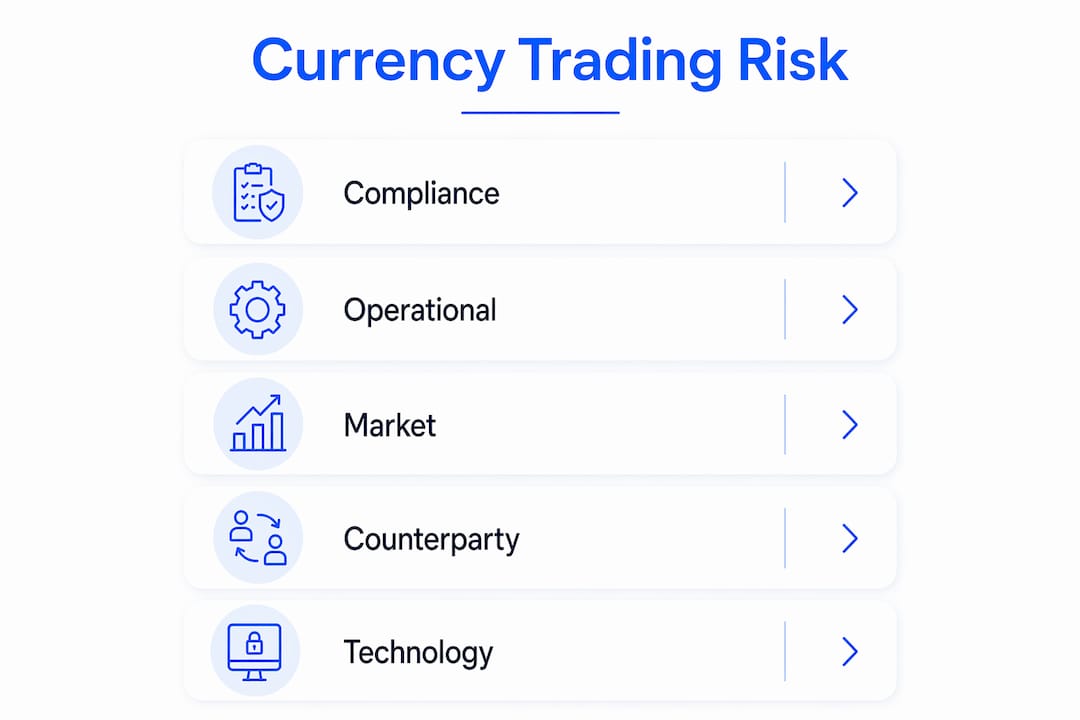
Currency trading risk, for a physical exchange operator, is not a single threat. It's a cluster of compliance, operational, physical, and market risks that can shut your business down if any one of them goes unmanaged. The most dangerous of these is compliance failure. Operators in Germany and across the EU must maintain individualized risk profiles per customer and document them regularly, per BaFin and EU AML/CFT mandates. Physical cash handling adds a second layer: authentication costs, secure storage, and the constant exposure to criminal exploitation that comes with anonymous cash transactions. Regional market volatility, particularly along the Bratislava-Vienna corridor, creates inventory and authenticity pressures that most generic risk frameworks simply don't address.
The core risk categories every operator must track:
- Compliance risk: AML/KYC failures, inadequate customer profiling, late suspicious activity reporting
- Operational risk: Cash authentication errors, inventory mismanagement, staff errors
- Physical risk: Theft, counterfeit exposure, insecure storage of large cash volumes
- Market risk: Currency price swings driven by interest rates, inflation, and political events
- Counterparty risk: Settlement failures and unverified trading partners
Pro Tip: Build your internal risk register around these five categories. A single spreadsheet that maps each risk to a control owner and a review date will outperform a 40-page policy document nobody reads.
1. Compliance risks from AML and KYC regulations
Compliance risk is the foremost existential threat for currency exchange operators. Failure to perform proper AML/CFT risk analyses, or delayed suspicious transaction reporting, can result in license revocations and criminal charges. This is not a theoretical outcome.
EU and BaFin regulations require a risk-based approach, which means you cannot apply the same due diligence to every customer. High-risk customers demand deeper scrutiny, more frequent profile updates, and closer transaction monitoring. Operators must also screen against EU and US sanctions lists before processing any transaction.
Key compliance obligations:
- Create and regularly update an individualized risk profile for every customer
- Monitor ongoing transactions against each customer's known profile
- Report suspicious transactions to the Financial Intelligence Unit immediately, without notifying the customer
- Screen all customers against current sanctions lists
- Document your general business risk assessment and revise it when conditions change
Transactions above a certain high-value threshold trigger mandatory enhanced due diligence. Operators in Germany must also report suspicious activity through the goAML portal. The AML compliance guide for exchange offices covers the full documentation chain.
2. Operational and physical risks in cash handling
Physical cash is expensive to manage safely. Cash logistics burdens include sorting, authentication, repatriation, and secure storage, each carrying its own cost and failure point. These are entirely separate from market price risk, and operators who conflate the two tend to underinsure both.

The anonymity of cash is what makes retail exchange attractive to criminals. Large cash volumes, denomination swaps, and repeated small transactions are all warning signals under AML law. Operators who don't train staff on risk management for beginners to recognize these patterns face both regulatory and criminal exposure.
Practical controls for physical and operational risk:
- Use certified banknote authentication devices at every counter
- Maintain a secure cash storage protocol with access logs
- Set internal transaction limits that trigger a supervisor review
- Carry professional liability insurance; in Germany, €2 million coverage is the standard, with additional cash and valuables insurance recommended for large storage volumes
- Train staff on AML warning signals, including structured transactions and denomination exchanges
Pro Tip: Log every banknote authentication result. If a counterfeit passes through and you can't show a documented authentication process, regulators will treat it as a control failure, not bad luck.
3. Regional market challenges on the Bratislava-Vienna axis
The Bratislava-Vienna corridor is one of Central Europe's most active currency zones. The Oesterreichische Nationalbank has documented that Austria receives substantial cash inflows from neighboring countries, with about four-fifths of total cash flows between Austria and its neighbors moving into Austria. The OeNB has been the most prominent receiver of returning banknotes in the euro area since 2003.
This creates a specific challenge for operators in the region. Currency here functions as both a transaction medium and a store of value; this means demand is harder to predict and inventory management is more complex than in markets where cash is purely transactional.
Key factors driving regional currency risk exposure:
- Economic and political conditions in home and neighboring countries
- Seasonal demand shifts tied to tourism and cross-border labor flows
- Exchange rate movements between the euro, Czech koruna, Hungarian forint, and Slovak euro legacy flows
- High euro cash holdings in non-euro EU member states, increasing cross-border exchange volumes
- The OeNB's sorting and redistribution burden, which affects banknote quality and availability
Operators on this axis need a risk strategy that accounts for inventory volatility, not just price volatility.
4. How Currexchanger addresses currency risk exposure
Currexchanger integrates compliance automation, transaction monitoring, and physical cash controls into one platform built for multi-branch exchange operators. The platform's capabilities cover the full risk surface: AML/KYC provider integrations, banknote verification tools, multi-factor authentication, activity logs, and geographic or IP-based access restrictions.
| Feature | Risk addressed |
|---|---|
| AML/KYC provider integration | Customer identity verification and sanctions screening |
| Transaction monitoring | Suspicious activity detection and reporting |
| Banknote verification integration | Counterfeit detection at point of exchange |
| Multi-factor authentication | Unauthorized system access |
| Activity logs | Audit trail for regulatory review |
| Customizable dashboards | Real-time inventory and balance visibility |
| Report generation | Documented risk assessments for regulators |
Best practices for using software to reduce currency trading risks:
- Automate customer risk profile updates when transaction patterns change
- Set threshold alerts for transactions approaching reporting limits
- Use the audit log as your primary evidence trail during regulatory inspections
- Generate and archive risk assessment reports on a fixed schedule, not just when regulators ask
5. How geopolitical events drive currency volatility
Political instability, sanctions regimes, and central bank policy shifts can move exchange rates faster than any operator can manually reprice inventory. For physical exchange operators, this creates a direct financial risk: the currency you bought at yesterday's rate may be worth less today before you've sold it.
The factors that move rates include interest rate decisions, inflation data, political stability, and economic performance. Operators in Central Europe face amplified exposure because several regional currencies, including the Hungarian forint and Czech koruna, are more sensitive to EU political developments than major reserve currencies. Maintaining a tight inventory position and reviewing exchange rate exposure daily is the practical response.
6. Counterparty risk in currency trading
Counterparty risk arises when the other party in a transaction fails to settle. In retail exchange, this is most visible with institutional counterparties: banks, cash-in-transit providers, or wholesale currency suppliers. No central clearing organization exists for forex transactions, which means operators bear the full settlement risk themselves.
Vetting counterparties before establishing relationships, setting credit limits, and requiring documented settlement terms are the baseline controls. For operators running multiple branches, centralizing counterparty approval through a single compliance function prevents individual branches from creating unreviewed exposures.
7. Legal and regulatory framework in Central Europe
Currency exchange operators in Central Europe operate under a layered regulatory structure. At the EU level, the Anti-Money Laundering Directives set the floor for AML/CFT obligations. National regulators, including BaFin in Germany, then add jurisdiction-specific requirements on top. The 2026 reporting requirements article covers the current rule set in detail.
In Germany, operating a currency exchange requires BaFin authorization, documented AML procedures, and a formal risk analysis. Operators must also comply with EU and US sanctions lists and report through the goAML portal. Czech, Slovak, and Hungarian operators face equivalent national frameworks aligned with EU directives. Cross-border operators need to map each jurisdiction's specific thresholds and reporting channels separately.
8. Technology and cybersecurity risks in exchange operations
Digital systems that manage transactions, customer records, and compliance documentation are now primary targets for fraud and data theft. An operator running an unpatched point-of-sale system or sharing login credentials across branches is carrying cybersecurity risk that regulators increasingly treat as a compliance failure, not just an IT problem.
Multi-factor authentication, role-based access controls, and geographic IP restrictions are the minimum controls for any platform handling financial data. Currexchanger builds these into its architecture by default. Staff training on phishing and social engineering is the control most operators skip, and it's where most breaches actually start. The staff training guide covers both compliance and cybersecurity awareness in one framework.
Managing currency trading risk across compliance, operations, and technology is exactly what Currexchanger is built for. The platform handles AML/KYC automation, transaction monitoring, banknote verification, and audit-ready reporting in one system. Explore Currexchanger to see how it fits your branch setup.
Key Takeaways
Currency trading risk for exchange operators is primarily a compliance risk, with AML/KYC failures posing the greatest threat to licensing and legal standing.
| Point | Details |
|---|---|
| Compliance is the top risk | AML/KYC failures can result in license revocation and criminal charges for operators. |
| Physical cash carries layered costs | Authentication, sorting, secure storage, and repatriation each add distinct operational risk. |
| Bratislava-Vienna axis demands tailored strategy | About four-fifths of cash flows between Austria and neighbors move into Austria, creating inventory complexity. |
| Geopolitical events move rates fast | Regional currencies like the forint and koruna are sensitive to EU political shifts, requiring daily rate reviews. |
| Software automates the risk controls | Currexchanger integrates AML/KYC, banknote verification, and audit logging into one platform. |
FAQ
What is currency trading risk for exchange operators?
Currency trading risk covers compliance failures, physical cash handling exposures, market price volatility, and counterparty settlement risk. For retail exchange operators, compliance risk is the most severe because it can trigger license revocation.
What AML reporting obligations apply in Central Europe?
Operators must report suspicious transactions to their national Financial Intelligence Unit immediately, without alerting the customer. In Germany, this is done through the goAML portal, and certain high-value transactions require enhanced due diligence.
How does geopolitical instability affect currency risk exposure?
Political events, sanctions, and central bank decisions can shift exchange rates faster than manual repricing allows. Operators holding inventory in sensitive regional currencies like the Hungarian forint face direct financial losses when rates move against their position.
How does Currexchanger help manage trading risk?
Currexchanger automates AML/KYC checks, monitors transactions for suspicious patterns, integrates banknote verification, and generates audit-ready risk assessment reports, reducing both compliance and operational risk across branches.
What insurance does a currency exchange operator need?
In Germany, professional liability insurance with €2 million coverage is standard for currency exchange operations. Additional cash and valuables insurance is recommended when storing large banknote volumes on-site.