
A currency spot transaction is an agreement to buy or sell one currency against another at the current market rate, with settlement typically occurring within two business days. This is the most direct form of foreign exchange, and it underpins everything from corporate import payments to retail forex trading. The global FX market processes over $9.6 trillion in daily volume, making it the largest financial market on earth. Understanding how currency spot transactions work gives you a concrete edge, whether you are moving money across borders for business or trading currencies for profit.
How does the currency spot exchange process work?
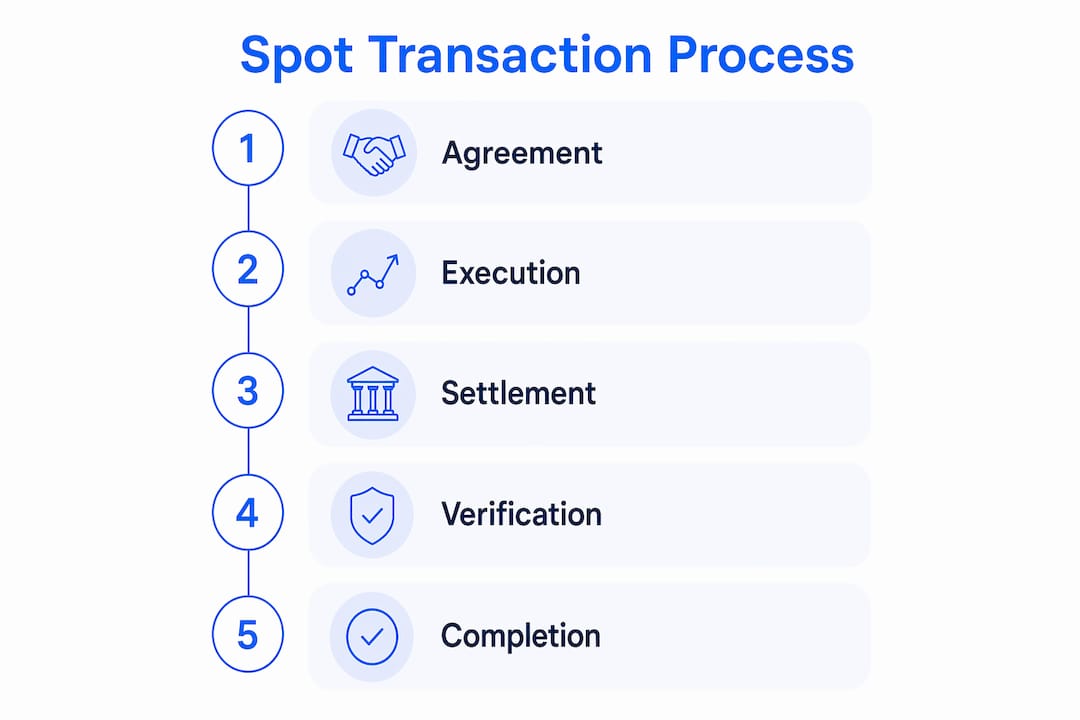
A spot FX trade follows a clear sequence from agreement to settlement. The industry term is "spot transaction," and it differs from forward contracts or options because the price is locked in at the moment of the deal, not at a future date.
The process breaks down into four stages:
- Initiation. The buyer and seller agree on a currency pair, such as EUR/USD, and confirm the spot rate. This rate reflects the current market price at that exact moment.
- Execution. The trade is confirmed electronically or verbally through a broker, bank, or trading platform. A trade confirmation document is generated immediately.
- Settlement instruction. Both parties send payment instructions through their respective banks. Cross-border payments typically route through SWIFT, while euro-zone transfers use SEPA.
- Settlement. Funds are exchanged and delivered. The standard settlement cycle is T+2, meaning two business days after the trade date. Some providers now offer same-day settlement for major currency pairs.
The T+2 rule exists for a practical reason. It gives banks time to process cross-border payments, verify transaction details, and confirm fund availability before delivery. Rushing that window increases the chance of a failed settlement.
Pro Tip: If your business needs faster access to converted funds, ask your provider specifically about same-day or T+1 settlement options for major pairs like USD/EUR or GBP/USD. Not all platforms advertise this capability upfront.

Retail traders rarely experience the settlement cycle directly. Most brokers use daily rollover processes to close and reopen positions before the T+2 deadline, allowing speculation without any physical currency delivery. Businesses, by contrast, go through full settlement because they need the actual currency in their accounts.
What determines the spot exchange rate?
The spot rate is not set by any single authority. It emerges from continuous buying and selling across a decentralized, over-the-counter market operating 24 hours a day, five days a week.
Several forces shape the rate at any given moment:
- Supply and demand. When more traders want to buy euros than sell them, the euro price rises against other currencies. This is the most immediate driver of rate movement.
- Central bank policy. Central bank actions and interest rate decisions critically shape exchange rate stability. A central bank raising rates typically attracts foreign capital, strengthening its currency.
- Economic indicators. Inflation data, employment reports, and GDP figures all move rates. A stronger-than-expected jobs report in the United States, for example, tends to push the USD higher.
- Geopolitical events. Elections, trade disputes, and military conflicts create uncertainty. Uncertainty drives traders toward safe-haven currencies like the USD, JPY, or CHF.
- Market liquidity. Low liquidity causes slippage and price volatility, especially during major news events or outside peak trading hours.
- Bid-ask spread. Every quoted rate includes a spread between the buy price (ask) and the sell price (bid). The spread represents the provider's minimum profit on the transaction.
One underappreciated dynamic is the role of large limit orders in the order book. Large limit orders create liquidity walls that temporarily stall price movement. When those walls are breached, prices can accelerate sharply. This matters most for businesses executing large spot transactions, where even a small rate shift on a big volume trade translates into real money.
Spot FX rates also function as a real-time economic barometer. The rate between two currencies reflects the collective judgment of millions of market participants about the relative health of two economies at that exact moment.
Who participates in the spot currency market and why?
The spot currency market draws participants with very different goals. Understanding who is trading alongside you changes how you interpret price movements.
The main groups are:
- Commercial banks. Banks are the largest participants. They execute spot trades on behalf of clients and trade for their own accounts to manage currency exposure.
- Corporations. Importers and exporters convert currencies to pay suppliers or repatriate revenue. Their trades are driven by business need, not speculation.
- Central banks. Governments intervene in spot markets to stabilize their currencies or manage foreign reserve levels.
- Retail traders. Individual traders access the spot market through brokers. Their positions are typically small relative to institutional flows.
- Hedge funds and asset managers. These participants trade large volumes and often drive short-term rate movements.
The most striking fact about the FX spot market is its composition. About 90% of FX transactions are speculative rather than commercial. Nine out of ten trades are placed by participants trying to profit from price changes, not by businesses moving money for operational reasons. That ratio explains why rates can move sharply even when no major economic news is released.
Retail traders and businesses also experience the market differently. Retail traders use margin accounts and never take physical delivery of currency. Businesses go through full settlement, meaning the actual euros, dollars, or pounds land in their bank accounts. The exchange rate control strategies that work for a corporate treasury team look very different from the tools a retail trader uses on a brokerage platform.
The market structure is also almost entirely over-the-counter. There is no central exchange for spot FX. Prices are negotiated directly between participants, which is why rates can vary between providers for the same currency pair at the same moment.
What are the costs and risks in currency spot transactions?
The rate you see is rarely the rate you get. Every provider builds a margin into the spot rate they offer, and that margin is the primary cost of a spot transaction.
The exchange rate offered to businesses always includes a margin over the mid-market rate. The mid-market rate is the midpoint between the buy and sell prices on the open market. No retail or business customer trades at the mid-market rate. The gap between the mid-market rate and your actual rate is the provider's margin, and it varies widely.
Beyond the rate margin, spot transactions carry additional costs and risks:
| Cost or Risk | What it means in practice |
|---|---|
| Rate margin | The spread between mid-market and your quoted rate, often 0.5%–3% depending on provider |
| Network fees | SWIFT transfers carry fixed fees per transaction; SEPA transfers are typically lower cost |
| Slippage | Your executed rate differs from the quoted rate due to low liquidity or fast market movement |
| Settlement risk | Funds are not delivered on time, leaving one party exposed between trade and settlement |
| Hidden conversion fees | Some providers charge additional fees on top of the rate margin, buried in transaction terms |
Businesses frequently overlook total conversion costs, focusing on the headline exchange rate while missing the combined impact of rate margins and network fees. A rate that looks competitive can become expensive once SWIFT charges and provider margins are added together.
Settlement risk is real but manageable. It arises when one party delivers currency but the counterparty fails to deliver on time. For businesses, working with regulated providers and using established payment networks reduces this risk significantly.
Pro Tip: Always ask your provider for the mid-market rate alongside their quoted rate. The difference tells you exactly what you are paying in margin. For high-volume transactions, even a 0.1% improvement in margin translates into meaningful savings.
Tracking liquidity across currencies is the other key discipline for managing costs. Executing large spot trades during low-liquidity windows, such as early Monday morning or during public holidays, increases slippage and widens spreads.
Key Takeaways
Currency spot transactions settle in two business days at the current market rate, and the total cost always exceeds the quoted rate once margins and network fees are included.
| Point | Details |
|---|---|
| Standard settlement is T+2 | Most spot trades settle two business days after execution, giving banks time to process payments. |
| Rate margin is the primary cost | The gap between the mid-market rate and your quoted rate is the provider's margin, not a neutral price. |
| 90% of FX trades are speculative | Most market volume comes from traders, not businesses, which drives short-term rate volatility. |
| Liquidity affects your execution price | Low-liquidity windows increase slippage, making timing a real cost factor for large transactions. |
| Settlement risk requires active management | Using regulated providers and established networks like SWIFT or SEPA reduces delivery failure risk. |
Why most businesses are still getting spot FX wrong
The most common mistake I see businesses make is treating the exchange rate as the only variable that matters. They spend time shopping for the best rate and then lose that advantage to SWIFT fees, provider margins, and poor timing on execution.
Liquidity is the factor that gets ignored most often. A great rate quoted at 3:00 AM on a Monday is not the same as that rate at 10:00 AM London time. The spread widens, slippage increases, and the actual executed rate ends up worse than the quote. For a business moving $500,000 in a single spot trade, that difference is not trivial.
The second mistake is treating spot transactions as one-off events rather than as a process to manage. Businesses that scale their currency exchange operations systematically, with defined rate thresholds, settlement schedules, and cost tracking, consistently outperform those that handle each transaction ad hoc.
My honest view is that the spot FX market rewards preparation more than it rewards timing. You cannot predict where rates will go. You can control when you trade, which provider you use, and how carefully you account for total costs. Those three variables are entirely within your control, and they matter more than trying to catch the perfect rate.
— Bartas
Currexchanger: built for businesses managing spot transactions
Currency exchange operators and financial businesses that run multiple offices need more than a rate feed. They need a system that tracks every spot transaction, monitors cash positions in real time, and flags compliance issues before they become problems.
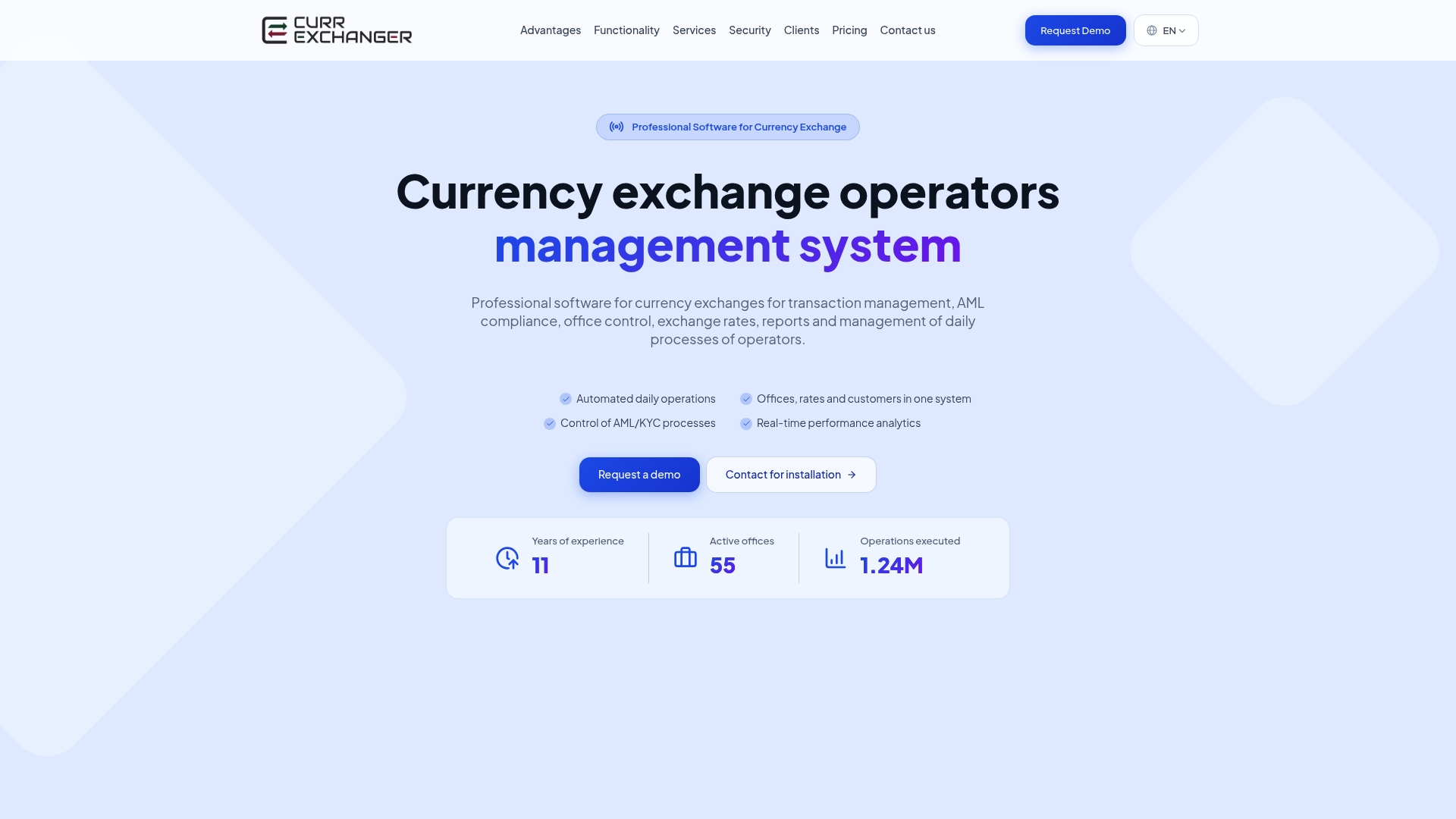
Currexchanger is a currency exchange management platform built specifically for that operational reality. It handles transaction management, exchange rate control, AML/KYC compliance, and cash inventory monitoring across single offices or multi-branch networks. The platform connects to external AML/KYC providers, banknote verification services, and accounting systems through API integrations. For businesses that need to move from manual spot transaction tracking to a system that generates real-time analytics and audit-ready reports, Currexchanger is the direct solution.
FAQ
What is a currency spot transaction?
A currency spot transaction is an agreement to exchange one currency for another at the current market rate, with settlement typically in two business days (T+2). It is the most common form of foreign exchange transaction.
How is the spot rate different from the mid-market rate?
The mid-market rate is the midpoint between buy and sell prices on the open market. The spot rate offered by a provider includes a margin above that midpoint, which represents the provider's cost and profit.
Why does spot FX settlement take two business days?
The T+2 settlement rule gives banks time to process cross-border payments and verify transaction details before funds are delivered. Some providers now offer same-day settlement for major currency pairs.
Do retail traders receive physical currency in spot FX?
Retail traders using brokerage platforms do not take physical delivery. Brokers use daily rollover processes to close and reopen positions before the T+2 deadline, enabling speculation without currency delivery.
What is the biggest hidden cost in spot currency transactions?
The exchange rate margin is the largest hidden cost. The total conversion cost includes the provider's rate margin plus network fees from systems like SWIFT or SEPA, both of which are often underestimated.