
Exchange rate control is the set of government-imposed regulations and interventions designed to manage currency values and cross-border capital movements. Central banks, finance ministries, and regulatory bodies use these mechanisms to stabilize economies, prevent capital flight, and protect foreign reserves. For businesses operating across borders, understanding exchange rate control is not optional. It directly shapes pricing, cash flow, and risk exposure on every international transaction.
What is exchange rate control and why does it matter?
Exchange rate control, formally known as foreign exchange regulation, covers everything from central bank approvals for cross-border transfers to hard caps on how much currency a business can move out of a country. Governments apply these tools most aggressively during crises, including recessions and hyperinflation, when capital flight threatens to drain reserves needed for vital imports. The core goal is always the same: keep the domestic currency stable enough to sustain trade and public confidence.
The practical stakes for businesses are significant. A company importing raw materials from a country with strict controls may face approval delays, transaction limits, or forced conversion at unfavorable official rates. Understanding the type of control in place, and its current intensity, is the first step in building a reliable financial plan for international operations.

What are the main exchange rate regimes?
Three primary exchange rate regimes/30%3A_Net_Exports_and_International_Finance/30.3%3A_Exchange_Rate_Systems) exist: fixed, managed float, and free float. Each represents a different level of government involvement in setting currency value.
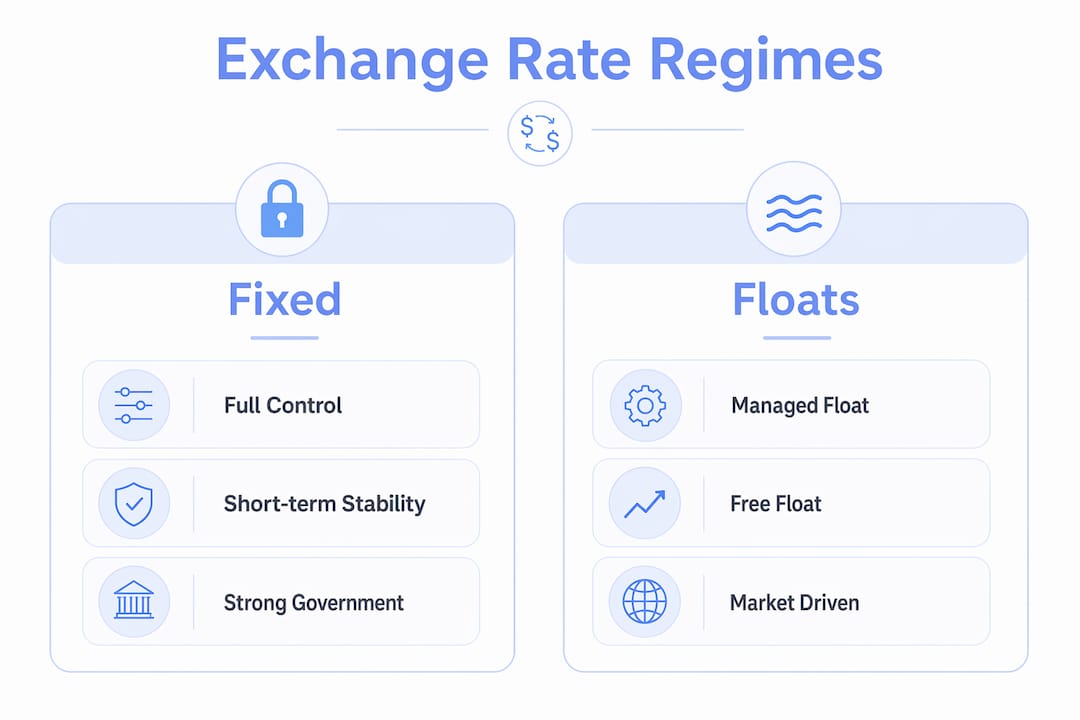
| Regime | Government role | Typical markets |
|---|---|---|
| Fixed (pegged) | Full control; rate set by decree and defended with reserves | Smaller or commodity-dependent economies |
| Managed float | Partial control; central bank intervenes to limit volatility | Emerging markets |
| Free float | No direct intervention; market forces set the rate | Major economies (USD, EUR, GBP) |
Fixed exchange rates give businesses predictability in the short term. A government pegs its currency to a major currency like the US dollar and defends that peg by buying or selling reserves. The risk is that the peg can break suddenly if reserves run low or fiscal policy drifts out of alignment.
Managed floats are the most common regime in emerging markets. Central banks allow the currency to move within an informal range, stepping in when volatility spikes. This approach reduces the shock of sudden capital flows while still letting market signals influence the rate.
Free floats offer the least government control. The rate moves continuously based on trade flows, interest rate differentials, and investor sentiment. Businesses operating in free-float markets face natural volatility but rarely encounter the approval requirements or transaction caps that come with controlled regimes.
How do governments and central banks actively control exchange rates?
Governments use both direct and indirect tools to influence exchange rates. Knowing which tool is in play tells you a great deal about how predictable the rate will be.
-
Direct currency intervention. A central bank buys or sells currency reserves to shift supply and demand. Buying the domestic currency reduces supply and pushes the rate up. Selling it increases supply and pushes the rate down. This is the most visible form of control.
-
Interest rate adjustments. Raising interest rates attracts foreign capital, increasing demand for the domestic currency and pushing its value up. Lowering rates has the opposite effect. This indirect tool works through market incentives rather than direct market transactions.
-
Sterilized intervention. Central banks often offset currency trades with bond purchases to keep the domestic money supply stable. This technique, called sterilized intervention, lets authorities influence the exchange rate without triggering inflation or deflation. The side effect for businesses is that central bank actions become harder to read and predict.
-
Reserves management. Governments accumulate foreign currency reserves specifically to fund future interventions. A country with deep reserves can defend a peg for years. A country with thin reserves may be forced to abandon a peg overnight.
-
Trade and capital policy. Import tariffs, export subsidies, and restrictions on foreign investment all affect currency demand indirectly. These tools are slower to act but can shift exchange rate pressure over months or years.
Pro Tip: Monitor a country's import cover ratio, which measures how many months of imports its reserves can fund. A ratio below three months is a warning sign that a peg or managed rate may be under stress.
Governments regulate exchange rates through a combination of monetary policy, reserves management, trade policy, and market psychology working together. No single lever controls the outcome. That complexity is exactly why exchange rate movements can surprise even experienced traders.
What are exchange controls and how do they affect businesses?
Exchange controls are the most direct form of government intervention. They restrict what businesses and individuals can do with foreign currency, often requiring central bank approval for transactions above a set threshold.
Common restrictions include:
- Transaction caps. Limits on how much foreign currency a company can purchase or transfer in a given period.
- Approval requirements. Mandatory central bank sign-off before large cross-border payments can proceed.
- Conversion mandates. Rules requiring exporters to convert a portion of foreign earnings into the domestic currency at the official rate.
- Repatriation bans. Prohibitions on moving profits out of the country, trapping capital inside the jurisdiction.
The stated purpose of these controls is to preserve foreign reserves and limit speculation, particularly during economic crises. Argentina and Venezuela are well-documented examples where capital controls were imposed to slow reserve depletion after sovereign stress events.
For businesses, the practical impact is liquidity pressure. You may hold local currency earnings that you cannot convert or move. Pricing becomes complicated when the official rate diverges sharply from the rate available offshore. This divergence, known as the dual rate problem, forces finance teams to track two numbers simultaneously and decide which one to use for contracts and forecasts.
The standard hedging response in restricted markets is the Non-Deliverable Forward, or NDF. Businesses in markets like China and Argentina use USD-settled NDF contracts to lock in an effective exchange rate without needing to access the restricted local market directly. NDFs settle in dollars offshore, so they sidestep local approval requirements while still providing meaningful currency protection.
Pro Tip: When operating in a country with exchange controls, always document the official rate and the offshore NDF-implied rate separately. The gap between them is your real cost of doing business in that market.
Understanding how exchange rate restrictions affect cross-border trade and investment is critical before entering any controlled market. The accounting treatment of gains and losses differs depending on which rate you apply, and regulators in both the home country and the target market may have conflicting requirements.
What are the risks and challenges of exchange rate controls?
Exchange rate controls create predictability in the short term but introduce structural risks that compound over time.
The most dangerous risk is sudden devaluation. Fixed or pegged exchange rate systems/30%3A_Net_Exports_and_International_Finance/30.3%3A_Exchange_Rate_Systems) can hold for years, then collapse within days when reserves run out or political will breaks. Businesses that priced contracts assuming a stable peg can face overnight losses that wipe out months of margin.
"Fixed exchange rate regimes risk disruption when government policy conflicts with market fundamentals, potentially causing sudden, sharp devaluations harmful to businesses. Political and fiscal policy misalignment is detectable by watching declines in import cover and reserve levels, but most businesses only notice the warning signs after the break has already happened."
Dual or parallel market rates create a second layer of risk. When the official rate is artificially strong, an unofficial market emerges at a weaker rate. Businesses that invoice at the official rate but face real costs at the parallel rate lose money on every transaction. Regulators in some jurisdictions treat use of the parallel rate as a legal violation, even when the official rate is economically unrealistic.
Capital mobility restrictions limit foreign investment. Investors who cannot repatriate profits avoid markets with strict controls. That reduces the pool of available financing and raises the cost of capital for local businesses. Over time, controlled markets tend to attract less foreign direct investment than comparable open markets.
Speculative pressure also builds under controlled regimes. Market participants who believe a peg is unsustainable will position against it, accelerating the very reserve depletion the government is trying to prevent. The official rate versus offshore rate gap is one of the clearest signals that speculative pressure is building. When that gap widens, the probability of a policy change rises sharply.
Key Takeaways
Exchange rate control is a government policy tool that shapes currency values, capital flows, and business risk across every international market.
| Point | Details |
|---|---|
| Three core regimes | Fixed, managed float, and free float each carry different levels of government control and business risk. |
| Direct vs. indirect tools | Central banks use reserve trades and interest rate policy together; sterilized intervention makes actions harder to predict. |
| Exchange controls hit liquidity | Transaction caps and conversion mandates can trap capital and force businesses to use NDFs for hedging. |
| Peg collapse risk is real | Watch import cover ratios and reserve levels as early warning signals before a fixed rate breaks. |
| Dual rates signal stress | A wide gap between the official rate and the offshore rate means the current regime is under pressure. |
Why most businesses misread exchange rate controls
Most businesses treat exchange rate controls as a compliance checkbox rather than a financial planning input. That is the wrong frame. I have seen companies price multi-year supply contracts using the official rate in a controlled market, only to find the peg abandoned halfway through the contract term. The loss was not from bad pricing. It was from failing to read the macro signals that were visible months before the break.
The most useful habit I have developed is tracking the spread between the official rate and the NDF-implied offshore rate for any market where I have material exposure. When that spread exceeds a few percentage points and is widening, the market is telling you something the government has not announced yet. That signal is more reliable than any official statement about the stability of the peg.
Hedging under capital controls requires creativity, but it is not impossible. NDFs, structured trade finance, and natural hedges through local currency revenue and local currency costs all reduce net exposure without requiring access to the restricted official market. The key is building the hedge before the stress event, not after.
Managing exchange rates across offices becomes exponentially more complex when some of those offices operate in controlled markets. The rate you use for internal transfers, the rate you report to regulators, and the rate that reflects your actual economic exposure can all be different numbers. Getting that reconciliation right is one of the most underrated skills in international treasury management.
— Bartas
How Currexchanger supports currency management under complex rate regimes
Currency exchange operators and financial businesses working across multiple jurisdictions face the full weight of exchange rate controls every day.
Currexchanger is built specifically for that environment. The platform tracks multi-currency liquidity across branches in real time, flags exposure when rate movements create imbalances, and integrates with AML and KYC compliance workflows so that regulatory requirements in controlled markets do not slow down daily operations. For businesses managing currency risk across offices in different rate regimes, Currexchanger provides the transaction visibility and reporting depth that manual processes cannot match. Visit Currexchanger to see how the platform handles exchange rate complexity at scale.
FAQ
What is exchange rate control?
Exchange rate control is a set of government regulations that restrict or manage how a currency is valued and how it moves across borders. Tools include central bank intervention, capital controls, and fixed exchange rate pegs.
How does exchange rate control work in practice?
Central banks buy or sell currency reserves to influence supply and demand, while governments impose transaction limits and approval requirements to restrict capital flows. These tools work together to keep the exchange rate within a target range.
What is the impact of exchange rate controls on businesses?
Exchange controls create liquidity constraints, force businesses to track official and offshore rates separately, and often require the use of derivatives like Non-Deliverable Forwards to hedge currency risk legally.
What are the main risks of a fixed exchange rate regime?
The primary risk is sudden devaluation when reserves deplete or fiscal policy diverges from the peg level. Businesses relying on rate predictability can face large, unexpected losses when a peg breaks.
How can businesses protect themselves under exchange rate controls?
Businesses should monitor reserve levels and the spread between official and offshore rates as early warning indicators. Using NDFs, natural hedges, and currency management platforms reduces exposure without requiring access to restricted official markets.