
Currency exchange staff training best practices are defined as structured, role-specific, and regularly updated programs that build both regulatory compliance and operational performance across every level of a currency exchange office. Regulators under Czech Act No. 253/2008 Sb. and EU AML directives do not just check whether training happened. They assess whether employees can identify and escalate risks in real time. That distinction separates offices that pass audits from those that fail them. This guide covers 10 proven practices that training coordinators and managers can apply directly in 2026.
1. Currency exchange staff training best practices start with regulatory requirements
AML regulations define the floor for every training program in currency exchange. Czech law and EU directives require documented AML training for all staff involved in client onboarding, transaction processing, and compliance roles. That documentation must be available for inspector review on demand.
Regulatory inspections by bodies such as the Czech National Bank (ČNB) and the Financial Analytical Unit (FAÚ) consistently treat missing training records as a compliance failure, not a minor gap. The absence of proof is treated the same as the absence of training itself. That means your program must produce evidence, not just knowledge.
Training frequency is also regulated. Annual mandatory sessions are the baseline, but updates are required whenever legislation changes, internal AML procedures are revised, or a significant operational incident occurs. Treating training as a fixed annual event is the fastest way to fall behind.
- Annual AML training is the minimum standard, not the full requirement.
- Updates must follow any change in law, internal policy, or business model.
- All sessions require timestamped attendance records for audit purposes.
- Inspectors from ČNB and FAÚ assess training quality, not just training presence.
Pro Tip: Build your training calendar around regulatory trigger points, not just the calendar year. Set automatic reminders for legislative updates from FAÚ so your team never misses a required refresh.
2. Segment training by role before building any content
Role-specific training outperforms generic programs because it matches content to the actual risks each employee faces. A frontline cashier and a compliance officer handle entirely different scenarios. Training them identically wastes time and leaves real gaps.

Frontline staff need deep fluency in Know Your Customer (KYC), Customer Due Diligence (CDD), and red-flag identification. They are the first point of contact and the first line of defense. Compliance officers and Money Laundering Reporting Officers (MLROs) require advanced knowledge of Suspicious Activity Report (SAR) filing, direct communication with regulatory agencies, and Enhanced Due Diligence (EDD) protocols.
Role segmentation also makes assessment more meaningful. A cashier's certification test should look nothing like an MLRO's. When each role has its own learning path and assessment, you can measure actual competency rather than generic recall.
- Frontline staff: KYC, CDD, red-flag identification, transaction verification
- Compliance officers: SAR filing, EDD, regulatory reporting, agency communication
- MLROs: Policy oversight, legislative monitoring, escalation management
- Transaction processors: Monitoring thresholds, documentation accuracy, internal escalation
3. Build training content around your specific business model
Training tailored to a company's business model and risk profile outperforms generic programs in both relevance and staff retention. A high-volume tourist exchange office faces different risks than a multi-branch operator handling corporate clients. Generic AML content fails to prepare staff for the actual transactions they process daily.
Start by mapping your transaction types, customer segments, and geographic exposure. Use that map to build scenarios your staff will actually encounter. A cashier in a high-traffic airport branch needs training on rapid KYC under time pressure. A compliance officer at a multi-branch network needs training on consolidating risk signals across locations.
AML training loses effectiveness when it does not reflect the specific risks of the operation. That is not an opinion. It is a documented pattern in regulatory feedback across the Czech Republic and EU member states.
Pro Tip: Run a short risk assessment workshop with your compliance officer before designing any new training module. The output becomes your content brief and your audit evidence at the same time.
4. Use digital delivery platforms with built-in attendance logging
Online learning platforms with mandatory final assessments and timestamped attendance logs solve two problems at once. They deliver training efficiently, and they generate the documentation regulators require. Paper sign-in sheets and email confirmations do not meet the standard that ČNB and FAÚ inspectors expect.
Digital platforms also allow you to lock content progression, meaning staff cannot skip modules or complete assessments without watching the full session. That feature matters because regulators assess demonstrated ability, not just completion rates. A platform that logs time-on-module gives you evidence of genuine engagement.
Blended learning works well for complex topics. Deliver foundational AML theory online, then run in-person scenario workshops to test application. The combination builds knowledge and tests behavior, which is exactly what inspectors want to see.
- Choose a platform that generates exportable attendance and completion reports.
- Require a passing score on final assessments before issuing certification.
- Lock module progression to prevent skipping.
- Archive all records with timestamps for a minimum of five years.
- Schedule in-person scenario sessions after each major online module.
5. Cover these core topics in every training program
The curriculum for any currency exchange training program must include specific AML components. Core AML training covers KYC, CDD, EDD, transaction monitoring, risk-based scoring, and SAR workflows. These are not optional additions. They are the baseline that regulators measure against.
| Training Topic | Who Needs It | Regulatory Basis |
|---|---|---|
| KYC and CDD procedures | All client-facing staff | Czech Act No. 253/2008 Sb. |
| EDD for high-risk clients | Compliance officers, MLROs | EU AML Directives |
| Transaction monitoring | All transaction processors | Czech and EU AML law |
| SAR filing workflows | Compliance officers, MLROs | FAÚ reporting requirements |
| Risk-based scoring | All staff | EU risk-based approach |
| Internal escalation protocols | All staff | Internal AML policy |
Risk-based scoring deserves particular attention. Staff must understand how to assign risk levels to customers and transactions in real time, not just in theory. Red-flag identification training should use real transaction patterns drawn from your own operation, not textbook examples.
Internal escalation protocols are often undertrained. Every employee must know exactly what to do when they identify a suspicious transaction, including who to contact, what to document, and how fast to act. Ambiguity in escalation is a compliance risk in itself.
6. Update training immediately after any regulatory or operational change
Training must be a continuous process updated immediately upon changes in business model, internal AML procedures, or legislation. The Czech Republic's AML reform requires comprehensive updates before july 2027 enforcement. That deadline makes 2026 the year to audit your current program and identify gaps.
Operational changes also trigger training needs. Opening a new branch, adding a new currency pair, or onboarding a new customer segment all change the risk profile of your operation. Each change requires a targeted training refresh for the affected staff.
Do not wait for the annual cycle. Build a trigger-based update process that activates whenever a defined change event occurs. That process should include a gap analysis, a content update, a delivery event, and a documentation record.
7. Appoint a compliance officer to own training continuity
The compliance officer's role extends beyond filing reports. It includes actively managing training relevance and keeping staff aware of evolving threats and regulations. Without a designated owner, training programs drift. Updates get delayed. Documentation gaps accumulate.
A strong compliance officer monitors legislative changes from FAÚ and ČNB, translates those changes into training updates, and coordinates delivery across all branches. That function is what regulators look for when they assess the quality of your compliance culture, not just your paperwork.
For multi-branch operators, the compliance officer should also coordinate with branch managers to confirm that local staff complete updates on schedule. Centralized oversight with local accountability is the model that holds up under inspection.
8. Measure knowledge retention, not just completion
Regulators assess not just the presence of training, but employees' demonstrated ability to identify and escalate risks in real time. Completion certificates prove attendance. They do not prove competency. Your measurement strategy must go further.
Use scenario-based assessments that require staff to make decisions under realistic conditions. A cashier who can identify a structuring pattern in a simulated transaction is more valuable than one who scored 80% on a multiple-choice quiz. Behavioral observation during live operations also provides evidence that training has changed how staff work.
Track assessment scores over time and by role. A drop in scores after a regulatory change signals that the update training did not land. That data lets you intervene before an inspector does.
- Track assessment scores by role and by training cohort.
- Use scenario simulations to test real-time decision-making.
- Conduct periodic spot checks during live operations.
- Review escalation logs to confirm staff are applying training in practice.
9. Maintain audit-ready documentation at all times
Granular, timestamped records of every training session are required because regulators frequently cite lack of proof as a compliance failure. The record must include the date, time, duration, attendees, content covered, and assessment results. A folder of signed attendance sheets does not meet that standard.
Build your documentation system before you deliver your first session. Retroactively reconstructing records after an inspection notice is both stressful and often insufficient. A well-structured digital archive makes audit preparation a routine task rather than a crisis response.
For AML compliance in exchange offices, the documentation standard is clear: every training event must leave a traceable, verifiable record. That record is your primary defense during any regulatory review.
10. Incorporate feedback loops to keep training relevant
Training programs that do not evolve become liabilities. Staff feedback after each session reveals whether content matched their real work, whether the delivery format worked, and whether the assessment reflected actual job demands. That feedback is data. Use it.
Build a short post-session survey into every training event. Review the results quarterly with your compliance officer. Use patterns in the feedback to identify modules that need rewriting, scenarios that need updating, or delivery formats that are not working for your team.
Feedback loops also signal emerging risks. If multiple staff members flag confusion about a specific transaction type, that confusion is a compliance gap waiting to become an incident. Addressing it in training is faster and cheaper than addressing it after a regulatory finding.
Key Takeaways
Effective currency exchange staff training requires role-specific content, trigger-based updates, and audit-ready documentation to satisfy regulatory standards and build genuine compliance competency.
| Point | Details |
|---|---|
| Regulatory baseline | AML training must be documented, timestamped, and available for ČNB and FAÚ inspectors on demand. |
| Role segmentation | Frontline staff need KYC and red-flag training; compliance officers need SAR filing and EDD expertise. |
| Trigger-based updates | Update training immediately after any legislative, operational, or policy change, not just annually. |
| Measurement beyond completion | Use scenario assessments and behavioral observation to confirm staff can act, not just recall. |
| Compliance officer ownership | Designate one person to own training continuity, legislative monitoring, and documentation integrity. |
Training culture is the real compliance asset
I have reviewed enough currency exchange operations to know where the real risk lives. It is not in the policy documents. It is in the gap between what staff were told in a training session and what they actually do at the counter on a busy Friday afternoon.
The offices that consistently pass regulatory inspections share one trait. Their compliance officers treat training as a living system, not an annual checkbox. They update content after every legislative change. They run scenario drills after incidents. They review escalation logs to see whether training is actually changing behavior.
The offices that struggle treat training as a documentation exercise. They produce certificates and attendance sheets, but their staff freeze when a real red-flag transaction appears. Regulators notice that gap immediately. The quality of an employee's response during a simulated inspection question tells an inspector more than a folder of signed forms.
My strongest recommendation is to invest in your compliance officer role before investing in any training platform. A skilled compliance officer will design a better program, maintain it more effectively, and produce documentation that holds up under scrutiny. The platform matters. The person running it matters more.
— Bartas
How Currexchanger helps you manage training compliance
Currency exchange managers who need to track training records, certifications, and compliance documentation across multiple branches face a real operational challenge. Currexchanger's currency exchange management platform includes activity logging, user access management, and compliance workflow tools that support training record-keeping alongside daily operations.
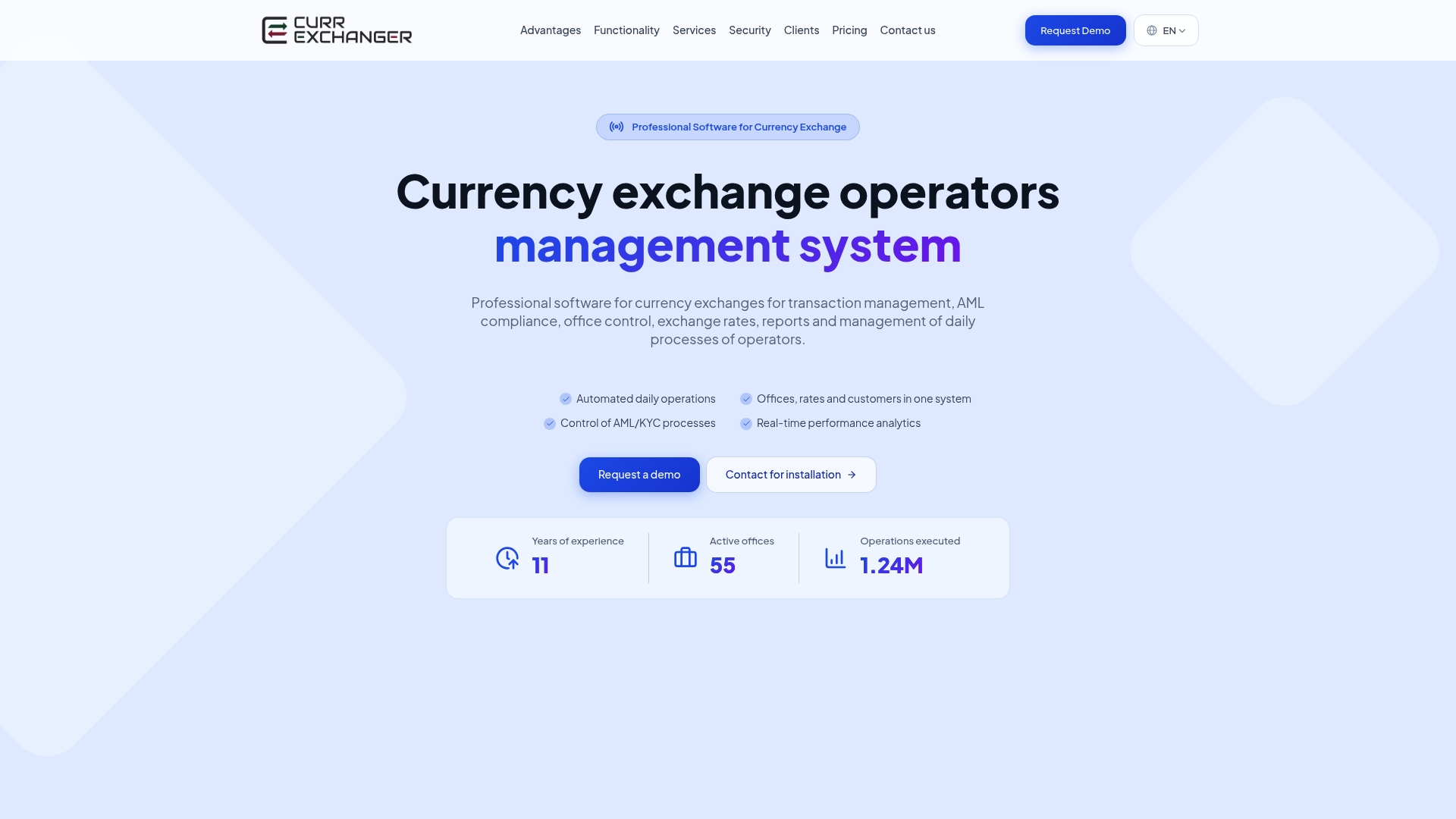
The platform's detailed activity logs and reporting functions give training coordinators a single place to store and retrieve session records, assessment results, and certification status for every staff member. When an inspector requests documentation, that information is ready. Currexchanger also integrates with external AML and KYC providers, so your compliance data and training records stay connected within one system. If you manage more than one branch, that centralization is not a convenience. It is a compliance necessity.
FAQ
What AML training is required for currency exchange staff?
Currency exchange staff must complete documented AML training covering KYC, CDD, EDD, transaction monitoring, and SAR workflows. Czech Act No. 253/2008 Sb. and EU AML directives require annual training at minimum, with updates triggered by legislative or operational changes.
How often should currency exchange staff training be updated?
Training must be updated immediately after any change in legislation, internal AML procedures, or business model. Annual training is the regulatory floor, not the full standard.
What records do regulators require for AML training?
Regulators require granular, timestamped records for every training session, including attendee lists, content covered, duration, and assessment results. Absence of documentation is treated as a compliance failure, even if training was delivered.
How do you measure whether staff training is effective?
Effective measurement goes beyond completion certificates. Use scenario-based assessments, behavioral observation during live operations, and escalation log reviews to confirm that staff apply training in practice.
What role does a compliance officer play in staff training?
The compliance officer owns training continuity by monitoring regulatory changes, updating content, coordinating delivery across branches, and maintaining documentation integrity. That function is what regulators assess when evaluating compliance culture.