
Currency network risk management is the practice of identifying, measuring, and controlling financial, operational, and regulatory exposures across interconnected exchange operations. Risk managers in currency networks face a compounding set of threats: volatile exchange rates, evolving AML obligations, and the operational complexity of multi-branch systems. Frameworks like MiCA, DORA, and global AML directives now define the minimum standard for how networks mitigate financial risk. Integrating KYC, KYT, and behavioral scoring into a single rules engine is no longer optional. It is the baseline expectation from regulators and the most effective defense against financial loss.
How currency networks manage risk: primary exposures and assessment models
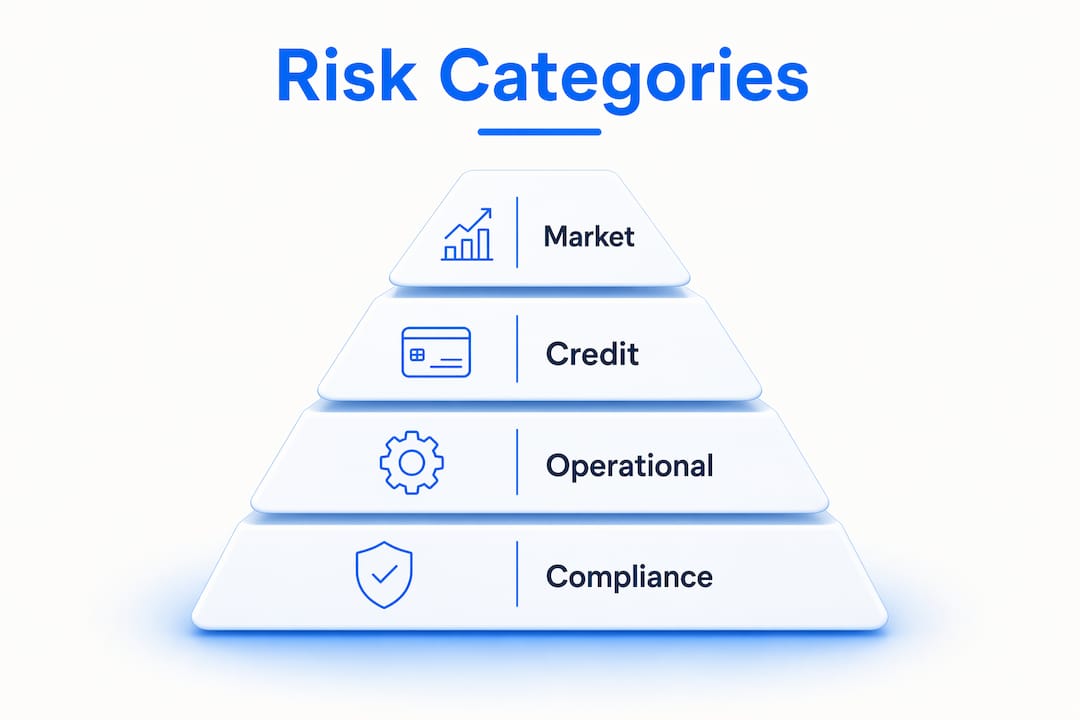
Currency networks face four distinct risk categories. Market risk covers adverse rate movements that erode margins between buy and sell positions. Operational risk includes system failures, human error, and process breakdowns across branches. Regulatory risk arises from non-compliance with AML laws, licensing requirements, and frameworks like MiCA. Reputational risk follows any public failure in compliance or security controls.
Risk assessment in currency networks relies on structured models rather than intuition. Regulators penalize generic AML templates and require individualized assessments built around a network's actual client typologies and transaction patterns. That means segmenting customers by behavior, geography, and product use before assigning risk scores.
Transaction pattern analysis sits at the core of effective risk assessment. Analysts map expected versus actual transaction volumes by client segment, flag deviations, and feed those signals into scoring models. Client profiling adds a second layer: PEP status, source of funds, and jurisdiction all adjust the base risk score assigned at onboarding.
The table below shows how risk categories map to assessment tools used in practice:
| Risk category | Primary assessment tool |
|---|---|
| Market risk | Position tracking and rate sensitivity models |
| Operational risk | Incident logs, process audits, and branch monitoring |
| Regulatory risk | AML typology scoring and compliance gap analysis |
| Reputational risk | Client profiling, adverse media screening |
Pro Tip: Build your risk typology library from actual transaction data, not industry templates. Regulators can tell the difference, and the penalty for a generic assessment can reach 130,000,000 CZK for regulated financial institutions.
How do rule engines integrate KYC, KYT, and behavior scoring?
KYC answers the question of who the client is. KYT answers the question of what that client's transactions look like over time. Behavior scoring connects both by tracking whether a client's activity matches their declared profile. Separately, each of these tools produces noise. Integrated into a single rules engine, they produce accurate, prioritized alerts.
The integration works through a layered rule structure:
- Identity verification layer. KYC checks confirm identity documents, screen against sanctions lists, and assign an initial risk tier at onboarding. Watchlists, PEP databases, and adverse media feeds update this tier continuously.
- Transaction monitoring layer. KYT rules fire on specific transaction patterns: structuring, rapid fund movement, unusual counterparty geography, or volume spikes. Each rule carries a weight that contributes to the client's running risk score.
- Behavioral scoring layer. The system compares current activity against the client's historical baseline. A client who normally exchanges $2,000 per month and suddenly processes $40,000 in a week triggers a behavioral anomaly flag, independent of whether any single transaction breaches a threshold.
- Alert governance layer. Alerts are ranked by composite score. Analysts review high-priority cases first. Low-scoring alerts are batched or suppressed based on pre-approved thresholds.
Optimizing rule thresholds with pattern matching can reduce false-positive alerts by 42% while preserving recall on genuine risk events. That reduction matters operationally because every false positive consumes analyst time and delays legitimate transactions.
Fine-tuning AML and KYT systems with behavioral scoring also increases on-ramp conversion by 5–12% without raising operational risk. That figure reflects a real business benefit: better-calibrated rules approve more legitimate customers faster while keeping the risk profile stable.

Real-time KYT monitoring integrated with core banking or exchange systems also reduces chargebacks and operational losses by catching suspicious patterns before settlement rather than after.
Pro Tip: Review your rule engine's false-positive rate quarterly. A rate above 90% signals that thresholds are miscalibrated and your analysts are spending most of their time on noise, not risk.
What regulatory compliance measures are essential for currency networks?
MiCA Class 3 operators must maintain a minimum capital floor of 150,000 EUR, but capital adequacy is the easier part of compliance. DORA's operational resilience requirements, including ICT risk management, incident reporting, and third-party oversight, represent the more demanding ongoing obligation.
The core compliance obligations for currency networks operating under current EU frameworks include:
- AML risk assessment. An individualized, documented assessment of the network's exposure to money laundering and terrorist financing, updated at least annually or after material changes.
- KYC and ongoing due diligence. Verified identity at onboarding, enhanced due diligence for high-risk clients, and continuous monitoring of the client relationship.
- Transaction monitoring and SAR/STR filing. Automated detection of suspicious activity, with timely and well-supported reports filed to the relevant financial intelligence unit.
- Operational resilience documentation. Under DORA, networks must maintain tested incident response plans, ICT continuity procedures, and records of third-party provider oversight.
- Audit trails. Every control must produce evidence of its operation. Policy documents alone do not satisfy regulators.
Regulators now require pro-active, real-world documentation: workflow protocols, test results, and audit trails that demonstrate controls are working in practice, not just described in policy. Abstract policy documents without operational evidence of effectiveness are treated as non-compliance.
Non-compliance carries direct financial consequences. EU regulators can impose fines up to 130,000,000 CZK on regulated financial institutions and up to 1,000,000 CZK on virtual asset service providers. Beyond fines, regulators can impose operational restrictions, suspend licenses, or require remediation programs that cost far more than the original penalty.
Document verification is the entry point for every compliance chain. Without verified identity at onboarding, every downstream control operates on an unreliable foundation.
How do layered wallet security and operational controls minimize risk?
Currency networks that handle digital assets use a multi-tier custody model to balance liquidity needs against security exposure. The structure assigns different proportions of assets under custody to wallets with different access speeds and security levels.
| Wallet tier | Typical AUC allocation | Access speed | Security model |
|---|---|---|---|
| Hot wallet | 1–5% | Immediate | Online, single-key or multi-sig |
| Warm wallet | 5–15% | Minutes to hours | Online, multi-sig required |
| Cold wallet | 75–90% | Hours to days | Offline, HSM or air-gapped |
| Deep cold | 0–10% | Days | Air-gapped, physical controls |
Layered wallet custody models balance cost, security, and operational complexity. Hot wallets fund daily transaction flow. Cold and deep cold storage protect the majority of assets from online attack vectors.
Multi-signature authorization requires multiple independent keyholders to approve any transaction above a set threshold. Hardware security modules (HSMs) store private keys in tamper-resistant hardware, preventing extraction even if the host system is compromised. Air-gapped procedures physically isolate signing devices from internet-connected systems.
Pro Tip: Outsourcing cold storage to a regulated custodian shifts the operational burden of physical security without transferring the compliance obligation. You remain accountable for the custodian's controls under DORA's third-party oversight rules.
Operational controls extend beyond custody. Incident response plans must be tested, not just written. Currency position tracking across branches provides real-time visibility into exposure, so risk managers can act before a position becomes a loss.
What best practices support liquidity management and risk reporting?
Liquidity risk and reporting quality are two areas where currency networks consistently underperform. Both are fixable with the right operational infrastructure.
Sub-ledgers and deferred state mapping eliminate balance leaks and reduce manual reconciliation work. Each branch or wallet maintains its own sub-ledger that feeds into a consolidated view. Deferred state mapping captures the gap between initiated and settled transactions, preventing double-counting and missed exposures.
Best practices for liquidity and reporting include:
- Real-time position monitoring. Track net currency exposure across all branches continuously, not at end-of-day.
- Risk-based SAR filing. Prioritize quality over quantity in suspicious activity reports. A well-supported report on a genuine case carries more regulatory weight than ten low-confidence filings.
- Compliance and liquidity integration. Connect AML monitoring outputs to liquidity dashboards so that frozen funds or restricted accounts are reflected immediately in available liquidity calculations.
- Staff training. Compliance culture depends on staff who understand why controls exist, not just how to follow procedures. Staff training programs that explain risk rationale produce better judgment in edge cases.
Regulatory reporting should follow a risk-based approach. Flooding the financial intelligence unit with low-value alerts damages the network's credibility and wastes analyst capacity on both sides of the report.
Key takeaways
Effective currency network risk management requires integrating KYC, KYT, and behavioral scoring into a single rules engine, maintaining pro-active compliance documentation, and applying layered operational controls across custody, liquidity, and reporting.
| Point | Details |
|---|---|
| Integrated rule engines | Combining KYC, KYT, and behavior scoring in one engine reduces false positives and improves alert quality. |
| Regulatory documentation | Regulators require operational evidence of controls, not just written policies, under MiCA and DORA. |
| Layered custody security | Allocating 75–90% of assets to cold storage significantly reduces exposure to online attack vectors. |
| Risk-based SAR reporting | Filing fewer, well-supported suspicious activity reports builds regulatory credibility and focuses analyst effort. |
| Liquidity and compliance integration | Connecting AML outputs to liquidity dashboards prevents blind spots when funds are restricted or frozen. |
The shift I keep seeing risk managers get wrong
The most common mistake I see in currency network risk programs is treating compliance as a documentation exercise. Teams spend weeks writing policy documents and almost no time testing whether the controls those documents describe actually work. Regulators have caught on. They now ask for workflow logs, test results, and evidence that your rule engine fired correctly on a real case last quarter.
The second mistake is running KYC, KYT, and behavioral scoring as three separate systems with three separate teams. The inconsistencies that creates, different risk scores for the same client depending on which system you query, are exactly what regulators flag during audits. A unified rules engine is not a technology preference. It is a governance requirement.
What I find works is building the compliance program around the audit trail first. Every control should produce a record automatically. If your team has to manually compile evidence before an inspection, your controls are not embedded in operations. They are a performance staged for regulators.
The 2026 compliance checklist for correspondent banking makes this point clearly: documentation that cannot be produced on demand is documentation that does not count.
— Bartas
How Currexchanger supports currency network risk management
Currency networks that manage risk well share one operational trait: their compliance, monitoring, and reporting tools work from the same data source.
Currexchanger is built for currency exchange operators managing multiple branches, and its architecture reflects that. The platform integrates AML and KYC compliance tools, real-time transaction monitoring, and liquidity tracking across currencies into a single operational environment. Audit trails are generated automatically. Exchange rate controls, user access restrictions, and activity logs are built into the core system, not added as afterthoughts. Risk managers who want a platform that produces compliance evidence as a byproduct of normal operations, rather than a separate reporting task, can review Currexchanger's full feature set to see how it fits their network's requirements.
FAQ
What is KYT and how does it differ from KYC?
KYC verifies who a client is at onboarding. KYT monitors what that client's transactions look like over time, flagging patterns that deviate from their declared profile or expected behavior.
How do currency networks reduce false-positive AML alerts?
Optimizing rule thresholds with pattern matching and behavioral scoring can reduce false-positive alerts by 42% while maintaining recall on genuine risk events.
What capital requirements apply under MiCA Class 3?
MiCA Class 3 operators must maintain a minimum capital floor of 150,000 EUR. DORA's operational resilience requirements add the more demanding ongoing compliance obligations.
Why do regulators reject generic AML risk assessments?
Regulators require individualized assessments built from a network's actual client typologies and transaction data. Generic templates do not demonstrate that the network has assessed its specific risk exposure.
What is the role of cold storage in currency network risk management?
Cold storage holds 75–90% of assets under custody in offline environments, protecting the majority of funds from online attack vectors while hot wallets fund daily transaction flow.