
Currency position tracking is the continuous, automated monitoring of net foreign currency exposures across all business units to inform risk management decisions and maintain regulatory compliance. Financial professionals who manage multi-currency operations rely on this process to know, at any moment, exactly how much of each currency they hold, owe, or have committed. Without it, exchange rate swings become unmanaged liabilities rather than calculable risks. Regulatory bodies including the Basel Committee on Banking Supervision (BCBS) and the European Central Bank (ECB) set the compliance floor that makes position tracking a legal obligation, not just a best practice.
How does currency position tracking work?
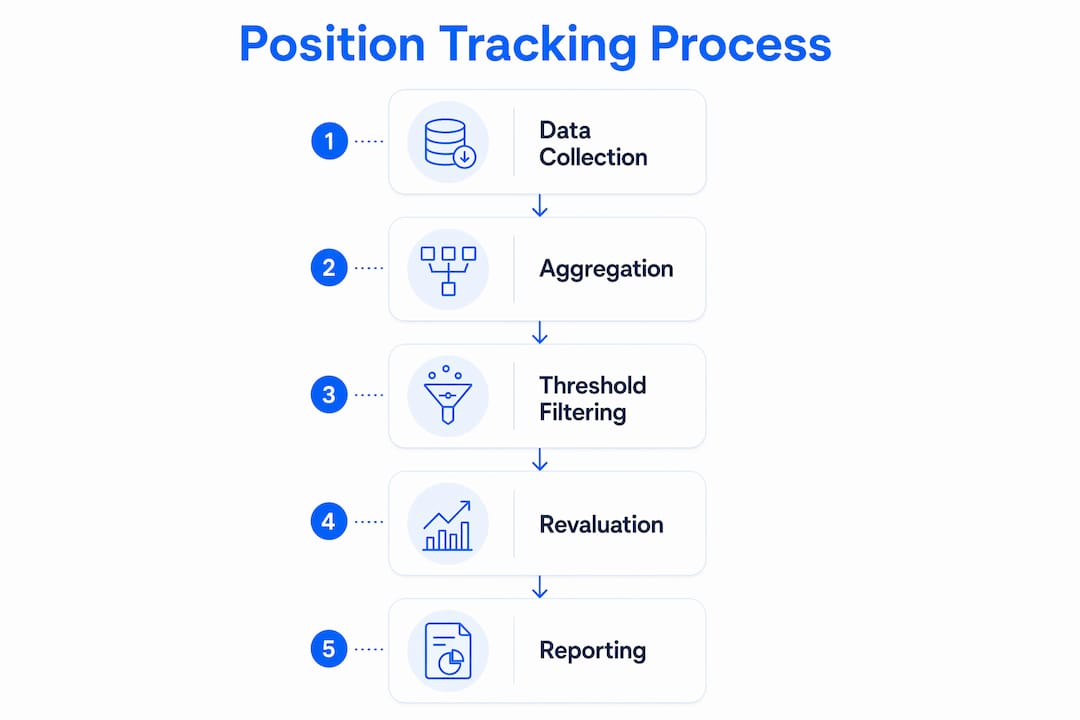
Currency position tracking works by continuously aggregating exposures across currencies and business units, giving finance teams instant visibility into their net risk. The system pulls transactional data from ERP platforms, banking portals, and trade feeds, then calculates the net long or short position for each currency in real time. That net figure is the number that drives hedging decisions, capital allocation, and regulatory reporting.
The industry term for this process is "FX position keeping." The phrase "currency position tracking" describes the same function from an operational perspective. Both terms appear in treasury management literature, and understanding the distinction helps professionals communicate clearly with auditors, regulators, and technology vendors.

Modern systems apply materiality thresholds to filter which exposures are large enough to hedge. A threshold might specify that any exposure below $50,000 equivalent is monitored but not actively hedged. This prevents the treasury team from spending resources on positions whose hedging cost would exceed the risk they carry.
Data sources that feed position tracking
Accurate position tracking depends on pulling data from every system that generates a currency obligation or asset. The core sources are:
- ERP systems (such as SAP or Oracle Financials) for accounts payable, accounts receivable, and intercompany balances
- Banking portals for cash balances, intraday transactions, and confirmed settlements
- Trade and contract management systems for forward commitments and purchase orders denominated in foreign currency
- Treasury management systems for derivative positions and hedge accounting records
Each source updates at a different frequency. Banking portals may push data every few minutes. ERP systems often batch-update overnight. The gap between these cycles creates a window where the stated position differs from the true position. Closing that gap is the central technical challenge of real-time currency tracking.
Pro Tip: Designate one system as the single point of truth for currency positions. When ERP data and bank portal data conflict, the reconciliation rule must be written down and enforced. Teams that lack this rule spend hours resolving discrepancies instead of managing risk.
What role do accounting frameworks play in position tracking?
Accounting standards define how currency positions are recorded, revalued, and reported. They are not optional guidelines. BCBS standards and local regulatory requirements mandate specific treatments that shape how every tracking system must be built.
The core accounting process follows a defined sequence:
- Identify the foreign currency balance. Every payable, receivable, cash account, or financial instrument denominated in a non-functional currency is flagged as a currency position.
- Move the balance to a position account. Regulatory frameworks require moving foreign currency balances from income statement lines to dedicated balance sheet position accounts.
- Revalue at fair market value. At each reporting date, the system applies the current spot rate to recalculate the functional currency equivalent of each position.
- Record gains and losses separately. Each currency and account type gets its own gain account and loss account. This separation isolates volatility and makes it visible to auditors and risk managers.
- Report to regulators. The revalued positions feed into regulatory capital calculations and external financial statements.
The table below shows how this sequence maps to typical review frequencies in a currency exchange operation.
| Accounting step | Typical review frequency | Primary purpose |
|---|---|---|
| Position identification | Continuous (automated) | Capture every new exposure |
| Balance sheet reclassification | Daily or at transaction | Regulatory compliance |
| Fair value revaluation | Daily or monthly close | Accurate P&L and capital reporting |
| Gain/loss account recording | At revaluation | Isolate FX volatility |
| Regulatory reporting | Monthly or quarterly | BCBS/ECB submission |
Currency exchange operators running multiple branches face a compounded version of this process. Each branch generates its own currency flows, and the consolidated position must reflect all of them simultaneously. Platforms like Currexchanger automate this consolidation, reducing the risk of manual aggregation errors that distort the reported position.
How does position tracking support hedging and risk management?
Position tracking is the input that makes hedging decisions defensible. Without an accurate, current exposure map, a treasury team cannot know whether a hedge is reducing risk or creating new risk. Effective currency position management integrates directly with formal hedging policies that specify which instruments are allowed, who can authorize trades, and how often the policy is reviewed.
A well-structured hedging policy built on position tracking data addresses these core elements:
- Allowed instruments: Forwards, options, and natural hedges are defined explicitly. Speculative instruments are excluded.
- Hedge ratios: The policy states what percentage of a given exposure must be hedged. A 75% hedge ratio on EUR receivables, for example, leaves 25% unhedged as a deliberate business decision.
- Roles and authorization: Segregation of duties separates execution, confirmation, accounting, and reporting among different staff members. This prevents conflicts of interest and strengthens audit trails.
- Review triggers: Policies review hedging quarterly or semiannually, with additional reviews triggered by significant market volatility or central bank policy shifts.
The most capital-efficient approach uses natural hedging first, then financial derivatives for residual risk. Natural hedging means matching currency inflows and outflows operationally. If a business collects EUR from European clients and pays EUR to European suppliers, those flows offset each other without any derivative cost. Position tracking makes these natural offsets visible, so the treasury team only hedges the net residual.
Over-hedging is a real and underappreciated risk. Fragmented exposure data causes hedge mismatches that create speculative risk rather than reducing it. A team that hedges a gross receivable without knowing about an offsetting payable ends up with a net long position in the derivative market. That is the opposite of risk reduction.
Pro Tip: Refresh your exposure map at least monthly. Markets and business pipelines change faster than annual policy cycles. A living exposure map, updated regularly, keeps hedge ratios aligned with actual business reality rather than last quarter's assumptions.
What are the common challenges in implementing position tracking?
The biggest implementation failures in currency position tracking come from ledger architecture problems, not technology failures. Incorrect ledger usage hides true exposures from both automated systems and manual review. A payable booked to the wrong account simply does not appear in the position report, creating a hidden exposure that only surfaces when a payment is due.
Cross-functional coordination is the second major challenge. Treasury cannot track what procurement and sales do not report. Currency risk management is a team effort requiring procurement, sales, and operations to flag currency risk at the contract stage, not after the invoice arrives. When a sales team signs a contract denominated in a foreign currency without notifying treasury, the exposure enters the business unhedged and untracked.
"Without cross-functional coordination, treasury cannot proactively hedge. It reacts instead to unflagged contract positions, always one step behind the actual risk."
Real-time tracking changes the response window significantly. Finance teams acting on live data rather than end-of-day reports can respond to intraday rate moves before they crystallize into losses. For currency exchange operators processing high transaction volumes, the difference between a four-hour-old position report and a live one can represent material financial exposure.
The path to reliable position tracking requires three organizational commitments. First, establish clear ledger governance so every transaction posts to the correct account. Second, train procurement and sales teams to identify and report currency-denominated commitments at inception. Third, build a monthly or quarterly exposure map review into the governance calendar, not as an ad hoc exercise but as a standing process with defined owners and outputs.
Key Takeaways
Currency position tracking works by continuously aggregating, revaluing, and reporting net foreign currency exposures through integrated systems, formal accounting standards, and cross-functional governance.
| Point | Details |
|---|---|
| Continuous aggregation is the foundation | Systems pull data from ERPs, banking portals, and trade feeds to calculate net positions in real time. |
| Accounting frameworks are mandatory | BCBS and ECB standards require balance sheet reclassification and fair value revaluation at defined intervals. |
| Natural hedging reduces derivative costs | Matching currency inflows and outflows operationally cuts the residual exposure that requires financial instruments. |
| Ledger accuracy prevents hidden exposures | Incorrect account posting hides positions from automated reports, creating untracked risk. |
| Cross-functional coordination is non-negotiable | Procurement and sales must flag currency commitments at contract stage for treasury to act proactively. |
Why I think most FX teams underestimate the governance problem
Most treasury teams I have seen focus their energy on technology selection. They evaluate platforms, compare integration specs, and debate dashboard features. The governance layer gets a fraction of that attention, and that is where position tracking breaks down in practice.
The ledger problem is almost always a training problem in disguise. Someone in accounts payable booked a foreign currency invoice to a domestic account because the system allowed it. No alert fired. The position report looked clean. The exposure was real. Automation catches this only if the rules are configured correctly from the start, and that requires treasury to own the chart of accounts conversation with accounting.
The cross-functional piece is harder to fix with software. Procurement teams do not think in treasury terms. They think in contract terms. The fix is a one-page escalation protocol: any contract with a non-functional currency clause triggers a treasury notification before signing. That single process change, embedded in the procurement workflow, does more for position accuracy than any dashboard upgrade.
Tracking liquidity across currencies and tracking positions are related but distinct disciplines. Operators who conflate them end up with liquidity reports that look healthy while their FX exposure is quietly accumulating. Keeping those two views separate, and reconciling them regularly, is the discipline that separates operators who manage FX risk from those who merely report it.
Currency risk management works best when it is treated as insurance, not as a performance driver. The goal is stability, not yield. Teams that internalize that framing make better hedging decisions and write better policies.
— Bartas
Currexchanger's approach to currency position management

Currexchanger is built for currency exchange operators who need position visibility across multiple branches without manual consolidation. The platform integrates with ERP systems and banking portals to pull transactional data automatically, updating position reports as transactions occur. Its accounting integration tools support balance sheet reclassification and revaluation workflows aligned with regulatory requirements. Audit trails, user access controls, and segregation of duties features are built into the platform's governance layer. Operators managing high transaction volumes can explore Currexchanger's full platform to see how automated position tracking reduces manual workload and supports compliance across every branch.
FAQ
What is currency position tracking?
Currency position tracking is the continuous, automated monitoring of net foreign currency exposures across all accounts and business units. It provides real-time visibility into how much of each currency an organization holds, owes, or has committed.
How does position tracking differ from simple balance reporting?
Balance reporting shows what a business holds at a point in time. Position tracking aggregates all exposures, including payables, receivables, and derivatives, to calculate the net risk across currencies continuously.
Why do accounting standards require position revaluation?
BCBS and ECB frameworks require revaluation at fair market value so that reported positions reflect current exchange rates, not historical transaction rates. This gives regulators and management an accurate picture of real-time currency risk.
What causes hidden exposures in position tracking systems?
Hidden exposures most often result from incorrect ledger usage, where transactions post to the wrong account and fall outside the position report. Cross-functional failures, such as procurement signing foreign currency contracts without notifying treasury, also create untracked exposures.
How often should an exposure map be updated?
A living exposure map should be refreshed monthly at minimum, with additional updates triggered by significant market moves or changes in business pipeline. Quarterly-only updates leave too much time for hedge ratios to drift from actual exposures.