
Ancillary revenue for currency exchange operators comes mainly from spread and explicit fees, then gets amplified by higher-margin add-ons: prepaid-card float, multi-currency conversion capture, and referral commissions. Understanding how exchange ancillary revenue works starts with recognizing that each stream has a different cost structure, not just a different price tag.
The mechanics break down into a handful of levers:
- Spread — the markup between your buy and sell rate against the interbank benchmark
- Explicit fees — flat or percentage charges disclosed at the counter or online
- DCC/MCP-style conversion — capturing the FX margin when a card transaction gets priced in the customer's home currency
- Prepaid card float — interest or investment yield earned on unspent balances sitting in card accounts
- Referral and commission splits — payouts from partners for insurance, courier, or ticketing sales
None of this is free money. Every new service line adds a slice of AML/KYC overhead, reporting complexity, or licensing exposure that can quietly erase a thin margin if you don't model it upfront.
Key Takeaways
Ancillary revenue grows most reliably when operators combine transparent pricing with clean per-branch measurement and a realistic compliance cost estimate.
| Point | Details |
|---|---|
| Core levers | Spread, explicit fees, prepaid card float, DCC-style conversion capture, and referral commissions drive most ancillary income. |
| Price with a formula | Effective margin equals spread plus fee, minus settlement costs and chargebacks; model this before launch. |
| Compliance costs bite early | Remittance and crypto-related services trigger enhanced due diligence that can exceed the margin they generate. |
| Tag every transaction | Branch-level KPIs like attach rate and ancillary revenue per transaction only work with clean point-of-sale tagging. |
| Currexchanger centralizes control | The platform provides rate control, transaction tagging, AML/KYC integration, and real-time dashboards for pilots and rollouts. |
Table of Contents
- Where Ancillary Revenue Actually Comes From
- How Do You Price Ancillary Services Without Losing Customers?
- What Compliance Costs Come With New Ancillary Services?
- How Should You Measure Ancillary Revenue by Branch?
- How Do You Pilot a New Ancillary Service Before Rolling It Out?
- What Operators Consistently Get Wrong
- How Currexchanger Supports Ancillary Revenue Rollouts
- Where to Verify These Rules
- Sources
- FAQ
Where Ancillary Revenue Actually Comes From
Most exchange offices already run on two core mechanics: the rate spread and a visible service fee. The spread is the gap between what you pay for currency and what you charge the customer, usually expressed against a benchmark rate. Service fees, by contrast, sit on top as a flat charge or percentage, and they need to be disclosed clearly to avoid disputes. Industry write-ups consistently point to spread and fees as the core revenue engines for exchange kiosks and full-service offices, with prepaid cards showing up as a fast-growing third leg.
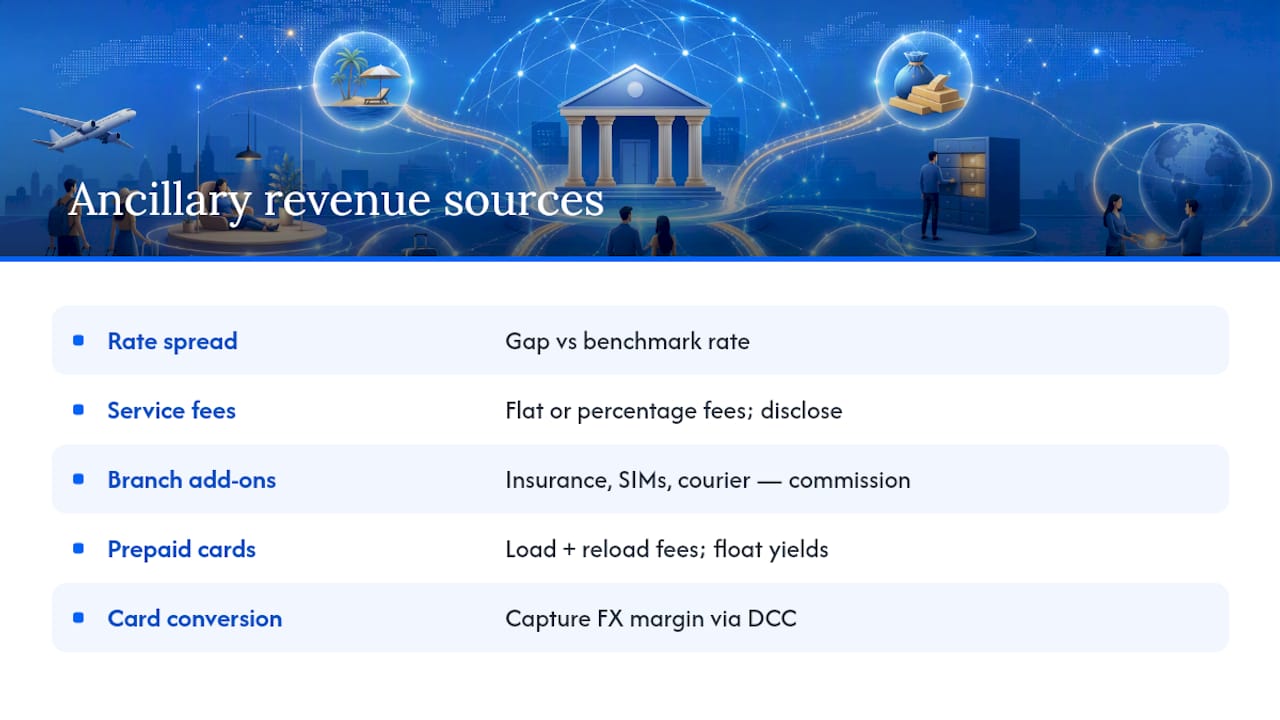
In-branch value-added sales are the next layer. Travel insurance, courier services for document delivery, event ticketing, even SIM cards at airport-adjacent branches: these generate commission income with almost no additional compliance burden, provided the partner handles their own licensing.
Prepaid travel cards deserve special attention because they create two revenue events, not one. You earn on the initial load (often a small percentage fee), then again on reload fees, and the float sitting on unused balances can generate passive yield if you manage liquidity carefully.
Card conversion income works similarly to airline-style dynamic currency conversion. When a foreign cardholder pays in their home currency instead of the local one, you capture the FX margin instead of the card network. One commercial case study on DCC implementation found that operators converting an unused card-transaction stream into captured margin saw material incremental revenue once volume justified the setup cost.
Referral partnerships round out the list. Set these up with clear tracking (unique codes or API callbacks) and a payout structure that's easy to audit monthly.
Pro Tip: Don't launch prepaid card float as a standalone project. Pair it with your existing reload infrastructure so the float accounting rides on transactions you're already logging.
How Do You Price Ancillary Services Without Losing Customers?
Your effective margin on any ancillary line is simple to model: quoted spread plus explicit fee, minus settlement costs, minus chargebacks. Get any one of those wrong and a service that looks profitable on paper bleeds money in practice.
A few pricing rules hold up across most branch networks:
- Use percentage fees for large transactions, flat fees for small ones. A flat $5 fee on a $50 exchange eats the margin; a percentage fee on a $5,000 transfer can look excessive to the customer.
- Tier by transaction size. Offer a lower percentage above a threshold (say, $1,000) to reward larger volume without discounting your baseline.
- Limit the currency pairs you actively push. Airlines running multi-currency pricing programs learned that a narrower, prioritized set of pairs converts better than an exhaustive list. One multi-currency pricing rollout reported 13% uptake in early testing, climbing to a 20% revenue lift after the airline optimized which currencies it offered and how it priced them.
- Write disclosure into the receipt, not just the verbal pitch. Clear line items for "exchange rate applied" and "service fee" cut disputes dramatically compared to bundled pricing.
That same MCP case study found that chargebacks and disputes usually trace back to poor disclosure, not the price itself. A one-line receipt change and a consistent staff script often do more to protect margin than any pricing tweak.
What Compliance Costs Come With New Ancillary Services?
Every currency exchange operator listing services in Lithuania needs to stay on the public register maintained by the Bank of Lithuania, with AML supervision handled jointly by the central bank and the Financial Crime Investigation Service. Adding a new revenue line doesn't always mean a new license, but it often means new reporting obligations.
Some services carry disproportionate compliance weight relative to the margin they generate:
- Money transfers and remittance-style products typically trigger enhanced due diligence thresholds you won't hit with simple cash exchange.
- Crypto-related ancillary products face tightening scrutiny; Lithuanian officials have flagged rising regulatory attention on the crypto-asset sector, meaning extra controls and inspections are likely, not optional.
- Any service requiring EDD workflows adds staffing and audit costs that operators routinely undercount when they first pencil out a new product line.
Before adding a service, estimate the incremental staffing, reporting, and audit cost, then subtract it from projected margin. If the math doesn't clear a meaningful buffer, the service isn't worth the licensing exposure. Practical controls like transaction limits and integration with AML/KYC providers keep exposure contained as you test new lines.
How Should You Measure Ancillary Revenue by Branch?
You can't manage what you don't tag. Ancillary revenue measurement fails most often because transactions get lumped into a single "other income" bucket instead of being attributed to a specific service and branch.
Track these KPIs at minimum:
- Ancillary revenue per transaction — total non-spread income divided by transaction count
- Attach rate — the percentage of core transactions that also generate an ancillary sale
- Average ancillary value — mean revenue per attached sale
- Float balance and yield — outstanding prepaid card balances and the interest they generate
- Chargeback rate — disputes per hundred conversion transactions
Tag each transaction at the point of sale with a service code, branch ID, and staff ID. This lets you run branch-level accounting integration that reconciles automatically instead of requiring manual spreadsheet exports at month end.
Pro Tip: Review branch dashboards weekly during a pilot, not monthly. A service that's underperforming becomes obvious in week two if you're watching daily attach rates, but it hides for months in a quarterly report.
How Do You Pilot a New Ancillary Service Before Rolling It Out?
A structured pilot beats a network-wide launch every time, because it isolates cost from opportunity before you commit staff training budget across dozens of branches.
- Pick two or three pilot branches based on footfall and payment mix, favoring locations with strong card-transaction volume for DCC-style tests.
- Set an 8 to 12 week test window with defined success metrics: minimum attach rate, target margin, acceptable chargeback ceiling.
- Lock in pricing rules, staff scripts, and receipt language before day one so results reflect the offer, not inconsistent execution.
- Monitor KPIs daily for the first two weeks, then weekly, logging every customer complaint and dispute by cause.
- Set a scale threshold in advance — for example, a 10% attach rate with margin above your compliance cost buffer justifies rollout; anything below means iterate or kill the pilot.
What Operators Consistently Get Wrong
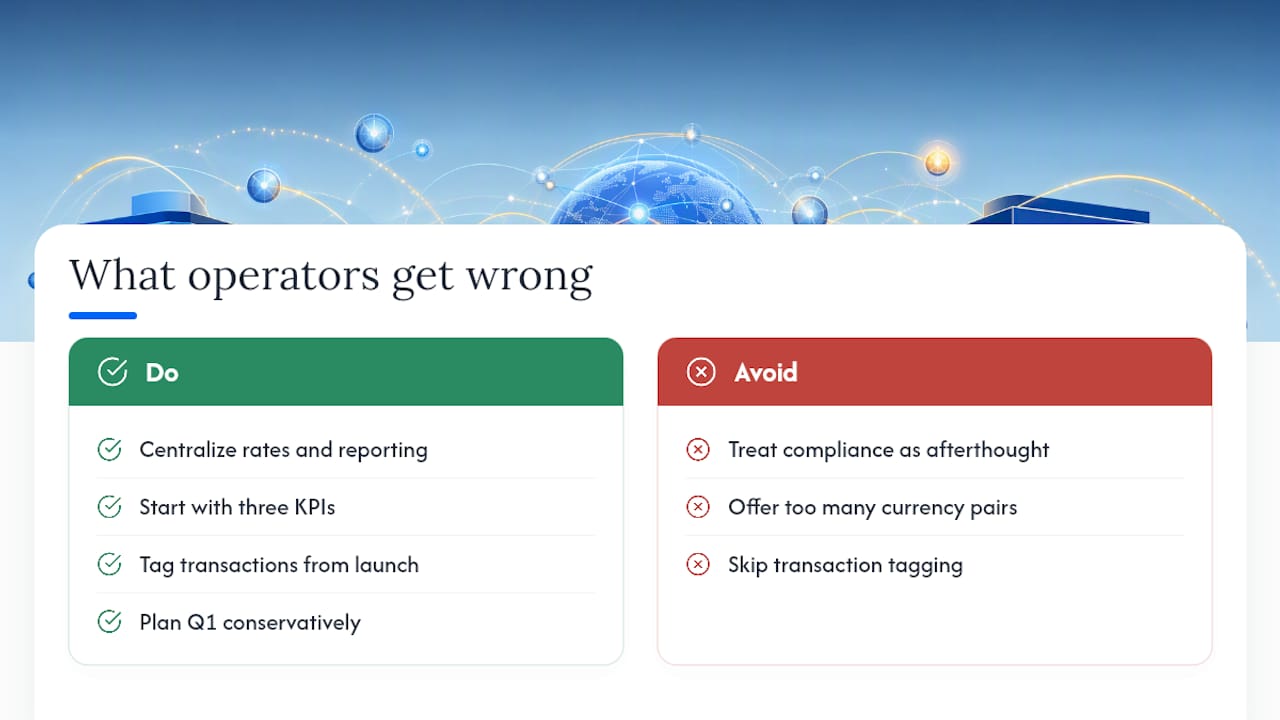
The three mistakes I see repeated across networks: treating compliance cost as an afterthought, offering too many currency pairs instead of the ones customers actually want, and skipping transaction tagging until after launch, which makes attribution nearly impossible to fix retroactively.
Networked operators do better when rate rules and reporting are centralized rather than left to individual branch managers. Start with three KPIs, not ten, and plan your first quarter conservatively. Reality rarely matches the optimistic pilot spreadsheet.
How Currexchanger Supports Ancillary Revenue Rollouts
Everything in this article, from tagging transactions cleanly to keeping compliance costs visible, depends on having systems that don't require a spreadsheet marathon every month. That's the gap Currexchanger is built to close for multi-branch operators.
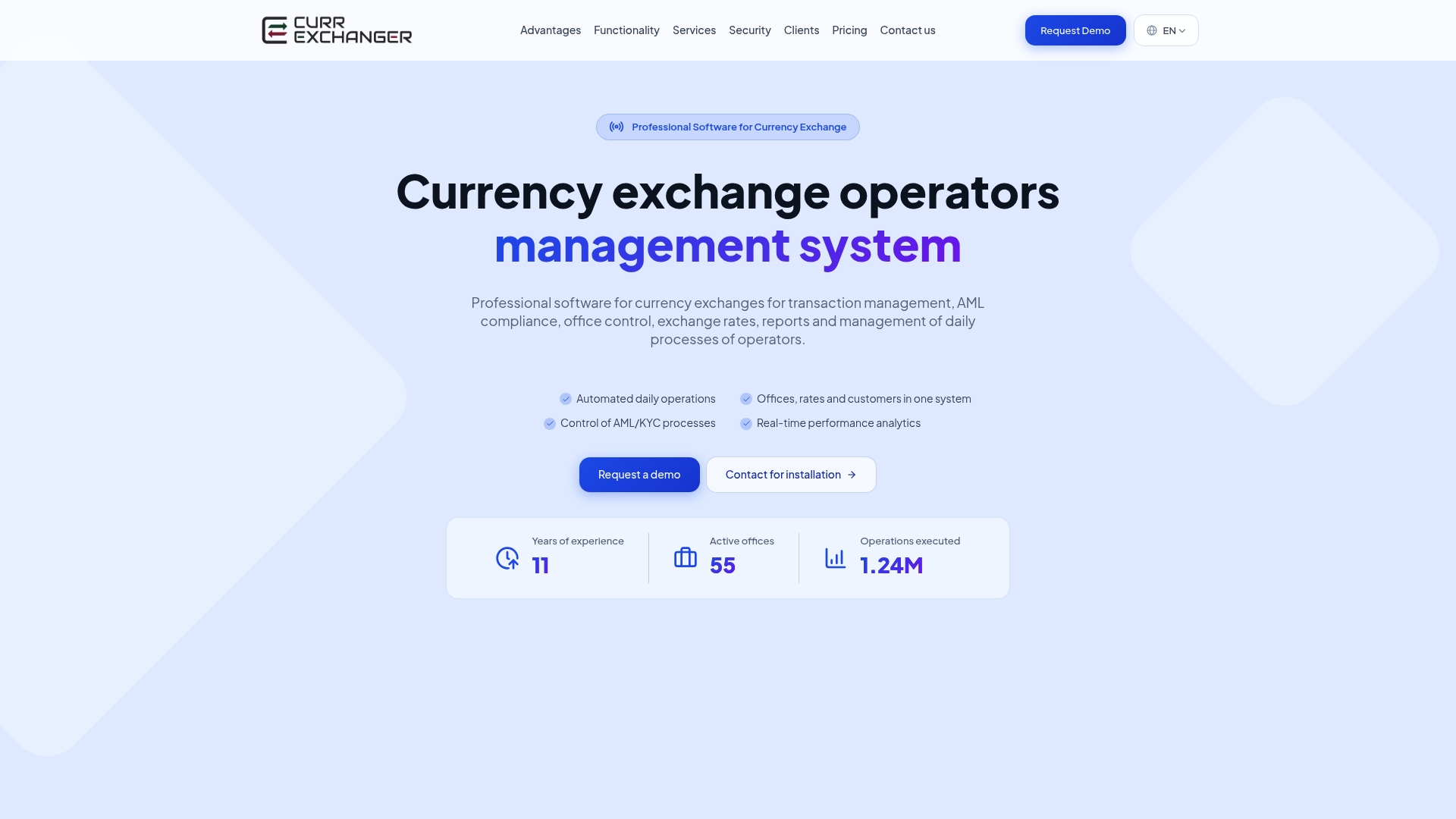
The platform centralizes rate rules across your network so a pricing change at headquarters applies consistently, instead of drifting branch by branch. Transaction tagging happens at the point of sale, feeding directly into real-time dashboards that show attach rate, ancillary revenue per transaction, and chargeback rate by location, without manual reconciliation. Built-in AML/KYC integrations and document verification keep new service lines from becoming a compliance blind spot, and float or prepaid card balances get tracked alongside your core cash positions rather than in a separate system.
If you're running a pilot on prepaid cards or multi-currency conversion, the fastest way to see whether it's actually profitable is to measure it properly from day one. Request a demo of Currexchanger and see how centralized rate control and branch-level reporting would look across your own network.
Where to Verify These Rules
- Bank of Lithuania's currency exchange operator page for licensing and fee details
- Law on Currency Exchange Operators for supervisory scope
- Multi-currency pricing case data for conversion-uptake benchmarks
Sources
- Law on Currency Exchange Operators (Lithuania) — e‑Seimas
- Currency exchange operators — Bank of Lithuania
- Outpayce case study: SriLankan Airlines multi-currency pricing
- Lithuanian Ministry of Finance — notes on crypto-asset sector regulation
FAQ
What Is the Main Source of Ancillary Revenue for Exchange Operators?
Spread and explicit service fees generate the bulk of ancillary income, with prepaid card float and card conversion capture adding a smaller but growing share.
How Does DCC-Style Conversion Generate Revenue for Exchange Offices?
When a foreign cardholder pays in their home currency, the operator captures the FX margin instead of ceding it to the card network, a mechanic commercial DCC case studies show can convert unused transaction volume into direct profit.
Do Ancillary Services Require Additional Licensing in Lithuania?
Not always, but services like remittances or crypto-related products often trigger enhanced due diligence and added AML reporting even without a separate license.
How Long Should an Ancillary Revenue Pilot Run?
An 8 to 12 week window is usually enough to measure attach rate, margin, and chargeback rate before deciding whether to scale a new service network-wide.
Can Software Help Track Ancillary Revenue by Branch?
Yes. Platforms like Currexchanger tag transactions at the point of sale and feed real-time dashboards, which removes the manual reconciliation that makes branch-level attribution unreliable.