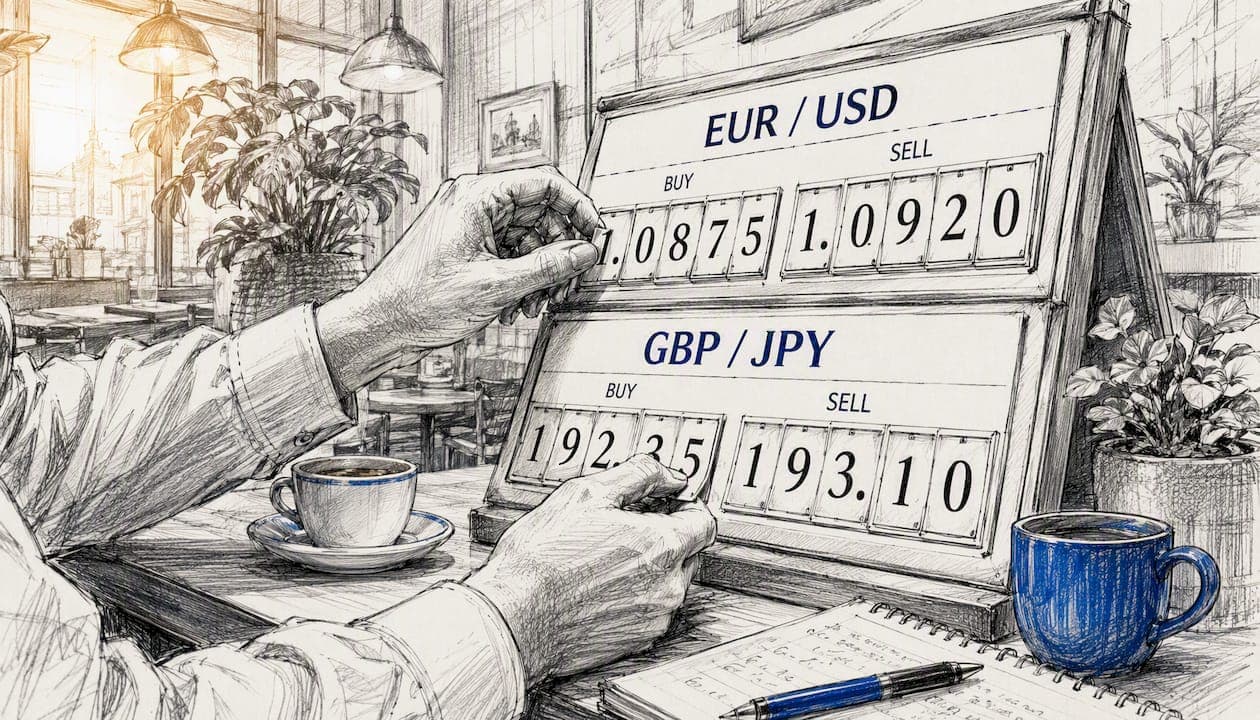
To set up custom exchange rate rules, you need six configured components working together: a rate source (fixed or market-linked), mid-rate handling, buy/sell spread definitions (points or percentage), rounding and denomination rules, branch propagation controls, and an authorization workflow with an immutable audit trail. Get all six right and every branch, counter display, and API endpoint quotes from the same governed rate. Miss one and you get margin leakage, reconciliation mismatches, or rates that drift between channels.
Two measurable outcomes confirm the setup is working: customer-facing rates are identical across all channels at any given moment, and every rate change carries a timestamped record showing the old value, the new value, and the approver's identity. A third signal worth checking early is whether your system offers a sandbox or simulation mode, so you can validate spread calculations before pushing live rates to branches.
Currexchanger supports all of these controls, including per-pair markups, branch propagation toggles, role-based approvals, and a full audit log, within a single rate engine built for multi-branch operators in Central Europe.
Table of Contents
- What do you need before configuring exchange rate rules?
- Which rule types should you implement and when?
- How do you compute buy/sell rates from the mid-rate?
- What operational controls keep rates correct after rollout?
- How do you handle currency pairs without direct market quotes?
- What are the most common operator mistakes and how do you fix them?
- Sample rate rule templates for Central European operators
- Key Takeaways
- Why governed FX rules matter more than operators expect
- Currexchanger gives you a governed rate engine, not just a calculator
- Useful sources
- FAQ
What do you need before configuring exchange rate rules?
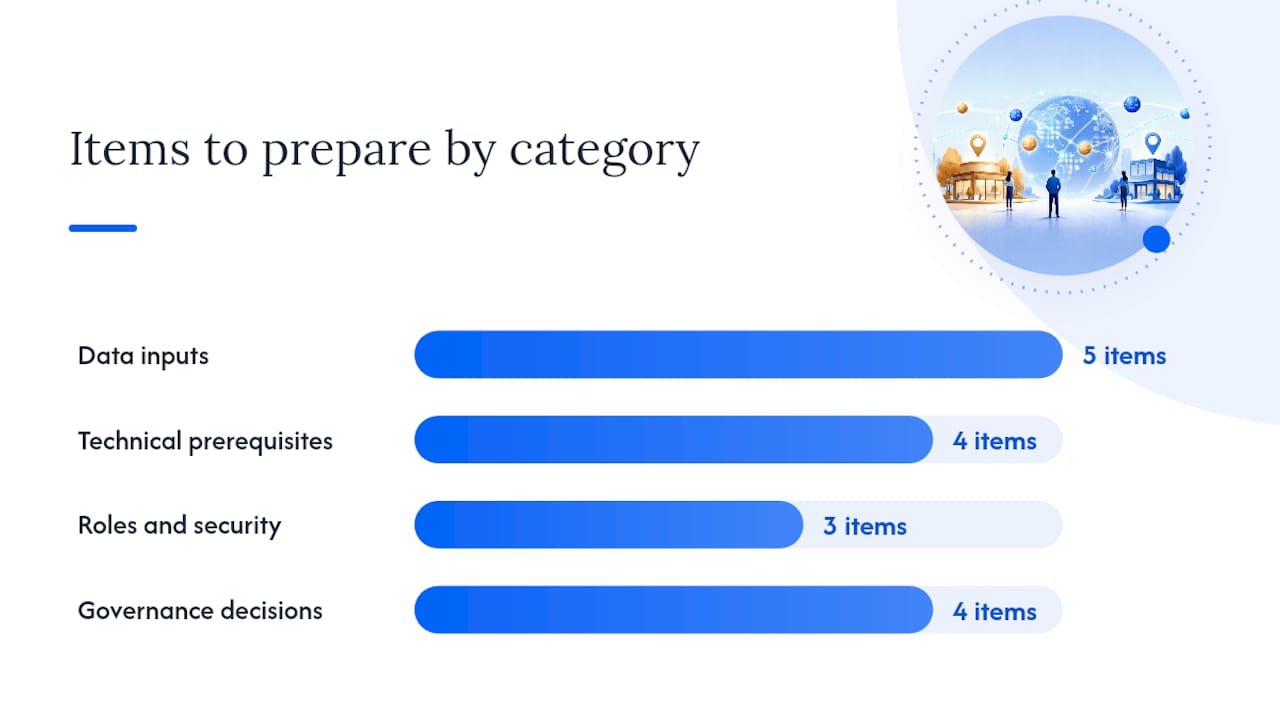
Before touching a single configuration field, collect the inputs that make rules reproducible rather than ad hoc.
Data inputs you must have ready:
- Mid-rate feed credentials (at least one primary feed; a fallback feed for outages)
- Master currency list with ISO 4217 codes for every pair you trade
- Denomination units per currency (e.g., HUF rounds differently than EUR)
- Till and POS identifiers for every branch counter
- Branch list with local base currencies and operating hours
Technical prerequisites:
- Sandbox environment access to test rules before live deployment
- API keys for any distribution endpoints (rate boards, web, POS)
- Reconciliation ledger integration confirmed and tested
- Feed freshness monitoring configured; platforms should warn when a rate source is outdated
Roles and security:
- RBAC roles defined: "rate author" (creates rules), "rate approver" (authorizes changes), "branch manager" (read-only or limited override)
- MFA enforced for all rate-management roles
- IP restrictions set for admin access
Governance decisions to document before you start:
- Universal markup vs per-pair spreads: which pairs get corridor-specific margins?
- Allowed per-trade overrides: who may request them, and what is the approval threshold?
- Rounding policy: round up, round down, or nearest unit?
- Regulatory reporting requirements for your Central European jurisdiction
Pro Tip: Write your governance decisions into a one-page policy document before opening the configuration UI. Operators who skip this step frequently contradict themselves mid-setup and end up with inconsistent rules across pairs.
Which rule types should you implement and when?
Pricing models for retail FX fall into three tiers, and most multi-branch operators use all three simultaneously.
| Rule Type | How It Works | Best For | Watch Out For |
|---|---|---|---|
| Universal markup | One spread applied platform-wide to all pairs | Tourist counters, simple ops, low pair count | Harms competitiveness on high-volume corridors |
| Per-pair (corridor) margin | Spread set per currency pair or route | Differentiated demand, corporate vs retail | Config overhead grows with pair count |
| Per-trade override | One-off rate for a specific deal | High-value corporate transactions | Must require stronger approval; audit every instance |
The markup hierarchy follows a "specific wins" rule: a trade-level override beats a corridor margin, which beats the universal default. This precedence means you can set a conservative universal spread as a floor, then tighten margins on your busiest corridors (EUR/PLN, EUR/HUF, EUR/CZK) without touching every other pair.
Per-trade overrides are where operators most often create compliance exposure. Limit them to named roles, require a business justification field in the approval UI, and log every instance with the approver's identity. Used sparingly and auditably, they are a legitimate commercial tool. Used freely, they erode margins and make reconciliation a nightmare.
How do you compute buy/sell rates from the mid-rate?
The standard formulas for direct quotation (domestic per foreign unit):
Buy Rate = Mid-rate − Buy Spread Sell Rate = Mid-rate + Sell Spread
For indirect quotation (foreign per domestic unit), the signs reverse. Most Central European operators work in direct quotation for retail counters.
Spread definitions:
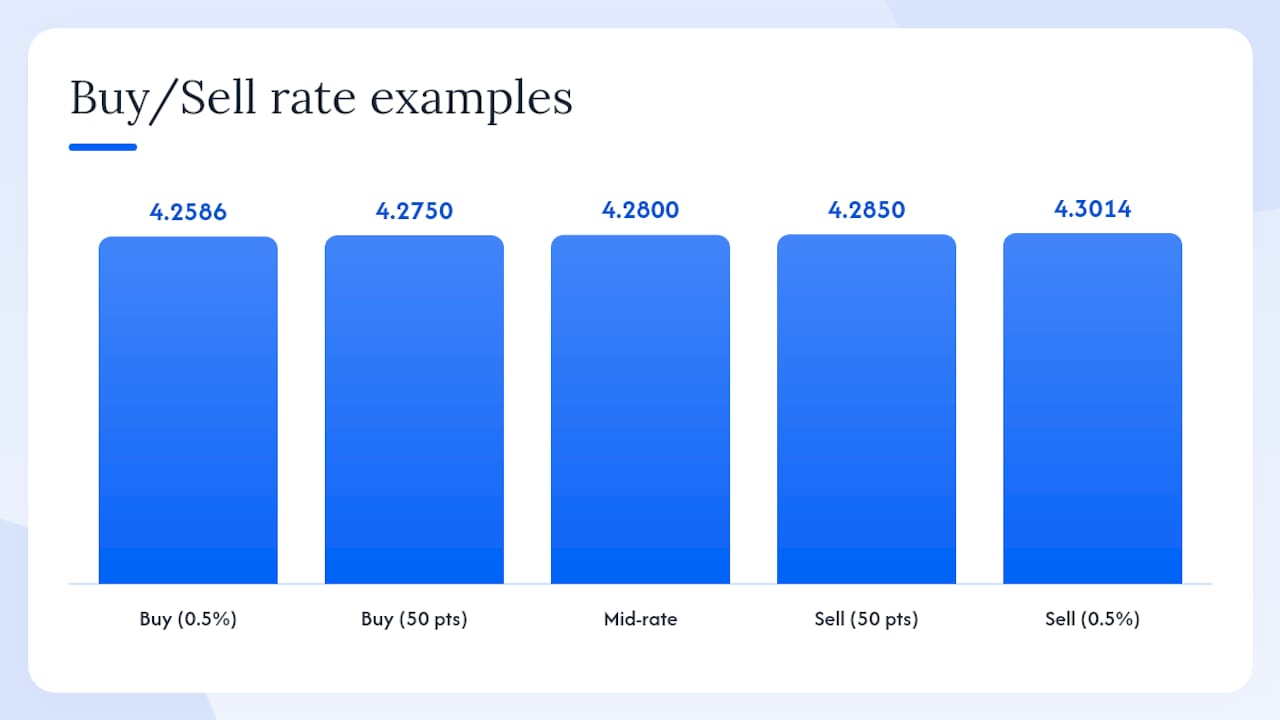
- Points: Spread = Points value × Multiplier. A mid-rate of 4.2800 HUF/EUR with a 50-point spread (multiplier 0.0001) gives a buy of 4.2750 and a sell of 4.2850.
- Percentage: Spread = Mid-rate × Spread%. A 0.5% spread on a 4.2800 mid-rate gives ±0.0214, so buy = 4.2586, sell = 4.3014.
Points work well for major pairs with tight, stable spreads. Percentage spreads are easier to govern when margins are set as a business policy (e.g., "never less than 0.4% on any pair") because the absolute spread scales automatically with the mid-rate.
Rounding matters more than most operators expect. A rounding rule that always rounds customer-facing totals up on sells and down on buys adds a small systematic gain per transaction. Across hundreds of daily trades, that accumulates. Document the rounding direction in your policy and confirm it matches your denomination unit per currency.
Pro Tip: Log both the computed rate and the spread basis (points or percent) in every rate-change record. If a compliance query arrives six months later, you need to reconstruct the exact calculation, not just the final number.
What operational controls keep rates correct after rollout?
Monitor these signals daily:
- Feed staleness: alert if the market feed has not refreshed within your configured threshold
- Margin erosion: flag any pair where the realized spread falls below the policy minimum
- Outlier trades: trades settled more than a defined tolerance from the quoted rate
- Failed propagation: branches that did not receive the latest rate push
- Reconciliation mismatches: executed amounts that do not match quoted client totals
Audit requirements are non-negotiable for Central European regulators. Every rate change must produce an immutable record showing the old value, the new value, the time of change, and the identity of both the author and the approver. Authorization fields should display old and new values side by side so approvers can see exactly what they are signing off on.
Rate history is not a nice-to-have audit feature. In a regulatory examination, the ability to reconstruct the exact rate a customer received on a specific date, and show which policy produced it, is the difference between a clean review and a remediation order.
Security controls: rate authors and approvers must use MFA. Admin access should be IP-restricted to office networks or VPN. Activity logs should capture every login, every rule view, and every change attempt, including failed ones.
How do you handle currency pairs without direct market quotes?
For illiquid pairs, through-currency routing composes a rate from two market quotes via a common third currency, most often USD.
Fallback priority list:
- Direct market quote from primary feed
- Direct quote from secondary/backup feed
- Fixed internal rate (manually entered, time-stamped)
- Last-known-good rate (with staleness flag visible to the teller)
- Admin override (requires elevated approval)
When through-currency routing is active, some spread definition fields are disabled at the pair level because the spread is inherited from the two component pairs. For example, routing ZAR/INR via USD means the system uses the ZAR/USD spread and the USD/INR spread; a separate ZAR/INR spread field cannot be set independently. Understand this constraint before configuring exotics. A currency transfer calculator can help you verify the composed rate manually before activating through-currency routing in production.
What are the most common operator mistakes and how do you fix them?
| Symptom | Likely Cause | Quick Fix |
|---|---|---|
| Displayed quote ≠ executed amount | Markup not persisted from quote to execution | Persist rate token; assert at settlement |
| Branch showing stale rate | Propagation failed or toggle set to branch-maintain | Force branch sync; check API health and permissions |
| Margin below policy minimum | Rounding direction eroding spread | Review rounding rule; adjust spread to compensate |
| Reconciliation drift accumulating | Denomination rounding inconsistency | Align denomination unit across all rule templates |
| Override used without audit trail | Override role not gated by approval workflow | Restrict override role; require justification field |
When escalating to finance or compliance, include in your support ticket: rule ID, pair, effective timestamp, old rate, new rate, feed source name, and the approver's user ID. That set of fields covers most regulatory and internal audit queries without back-and-forth.
Sample rate rule templates for Central European operators
| Field | Universal Markup | EUR/USD Corridor | Corporate Override |
|---|---|---|---|
| Base currency | Any | EUR | EUR |
| Quote currency | Any | USD | HUF |
| Mid-rate source | Market feed (primary) | Market feed (primary) | Market feed (primary) |
| Spread type | Percentage | Percentage | Points |
| Spread value | 0.5% | 0.4% | 50 points |
| Rounding rule | Round to 2 decimal places | Round to 4 decimal places | Round to nearest 1 HUF |
| Propagation | HO push, all branches | HO push, all branches | Branch-level, named counter |
| Approval required | Rate approver | Rate approver | Senior approver + justification |
Deploy the universal markup template first as your safety floor. Then layer the EUR/USD corridor template on top; the "specific wins" precedence means it overrides the universal rate for that pair automatically. The corporate override template should be tested with a single named teller before any branch-wide activation.
For each template, run one test transaction in the sandbox at a known mid-rate and verify the customer-facing total matches your manual calculation before promoting to production.
Key Takeaways
Reproducible retail FX pricing requires configured rate sources, spread definitions, rounding rules, branch propagation, and an authorization workflow with an immutable audit trail working as a single governed system.
| Point | Details |
|---|---|
| Define governance first | Document universal vs per-pair markup policy and rounding rules before opening the configuration UI. |
| Use the "specific wins" hierarchy | Universal markup sets the floor; corridor margins and trade overrides take precedence when configured. |
| Persist markup from quote to execution | The rate token from the quote stage must match the settled rate exactly to prevent reconciliation drift. |
| Audit trail is a regulatory requirement | Every rate change needs old value, new value, timestamp, and approver identity in an immutable log. |
| Currexchanger centralizes all controls | The platform covers per-pair markups, branch propagation toggles, RBAC, sandbox testing, and audit logs in one system. |
Why governed FX rules matter more than operators expect
Most operators who struggle with margin leakage or reconciliation problems are not making pricing errors. They are making governance errors: rates configured in one place but distributed from another, overrides applied without logging, rounding rules that differ between the counter system and the API feed. The pricing math is usually fine. The infrastructure around it is not.
The operators who run clean audits and tight margins share one habit: they treat their rate configuration as infrastructure, not as a daily task. They define a scheme once, test it thoroughly, lock down who can change it, and then monitor the outputs rather than the inputs. When something drifts, the audit trail tells them exactly where it broke and who touched it last.
Documenting your rate policy and keeping a change log tied to approvals is not bureaucracy. It is the only way to answer a regulator's question about a specific transaction from eight months ago in under ten minutes.
Currexchanger gives you a governed rate engine, not just a calculator
Rate configuration without governance infrastructure is just a spreadsheet with extra steps. Currexchanger is built specifically for multi-branch currency exchange operators who need the full stack: a central scheme engine with per-pair markups and per-trade overrides, branch propagation toggles for HO-push or branch-maintain workflows, RBAC with MFA and IP restrictions, a sandbox for pre-live testing, and an immutable audit log that shows old and new values at every authorization step.

The platform also connects to your accounting and AML/KYC systems, so rate events flow directly into reconciliation and compliance reporting without manual export. For operators scaling across multiple offices, that integration removes the biggest source of operational rework as branch count grows.
Request a demo at currexchanger.com to see the rate engine, sandbox mode, and audit trail in a live walkthrough.
Useful sources
- Maintain Currency Exchange Rates
- Maintain Currency Pair
- Currency Exchange Software | Set & Sell FX Rates | Remitz
- FX Markup Functionality
- Corefy — Currency conversion
FAQ
What is the minimum setup needed to configure exchange rate rules?
You need a rate source, a mid-rate, buy/sell spread definitions, a rounding rule, and at least one authorization role assigned before any rule can be published safely.
How does through-currency routing work for illiquid pairs?
The system composes the rate for an illiquid pair by chaining two quotes through a common third currency, typically USD; some pair-level spread fields are disabled when this routing is active.
What should an audit trail for rate changes include?
Every change record must show the old rate, the new rate, the effective timestamp, the rate author's identity, and the approver's identity, stored in an immutable log.
How does Currexchanger handle branch propagation?
Currexchanger supports both HO-push (head office distributes rates to all branches) and branch-maintain modes, controlled by a propagation toggle at the scheme level.
How do you prevent a quoted rate from differing from the settled rate?
Persist the rate token generated at the quote stage and pass it unchanged to the execution stage; assert that both values match during reconciliation to catch any markup drift.