
The fastest way to reduce operational costs in a multi-branch currency business is to centralize transaction control, treat each currency as inventory, and automate cash reconciliation so your tills connect directly to accounting. Operators who do this first typically see the largest gains: fewer staff hours on end-of-day close, fewer pricing errors, and less idle capital locked in low-turnover currencies.
Start here — four levers you can act on within 30–90 days:
- Automate daily close and reconciliation. Replace manual end-of-day entry with straight-through posting from till to accounting. You can cut daily-close time by as much as 80% compared to fully manual workflows.
- Enable inventory-based pricing. Use an average-cost engine to set real-time minimum sale prices per currency, so no branch sells below acquisition cost during a market drop.
- Test virtual or centralized accounts. Consolidate physical bank accounts under a single multi-currency structure to reduce account management overhead and improve liquidity visibility.
- Redeploy staff. Once reconciliation is automated, shift teller time toward customer service and margin management rather than data entry.
Start with one pilot branch, connect it to your accounting system, and measure hours saved and reconciliation errors over 30 days before scaling.
Table of Contents
- What operational levers actually cut costs across branches?
- How do Central Europe's regulatory constraints drive up your costs?
- Which software capabilities directly reduce your operating costs?
- How do you pilot and scale without disrupting operations?
- How do you model the ROI before committing?
- Why Currexchanger fits the requirements described here
- Key Takeaways
- Why automation is now table stakes for Central Europe operators
- Currexchanger: start a pilot in 30–90 days
- Useful sources
- FAQ
What operational levers actually cut costs across branches?
The biggest cost lines in a multi-branch currency operation are labor (daily close, reconciliation, compliance checks), cash carrying costs (idle capital in low-demand currencies), and error-driven losses (mispriced transactions, shrinkage, manual entry mistakes). Each has a direct software fix.

Automation of daily close. Manual reconciliation is where most operators bleed hours. Accounting integration that posts transactions straight through to your ledger eliminates duplicate data entry and removes the human error layer entirely. The daily close becomes a confirmation step, not a two-hour rebuild.
Treat currency as inventory. This is the paradigm shift that changes everything. When each currency is modeled as physical stock with a weighted average acquisition cost, you can calculate the real profit margin on every transaction, separate from market fluctuation gains or losses. You also get automatic minimum-price controls: the system blocks a sale below cost, protecting the business during sudden rate moves. Cash inventory tracking at counter and vault level makes this possible.
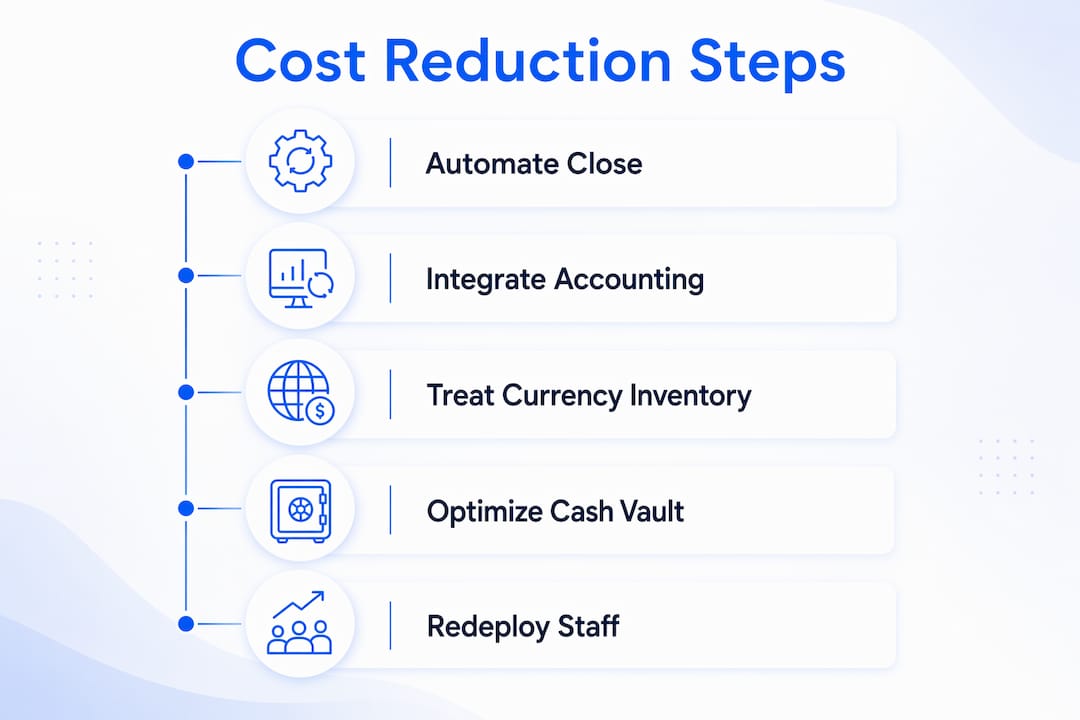
Cash and vault optimization. Demand-based replenishment across branches frees capital tied up in currencies that rarely turn over. Virtual account structures reduce the number of physical bank accounts and the overhead that comes with managing them. One European group cut payment servicing costs significantly after consolidating accounts onto a single platform.
Staff redeployment. After automation, the hours recovered from reconciliation and compliance data entry should go toward margin management and customer-facing work, not just headcount reduction. That reallocation is where the second wave of value comes from.
Pro Tip: Sequence matters. Connect accounting integration before enabling inventory pricing. If your ledger isn't receiving automated postings, minimum-price controls will generate reconciliation gaps that are harder to fix mid-rollout than at the start.
How do Central Europe's regulatory constraints drive up your costs?
Central Europe operators face a specific set of pressures that generic cost-reduction advice ignores. Understanding them shapes every software decision.
T+1 settlement and non-CLS currencies. Europe's move toward T+1 settlement compresses the window for reconciliation and error correction. For currencies outside the CLS settlement system, which includes several Central European currencies, the risk of a failed settlement from a manual process error is real and growing. Automation is no longer a nice efficiency project; it's a systemic risk control.
EBA/CRD6 booking arrangements. The EBA's final RTS on booking arrangements under CRD6 requires group-level governance while allowing branches to use group-wide systems, provided local risk management and oversight can be evidenced. Your software must support both modes simultaneously: centralized reporting and branch-level configurability.
The AML/KYC harmonization paradox. EU-level harmonization raises the expectation of common rules, but local enforcement and reporting formats still vary by jurisdiction. The AMLR groupwide RTS requires groupwide policies, documentation, and the ability to escalate branch-level compliance failures. Software that can't adapt per branch forces large manual compliance teams.
Regulatory callout: Multi-jurisdictional expansion raises hidden operational costs; technology architecture must be designed for multi-jurisdictional requirements from the start, not retrofitted after growth.
Practical mitigations:
- Configure local AML/KYC rules per branch without rebuilding the group policy.
- Maintain full audit trails and standardized SAR/STR templates in the platform.
- Build contingency steps for fines into your ROI model — regulatory risk avoidance is a real cost line.
Which software capabilities directly reduce your operating costs?
Not every feature in a currency platform saves money. These are the ones that do.
Core functional checklist:
- Average-cost engine with real-time minimum-price controls
- Counter and vault-level cash inventory tracking
- Automated daily close with straight-through accounting posting
- Centralized exchange-rate control with per-branch override permissions
- Inter-branch transfer workflows for demand-based replenishment
- AML/KYC connector integrations and automated compliance reporting
- Offline mode for branch continuity during connectivity failures
Integration requirements:
| Integration | Cost impact |
|---|---|
| Accounting ERP (straight-through posting) | Eliminates manual close; cuts reconciliation errors |
| Bank / virtual account APIs | Reduces physical accounts; improves liquidity visibility |
| AML/KYC providers | Automates screening; reduces manual compliance hours |
| Banknote verification hardware | Cuts shrinkage and counterfeit losses |
| POS / till systems | Single source of truth for rates and transactions |
| Payment rails | Supports cross-border payment automation and settlement speed |
Security and compliance requirements: Multi-factor authentication, branch-level role permissions, IP and geographic restrictions, immutable activity logs, and audit-ready reporting aligned to EBA/CRD6 requirements.
Pro Tip: The accounting integration delivers the highest ROI of any single integration. Straight-through posting plus automatic daily revaluation removes the most labor-intensive manual step and eliminates the error class that causes the most reconciliation rework.
How do you pilot and scale without disrupting operations?
A phased rollout reduces risk and gives you real data before committing group-wide.
- Select a pilot branch. Choose a mid-volume branch with a cooperative manager and a clean accounting setup. Define success metrics upfront: hours saved on daily close, reconciliation error count, cash variance percentage.
- Run data mapping and integration tests. Map existing transaction data to the new system. Test accounting integration in a sandbox before go-live. Confirm POS/till connectivity and AML provider sandbox access.
- Train staff before go-live. A two-day training plan covering the new daily-close workflow and inventory pricing rules is enough for most tellers. Compliance staff need a separate session on the AML/KYC connector and audit trail navigation.
- Measure for 30–90 days. Track the defined KPIs weekly. Set a rollback checkpoint at day 30 if variance or error rates increase.
- Scale by cluster. Group branches by geography or volume tier and roll out in waves. Scaling operations effectively means each wave benefits from the lessons of the last.
Pilot checklist before go-live:
- Accounting integration tested end-to-end
- Inventory pricing rules configured and verified
- AML/KYC connector live in sandbox
- Staff training completed and signed off
- Rollback plan documented
"An 80% reduction in cash close and reconciliation time is achievable when currencies are modeled as inventory and the counter connects directly to accounting — the daily close becomes a confirmation step, not a rebuild." — COBIZ ERP case study
For contingency planning: if a currency shock or regulatory change hits mid-rollout, the ability to revert branch-level pricing rules centrally, without touching the group policy, is the control that prevents a compliance gap from becoming a fine.
How do you model the ROI before committing?
Use this sample framework to build your own business case.
| Input | Conservative | Aggressive |
|---|---|---|
| Staff hours/day on reconciliation | 3 hrs × 2 staff | 4 hrs × 3 staff |
| Hourly labor cost | €20 | — |
| Break-even | ~9 months | ~4 months |
- Calculate labor savings first. Hours saved on daily close multiplied by hourly cost gives the clearest, most defensible number for leadership.
- Add error and fine avoidance. Regulatory fines and manual-entry errors are real cost lines; even a conservative estimate strengthens the case.
- Include capital freed from inventory optimization. Reducing idle stock in low-turnover currencies releases working capital.
- Track post-implementation KPIs: daily-close time, reconciliation error count, cash variance percentage, inventory turnover per currency, and capital freed.
Why Currexchanger fits the requirements described here
Currexchanger is built specifically for multi-branch currency exchange operators. Its feature set maps directly to the cost-reduction checklist above.
Functional coverage:
- Average-cost engine and inventory-based minimum-price controls
- Automated daily close with straight-through accounting integration
- Centralized exchange-rate control with branch-level configurability
- Inter-branch transfer workflows and cash inventory tracking
- AML/KYC provider integrations and automated compliance reporting
- Banknote verification hardware connectors and POS/till integration
- Offline mode for branch continuity
Security and compliance:
- Multi-factor authentication, IP and geographic restrictions
- Immutable activity logs and audit-ready reporting
- Branch-level role permissions aligned to EBA/CRD6 group oversight requirements
Deployment model: Subscription-based, with modules priced per branch and integration tier. That structure means you pay for what you deploy, and the ROI model above applies directly from month one of the pilot.
Pro Tip: Request that the accounting integration and inventory pricing modules are both active during the pilot. Running them together from day one gives you the clearest before/after comparison on daily-close time and margin visibility.
Key Takeaways
Automating reconciliation and treating currencies as inventory are the two highest-impact changes a multi-branch currency operator can make to cut day-to-day operating costs.
| Point | Details |
|---|---|
| Automate daily close first | Straight-through accounting posting cuts reconciliation time and removes the largest manual error source. |
| Treat currency as inventory | An average-cost engine reveals real margin per transaction and enforces minimum-price controls automatically. |
| Test virtual accounts early | Consolidating physical bank accounts reduces overhead and improves liquidity visibility across branches. |
| Configure per branch, govern centrally | EBA/CRD6 requires group oversight with local adaptability; software must support both simultaneously. |
| Currexchanger covers the full checklist | Inventory engine, automated close, AML connectors, MFA, and branch-level config are all in one platform. |
Why automation is now table stakes for Central Europe operators
The operators I see struggling most are not the ones with bad processes. They are the ones with processes that worked fine at two branches and quietly became unmanageable at six. T+1 settlement compresses the error-correction window to near zero for non-CLS currencies. The AMLR groupwide RTS adds documentation and escalation obligations that a spreadsheet-based compliance workflow simply cannot meet at scale. And margin compression in retail FX means the spread you earn per transaction is thinner than it was three years ago, so every hour of unnecessary manual labor is a larger percentage of your actual profit.
The fix is not complicated. Fix reconciliation first. Then enforce inventory pricing so no branch sells below cost. Then centralize reporting while keeping local rule configurability. Those three steps, in that order, address the three biggest cost drivers simultaneously. The technology to do all of it exists and is available to Central Europe operators today.
For deeper reading on the regulatory side, Bartas has covered currency trading risk and compliance reporting automation in detail on the Currexchanger blog.
Currexchanger: start a pilot in 30–90 days
Running five branches manually while watching your reconciliation hours grow is a solvable problem. Currexchanger offers a structured pilot that proves the cost reduction in your own operation before any group-wide commitment. In 30–90 days, a single-branch pilot with accounting integration active will show you the exact hours saved on daily close, the margin visibility you gain from inventory pricing, and the compliance audit trail your regulators expect.
The platform includes MFA, IP restrictions, and immutable activity logs from day one, so compliance credentials are in place before you scale. Pilot support is included, with dedicated onboarding for ops, finance, and compliance teams.
Request a demo or contact the Currexchanger team to scope a pilot for your operation.
This article is general information for currency exchange operators and does not constitute legal, financial, or regulatory advice. Confirm current rules with the relevant regulatory authority or a qualified professional for your specific situation.
Useful sources
Primary regulatory and market sources:
- EBA Final Report on draft RTS for booking arrangements (CRD6) — group oversight and branch-level flexibility requirements under CRD6.
- T+1 Europe: the next big test for global FX operations (Citigroup) — operational urgency of T+1 adoption and automation requirements.
- EU: Turning AMLR into practice — Draft RTS on groupwide requirements (Conventus Law) — AMLR groupwide obligations and documentation requirements.
- IWG opts for a European virtual account structure (Treasury Today) — virtual account case study showing cost reduction from account consolidation.
- Payment automation benefits for banks and fintechs (Cray Finance) — payment automation approaches that reduce treasury overhead.
Currexchanger blog posts for continued execution:
- Currency Exchange Accounting Integration Benefits Explained
- How to Scale Currency Exchange Operations Effectively
- Currency Exchange Reporting Requirements 2026: Key Rules
FAQ
What is the single fastest way to reduce costs in a currency exchange?
Automating the daily close with straight-through accounting integration removes the largest block of manual labor in most operations and is the fastest single change to implement.
How does treating currency as inventory reduce operational costs?
An average-cost engine calculates real profit per transaction and enforces minimum-price controls automatically, preventing loss-making sales and eliminating the manual margin-checking step.
What does T+1 settlement mean for Central Europe operators?
T+1 compresses the reconciliation window to one business day, making manual processes a systemic settlement risk, especially for non-CLS currencies common in Central Europe.
Does Currexchanger support EBA/CRD6 group oversight requirements?
Currexchanger supports centralized reporting with branch-level configurability, MFA, immutable activity logs, and role-based permissions, aligning to the group oversight and local adaptability requirements of EBA/CRD6.
How long does a pilot typically take to show measurable results?
A 30–90 day single-branch pilot with accounting integration and inventory pricing active is enough to measure daily-close time savings, reconciliation error reduction, and margin visibility improvements.