
Currency business performance tracking is the systematic process of measuring financial results while neutralizing the distorting effects of exchange rate movements. The standard industry method for doing this is constant currency reporting, which recalculates prior period figures using fixed exchange rates so that period-over-period comparisons reflect operational reality rather than forex noise. For Central European multinationals reporting under IFRS or US GAAP, this distinction is not academic. A Czech subsidiary posting 12% revenue growth in CZK can look flat or even negative once consolidated into euros during a period of koruna weakness, even though nothing changed operationally.
Currency business performance tracking covers three core components:
- Constant currency adjustment: Recalculating prior period results at current period exchange rates to isolate operational movement
- FX impact quantification: Measuring the translation and transaction effects separately from volume, price, and mix
- Exposure identification: Mapping which revenue streams, cost lines, and balance sheet items carry currency risk under IAS 21
The goal is straightforward: give boards and managers a number they can actually act on.
How constant currency reporting works in practice
Constant currency reporting recalculates one period's results using the exchange rates from another period, so the comparison is free of rate movement. The calculation is conceptually simple: multiply the current period's foreign currency result by the base period's exchange rate, then compare that figure to the base period's reported result.
Constant Currency Value = (Current Period Result in Foreign Currency) × (Base Period Exchange Rate)

A worked example makes this concrete. Suppose a Polish subsidiary generated €100M in revenue last year when the EUR/PLN average rate was 4.30, and €108M this year when the rate moved to 4.55. The as-reported growth appears sizable due to currency movement, but recalculating using a fixed exchange rate shows the actual operational growth was significantly lower, with the remainder attributable to currency effects.
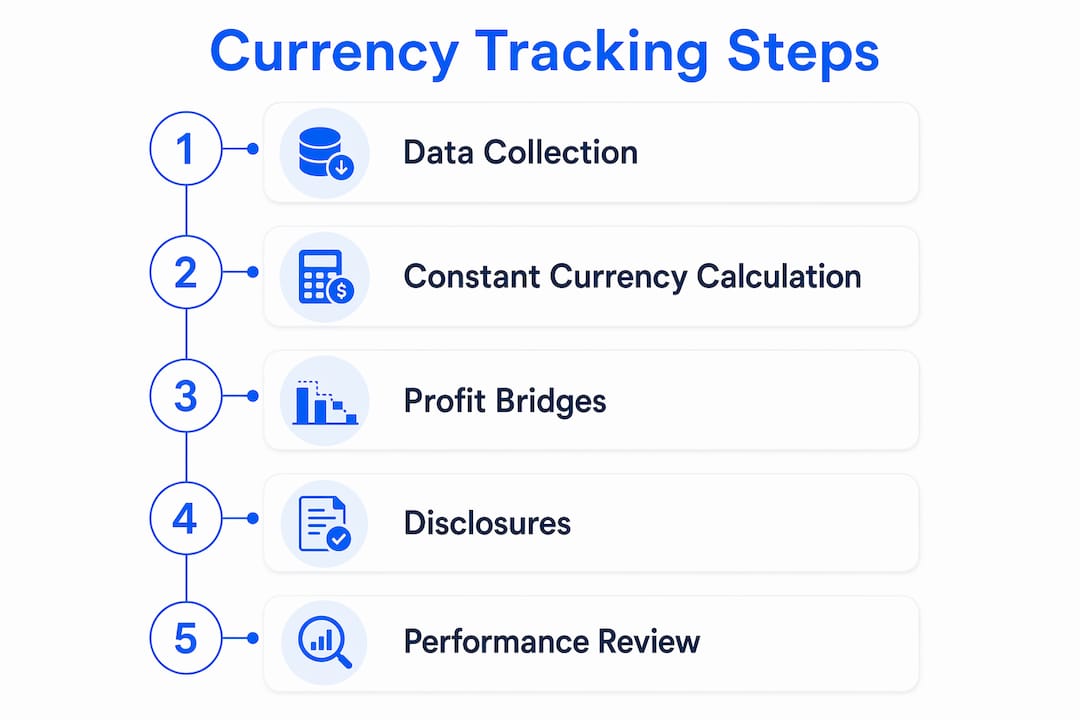
The stepwise methodology most finance teams follow:
- Identify the base period exchange rate (prior year average is the most common choice)
- Translate current period foreign currency results at that base rate
- Compare the constant currency figure to the base period's reported figure
- Report both the as-reported and constant currency figures side by side for transparency
- Disclose the methodology and rate source in the notes
Profit bridges extend this further by separating currency effects from volume, price, variable cost, and mix changes in a single waterfall view. Academic research on profit bridge methodology formalizes this decomposition, defining distinct impact terms for quantity (IQG), price (IPG), variable cost (IVG), mix (IMG), and exchange rate (IEG) at both corporate and business unit levels.
Pro Tip: Always disclose which period's rates you used as the base and whether you applied average or closing rates. Switching methodology between periods is one of the fastest ways to lose investor trust.
Why constant currency reporting improves business performance evaluation
The clearest benefit is that it separates what management controls from what it does not. Currency rates are exogenous. Volume, pricing, and cost management are not. Mixing them in a single reported figure makes it nearly impossible to evaluate a regional manager fairly or to set credible targets for the next planning cycle.
Constant currency metrics complement, rather than replace, GAAP and IFRS figures. Reported numbers govern fiduciary evaluations and cash flow analysis. Constant currency numbers reveal operational trends. Institutional investors analyzing growth almost always look at the constant currency figure first, then reconcile back to reported results to understand the FX component.
Key benefits for Central European multinationals:
- Period-over-period comparability: Locks the rate so revenue trends reflect real business movement, not rate swings between the Hungarian forint, Czech koruna, or Polish zloty and the euro
- Investor transparency: Boards can distinguish genuine market expansion from currency tailwinds, avoiding strategic missteps built on inflated growth numbers
- Internal accountability: Regional managers are evaluated on local currency performance, not on rate movements outside their control
- Forecasting accuracy: Planning teams can model volume and price scenarios without embedding FX assumptions into operational targets
- Compliance alignment: Constant currency disclosures sit alongside statutory IFRS figures, satisfying both internal governance and external reporting requirements
One practical illustration: a Slovak distributor reporting in euros with significant USD-denominated import costs could show margin compression in a strong-dollar year even while improving its operational efficiency. Without constant currency analysis, the board sees margin decline. With it, they see the FX headwind separately and can decide whether to hedge, reprice, or absorb it.
Common challenges when tracking currency business performance
The biggest operational trap is using a single exchange rate for the entire P&L. Translating the full income statement at the month-end closing rate rather than the average rate systematically overstates or understates every line item depending on the direction of currency movement, and the error compounds across a full year.
Other challenges finance teams in Central Europe regularly encounter:
- Rate source inconsistency: Different subsidiaries pulling rates from different sources (ECB, Reuters, local central banks) on different days creates reconciliation headaches and audit risk
- Translation versus transaction confusion: Translation exposure (converting a foreign subsidiary's financials to the parent currency) is an accounting entry with no cash impact. Transaction exposure (paying a supplier invoice in a foreign currency) is real cash. Treating them identically in management reports obscures where the actual risk sits
- Incentive misalignment: Holding regional managers accountable for consolidated currency-adjusted results penalizes them for rate movements they cannot influence
- Non-cash nature of translation adjustments: The cumulative translation adjustment sitting in equity under IAS 21 grows over time. If no one tracks which entities and periods drive it, auditors will question it and investors will discount it
- Hedging cost opacity: Hedging reduces FX volatility but produces real costs. Adjusted EPS that strips out FX impact without accounting for hedging costs overstates true normalized earnings
Regulatory complexity adds another layer. Central European companies operating across EU and non-EU jurisdictions often face different functional currency determinations under IAS 21 for each entity, requiring careful documentation of which currency governs each subsidiary's primary economic environment. Getting that determination wrong flows through to every subsequent translation calculation.
How to implement currency performance tracking in management reporting
Start with a documented translation policy before touching any software. The policy should specify which rate source is authoritative (ECB daily reference rates are the most defensible choice for euro-zone reporting), whether average or closing rates apply to each P&L line, and how often the rate table is updated. A single source of truth for exchange rates, applied consistently across all entities and periods, is the foundation that determines whether the whole program works.
Implementation steps for a management reporting framework:
- Build an FX exposure register: List every revenue stream, cost line, and balance sheet item by currency, tagged as contracted, highly probable, or anticipated. This is the artifact every credible currency risk program is built on
- Integrate rate tables into your reporting model: Whether you use SAP, Oracle, or a well-structured Excel model, the rate table must feed every entity's translation automatically rather than being entered manually per report
- Design a constant currency reporting template: Show as-reported figures, the constant currency equivalent, and the FX impact as a separate line for each major P&L metric
- Build an FX bridge waterfall: A waterfall chart reconciling prior period revenue to current period revenue, with FX broken out as its own bar, gives boards immediate visual clarity on what drove the change
- Align incentives with local currency results: Measure regional managers in their local currency. Manage the consolidated FX exposure centrally, not through regional P&Ls
Currexchanger supports this framework directly. Its currency position tracking capabilities give finance teams real-time visibility into open positions across multiple branches, while its reporting module generates the rate-consistent transaction records that feed constant currency calculations without manual reconciliation.
Pro Tip: Align regional performance incentives with local currency results and manage consolidated FX exposure centrally. Penalizing a Warsaw branch manager for euro weakness against the zloty destroys accountability and distorts the data you need to make good hedging decisions.

For teams assessing portfolio-level currency risk alongside operational tracking, a portfolio risk calculator can help quantify exposure before committing to a hedge policy.
Best practices for Central European multinationals in 2026
Central Europe presents a specific set of currency tracking challenges that generic frameworks underestimate. Companies operating across the Czech Republic, Poland, Hungary, Slovakia, and Romania deal with multiple non-euro currencies that can move independently of one another and of the euro, all within a single consolidated group. The koruna, zloty, forint, and leu each carry distinct volatility profiles, and none of them trade with the liquidity of major G10 pairs.
Operational benchmarks for 2026:
- Document functional currency determinations for each entity under IAS 21 at least annually, and revisit them when a subsidiary's revenue or cost mix shifts materially
- Apply ECB reference rates as the default authoritative source for EUR-denominated reporting, with documented exceptions for non-EU currencies
- Run sensitivity analysis on the top three currency pairs by exposure, quantifying the revenue and margin impact of a defined rate move (for example, a 5% koruna depreciation against the euro)
- Disclose constant currency methodology in management accounts with the same rigor applied to statutory notes, so the board sees a consistent picture across both reporting layers
- Review 2026 reporting requirements for currency exchange operators, particularly AML and transaction reporting obligations that affect how FX data flows into management accounts
Currexchanger's platform is built specifically for multi-branch currency operations in this environment. Its real-time analytics dashboard tracks transaction-level FX data across offices, feeds into customizable reporting templates, and integrates with accounting systems via API, so the data flowing into management reports is the same data driving compliance filings. That consistency matters when auditors or regulators ask how a reported figure was derived.
Operational insight for Central European finance teams: The most common failure in currency performance tracking is not a software problem. It is a governance problem. Companies that invest in treasury platforms but skip the documented policy, the consistent rate source, and the board-level discussion about what FX tolerance is acceptable end up with expensive tools producing numbers nobody trusts. Get the policy right first. The software then does what it is supposed to do.
For currency exchange operators specifically, accounting integration between transaction management and financial reporting eliminates the manual rate-entry errors that corrupt constant currency calculations at the source.
Key Takeaways
Constant currency reporting is the most reliable method for isolating true operational performance from exchange rate noise in multinational financial analysis.
| Point | Details |
|---|---|
| Core method | Constant currency reporting recalculates prior period results at current period rates to isolate operational movement from FX effects. |
| Calculation formula | Constant Currency Value equals the current period result in foreign currency multiplied by the base period exchange rate. |
| Complement, not replace | Constant currency figures supplement GAAP and IFRS reported numbers; they do not substitute for statutory financial statements. |
| Central Europe specifics | Companies across Czech, Polish, Hungarian, and Romanian operations face multiple non-euro currencies requiring separate exposure tracking and documented IAS 21 functional currency determinations. |
| Governance first | A single authoritative rate source and a documented translation policy matter more than software complexity for accurate currency performance tracking. |
FAQ
What is currency business performance tracking?
Currency business performance tracking is the process of measuring financial results while removing the distorting effects of exchange rate movements, primarily through constant currency reporting. It lets managers and investors see whether revenue and profit changes reflect real operational performance or simply rate fluctuations.
What is performance currency in a financial context?
Performance currency refers to the currency in which a business unit's results are measured for management purposes, as distinct from the group's presentation currency. Measuring regional performance in local currency prevents exchange rate movements from masking or inflating a manager's actual results.
What are the key indicators of financial performance in a multicurrency business?
The most important metrics are constant currency revenue growth, constant currency operating margin, the FX impact line (translation and transaction separately), and the cumulative translation adjustment in equity. Together, these give a complete picture of both operational health and currency exposure.
What does currency mean in a business context?
In business, currency refers to both the denomination in which transactions are conducted and the functional currency each entity uses as its primary operating currency under IAS 21. For multinationals, the gap between functional currency and presentation currency is where translation exposure originates.
How do you track currency performance across multiple business units?
Build an FX exposure register mapping each unit's revenue and cost by currency, apply a consistent authorized rate source across all entities, and produce a constant currency bridge for each reporting period that separates FX impact from volume, price, and mix. Currexchanger's multi-branch reporting module automates the transaction-level data collection that makes this process reliable at scale.