
Financial crime compliance (FCC) is the framework of policies, controls, and processes that financial institutions use to prevent, detect, and report crimes such as money laundering, fraud, and sanctions violations. Compliance officers working in this space operate under a fast-changing regulatory environment shaped by the EU's AML Package, the Anti-Money Laundering Regulation (AMLR), and the Sixth Anti-Money Laundering Directive (6AMLD). The EU Single Rulebook is replacing fragmented national rules with harmonized standards, and the new Anti-Money Laundering Authority (AMLA) will begin direct supervision of high-risk institutions in 2028. Understanding what is financial crime compliance means understanding this shift from reactive box-ticking to proactive, risk-based governance.
What is financial crime compliance and its core components?
Financial crime compliance rests on five operational pillars: customer due diligence (CDD), enhanced due diligence (EDD), transaction monitoring, sanctions screening, and suspicious activity reporting (SAR). Each pillar targets a specific risk vector, and regulators expect all five to work together as an integrated system.
Customer due diligence and beneficial ownership
CDD requires institutions to verify customer identity at onboarding and maintain that information throughout the relationship. EDD applies to higher-risk customers, such as politically exposed persons (PEPs) and those in high-risk jurisdictions, and demands deeper verification of source of funds and business purpose. Beneficial ownership transparency is now a formal requirement under the EU AML Package. Institutions must identify and verify the natural persons who ultimately own or control a legal entity, not just the named account holder.

Transaction monitoring and SAR obligations
Transaction monitoring systems flag activity that deviates from a customer's established behavior or known risk profile. When a flag meets the threshold for suspicion, the institution must file a Suspicious Activity Report with its national Financial Intelligence Unit (FIU). EU AMLR obligations require firms to respond to FIU information requests within 5 days, or within 24 hours in urgent cases. That timeline is tight, and institutions without automated case management routinely miss it.
Sanctions screening and whistleblowing
Sanctions screening checks customers and transactions against lists maintained by bodies such as the UN Security Council, the EU, and the U.S. Office of Foreign Assets Control (OFAC). Firms must also implement internal AML whistleblowing systems that allow anonymous reporting. These requirements become effective under AMLR by july 10, 2027.
The table below maps each FCC component to its primary regulatory driver and operational output.
| FCC Component | Regulatory Driver | Operational Output |
|---|---|---|
| Customer due diligence (CDD/EDD) | AMLR, 6AMLD | Verified customer risk profiles |
| Beneficial ownership transparency | EU AML Package | Ownership registers and UBO records |
| Transaction monitoring | AMLR, national FIU rules | SAR filings and case management |
| Sanctions screening | OFAC, EU, UN lists | Blocked transactions and alerts |
| Whistleblowing systems | AMLR (effective July 2027) | Anonymous internal reporting channel |
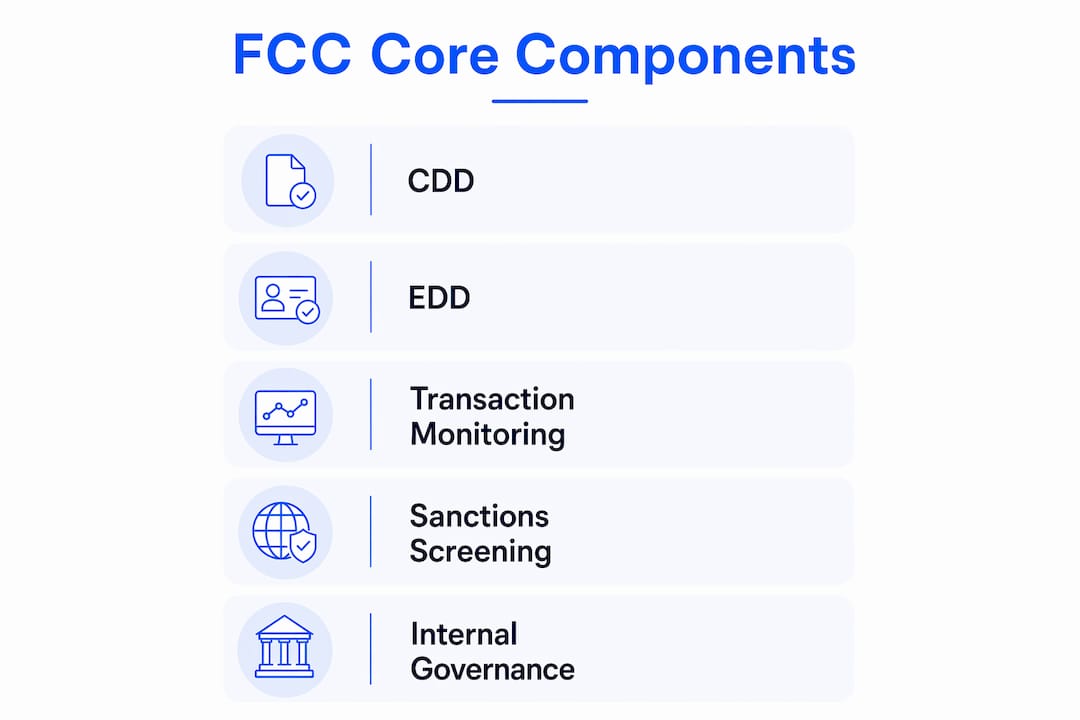
Internal governance sits above all five pillars. Compliance officers must have defined authority, direct board access, and adequate resources. Regulators treat governance gaps as a primary indicator of systemic risk.
How is financial crime compliance evolving under the new EU AML supervisory framework?
The EU's supervisory model for anti-money laundering is undergoing its most significant structural change in decades. AMLA replaces fragmented national oversight with a single, EU-level authority that applies consistent standards across all member states.
-
AMLA begins direct supervision in 2028. AMLA will directly supervise approximately 40 high-risk cross-border financial institutions. These are institutions with operations in multiple member states and elevated exposure to money laundering or terrorist financing risk.
-
The EU Single Rulebook standardizes thresholds. The harmonized €10,000 cash transaction threshold replaces the patchwork of national standards that previously required institutions to maintain separate compliance policies for each jurisdiction. One threshold means one policy framework.
-
Continuous monitoring replaces periodic checks. AMLA transforms AML compliance from periodic reviews into data-driven, continuous EU-level oversight. Institutions must now maintain live data pipelines, not annual audit snapshots.
-
Cross-border information sharing improves. AMLA creates formal channels for national FIUs and supervisors to share data across borders. This directly addresses the coordination gaps that allowed complex layering schemes to go undetected across multiple jurisdictions.
-
Fintech and virtual asset providers face tighter scrutiny. Countries like Slovakia and Romania have already tightened scrutiny of virtual asset providers and gatekeepers, with increased penalties and improved FIU coordination. AMLA extends this approach EU-wide.
Pro Tip: Start mapping your institution's data architecture against AMLA's reporting requirements now. Institutions that wait until 2027 to align their data structures will face compressed timelines and higher remediation costs.
The practical implication for compliance officers is clear. The 2028 deadline is not a distant horizon. Institutions need 18–24 months to restructure data governance, retrain staff, and align internal controls with the EU Single Rulebook.
What technologies and strategies improve financial crime compliance effectiveness?
Technology does not replace compliance judgment. It removes the manual bottlenecks that prevent compliance officers from exercising that judgment at scale.
Automated KYC and KYB processes cut onboarding time and reduce human error in identity verification. Early fintech adopters of eIDAS-compliant eKYC reduced operational costs by 35%. That figure reflects not just faster onboarding but fewer downstream errors that require costly remediation.
The risk-based approach (RBA) is the strategic foundation for effective compliance in finance. Under the RBA, institutions allocate their compliance resources in proportion to the actual risk each customer or transaction presents. The European Central Bank and other regulators now focus on compliance effectiveness over mere policy existence. Having a written AML policy is no longer sufficient. Regulators want evidence that the policy works.
Key technology capabilities that support effective FCC include:
- Automated transaction monitoring with configurable rule sets that reduce false positives without increasing missed alerts
- Blockchain analytics for tracing virtual asset flows across wallets and exchanges
- eIDAS-compliant digital onboarding that satisfies KYC requirements without paper-based processes
- API-connected case management that links transaction alerts to customer risk profiles in real time
- Compliance dashboards that give officers a live view of open cases, SAR filing status, and screening queue volumes
Pro Tip: Measure your false positive rate monthly. A rate above 95% signals that your transaction monitoring rules need recalibration, not more staff.
Successful firms embed AML compliance into core business processes rather than running it as a parallel function. When compliance is integrated into onboarding, transaction processing, and account management, the cost per compliant transaction drops and the detection rate improves.
What are the challenges of managing compliance across multi-jurisdictional operations?
Cross-border financial crime compliance is the hardest version of the problem. Institutions operating in multiple jurisdictions face regulatory variance, data localization requirements, and governance complexity that single-market firms do not encounter.
The most common failure point is beneficial ownership data. Central European countries have improved their beneficial ownership legislation, but practical application remains inconsistent. An institution may satisfy the letter of the law in one jurisdiction while holding incomplete ownership records for the same corporate group in another.
Cross-border AML compliance requires centralized oversight, consistent policies, and enhanced data sharing across jurisdictions. Group-wide monitoring architectures, where all branches report into a single AML platform, are the most effective structural response to this challenge. They allow compliance officers to see risk at the group level rather than managing it branch by branch.
Role clarity is a separate but equally serious challenge. Regulators expect defined accountability and governance structures with clear distinctions between strategic compliance manager roles and operational compliance officer roles. When those lines blur, accountability gaps appear, and regulators treat those gaps as evidence of systemic weakness.
The table below contrasts common governance weaknesses with their recommended structural fixes.
| Governance Weakness | Recommended Fix |
|---|---|
| Blurred strategic and operational roles | Define compliance manager vs. officer responsibilities in writing |
| Inconsistent beneficial ownership records | Implement a group-wide UBO registry with mandatory update triggers |
| Fragmented national AML policies | Adopt a single group AML policy aligned to the EU Single Rulebook |
| Siloed transaction monitoring by branch | Deploy centralized monitoring with group-level risk aggregation |
| Slow FIU response times | Automate case escalation with predefined 5-day and 24-hour workflows |
A compliance risk assessment conducted at the group level, rather than entity by entity, gives compliance officers the clearest picture of where cross-border exposure concentrates.
Key Takeaways
Effective financial crime compliance requires integrating CDD, transaction monitoring, sanctions screening, and governance structures into a single, risk-based framework aligned to the EU Single Rulebook and AMLA's 2028 supervision timeline.
| Point | Details |
|---|---|
| FCC is a five-pillar system | CDD, EDD, transaction monitoring, sanctions screening, and SAR filing must work as one integrated framework. |
| AMLA changes the supervisory model | Direct EU-level supervision of ~40 high-risk institutions begins in 2028, replacing fragmented national oversight. |
| Technology reduces cost and error | eIDAS-compliant eKYC and automated monitoring cut operational costs and false positive rates measurably. |
| Role clarity prevents regulatory scrutiny | Compliance manager and compliance officer responsibilities must be defined in writing with clear accountability. |
| Cross-border operations need centralized oversight | Group-wide AML monitoring and a unified policy framework are the most effective multi-jurisdictional controls. |
Why FCC is now a core business discipline, not a back-office function
I have worked with financial institutions that treat compliance as a cost center to be minimized. That approach consistently produces the same result: a compliance function that is perpetually under-resourced, reactive, and one regulatory examination away from a serious finding.
Financial crime compliance is increasingly viewed as a strategic operational discipline that enhances business performance and reputation beyond mere regulatory fulfillment. I agree with that framing, and I would push it further. Institutions that invest in compliance infrastructure early, before a regulatory deadline forces them to, consistently outperform their peers on onboarding speed, false positive rates, and examination outcomes.
The AMLR implementation deadline is not a compliance project. It is a business transformation. Institutions that treat it as a checklist will spend 2027 in remediation mode. Those that treat it as an opportunity to rebuild their data architecture and governance model will enter AMLA supervision in a position of strength.
The hardest conversation I have with compliance teams is about role clarity. Most institutions have a compliance officer. Far fewer have clearly documented the boundary between that officer's operational responsibilities and the strategic responsibilities of senior management. AMLA will make that ambiguity expensive.
My practical advice: run a compliance risk assessment at the group level before the end of 2026. Map your data gaps, document your governance structure, and identify where your transaction monitoring rules are generating noise rather than signal. That work takes months. Starting it now is the only way to finish it before the 2028 clock matters.
— Bartas
Currexchanger's approach to compliance management
Currency exchange operators face the same FCC obligations as larger financial institutions, often with smaller compliance teams and tighter operational margins.

Currexchanger is built specifically for currency exchange businesses managing multiple branches, and its platform integrates KYC/KYB verification, automated transaction monitoring, and SAR reporting into a single operational system. Compliance officers get real-time dashboards showing open cases, screening queue status, and branch-level risk exposure without switching between tools. The platform connects to external AML and KYC providers via API, supports document verification, and maintains detailed activity logs for regulatory examination. For operators preparing for AMLR and AMLA requirements, Currexchanger's compliance platform provides the infrastructure to manage those obligations without building it from scratch.
FAQ
What is financial crime compliance in simple terms?
Financial crime compliance is the system a financial institution uses to prevent, detect, and report crimes like money laundering and fraud. It combines customer verification, transaction monitoring, and regulatory reporting into one operational framework.
What is AML compliance and how does it relate to FCC?
AML compliance is the anti-money laundering component of financial crime compliance, focused specifically on detecting and reporting money laundering activity. FCC is the broader discipline that includes AML alongside sanctions screening, fraud prevention, and financial crime risk management.
When does AMLA begin supervising financial institutions?
AMLA begins direct supervision of approximately 40 high-risk cross-border financial institutions in 2028. Institutions should align their data structures and governance frameworks with EU Single Rulebook requirements well before that date.
What is the EU cash transaction due diligence threshold under AMLR?
The harmonized threshold is €10,000. This standard replaces the varying national thresholds that previously required institutions to maintain separate compliance policies across EU member states.
How do compliance officers measure FCC effectiveness?
Regulators now assess whether compliance controls actually work, not just whether they exist. Key metrics include false positive rates in transaction monitoring, SAR filing timeliness, and the completeness of beneficial ownership records across the institution's customer base.