
Reducing compliance risk in money transfers requires coordinated, multi-jurisdictional controls aligned with the specific payment corridors your business operates. The standard industry term for this discipline is AML/CFT compliance risk management, and it covers everything from customer due diligence (CDD) thresholds to sanctions screening and partner oversight. Under EU Regulation (EU) 2024/1624, the CDD threshold for wire transfers sits at just 1,000 EUR, far below the general 10,000 EUR mark most compliance teams anchor to. That gap alone creates significant exposure for businesses that apply generic controls to money transfer operations. The path forward is a corridor-aware compliance framework that unifies sender data, beneficiary data, and partner monitoring into one reconstructible evidence file.
What key regulatory thresholds must money transfer businesses monitor?
The 1,000 EUR CDD threshold is the single most misunderstood rule in money transfer compliance. Most financial institutions train staff on the general 10,000 EUR trigger, but wire transfer transactions fall under a separate, lower rule. Missing this distinction means your CDD program is structurally incomplete before a single transaction is processed.
Beyond the monetary threshold, the "3-transactions-in-12-months" rule converts what looks like an occasional sender into an ongoing business relationship. That conversion triggers full CDD obligations, including enhanced monitoring and periodic review. Automated systems must track this dynamically, not through manual review.
Regulatory cooperation timelines add another layer of operational pressure. FIU inquiry responses are due within 5 working days, with urgent requests requiring a response in under 24 hours. Your compliance team needs documented escalation procedures, not ad hoc responses.
The thresholds also vary by payment instrument. Cash transactions, crypto assets, and card-based payments each carry different CDD triggers under current national acts and the incoming EU AMLR. The table below summarizes the core thresholds compliance teams must track:
| Instrument | CDD Trigger | Relationship Rule |
|---|---|---|
| Wire transfer (money transfer) | 1,000 EUR | 3 transactions in 12 months |
| General cash transaction | 10,000 EUR | Ongoing relationship flag |
| Crypto asset transfer | Varies by national act | Subject to AMLR harmonization |
| Card-based payment | Varies by instrument | Assessed per transaction pattern |
Key obligations under current rules include:
- Verify sender and beneficiary identity at the 1,000 EUR threshold for wire transfers.
- Track cumulative transaction volumes to apply the 3-in-12-months relationship rule.
- Retain transaction records for the period required by your national AML act (typically 5 years).
- Respond to FIU inquiries within the mandated timeframes, with documented escalation paths.
- Apply enhanced CDD for high-risk corridors, politically exposed persons, and sanctioned jurisdictions.
How can a corridor-aware framework unify sender, beneficiary, and partner monitoring?
The biggest compliance gap in money transfer businesses is the foreign payout partner. Most firms treat their payout partners as vendors, not as part of their compliance perimeter. That framing creates regulatory blind spots that regulators and FIUs will find during reviews.
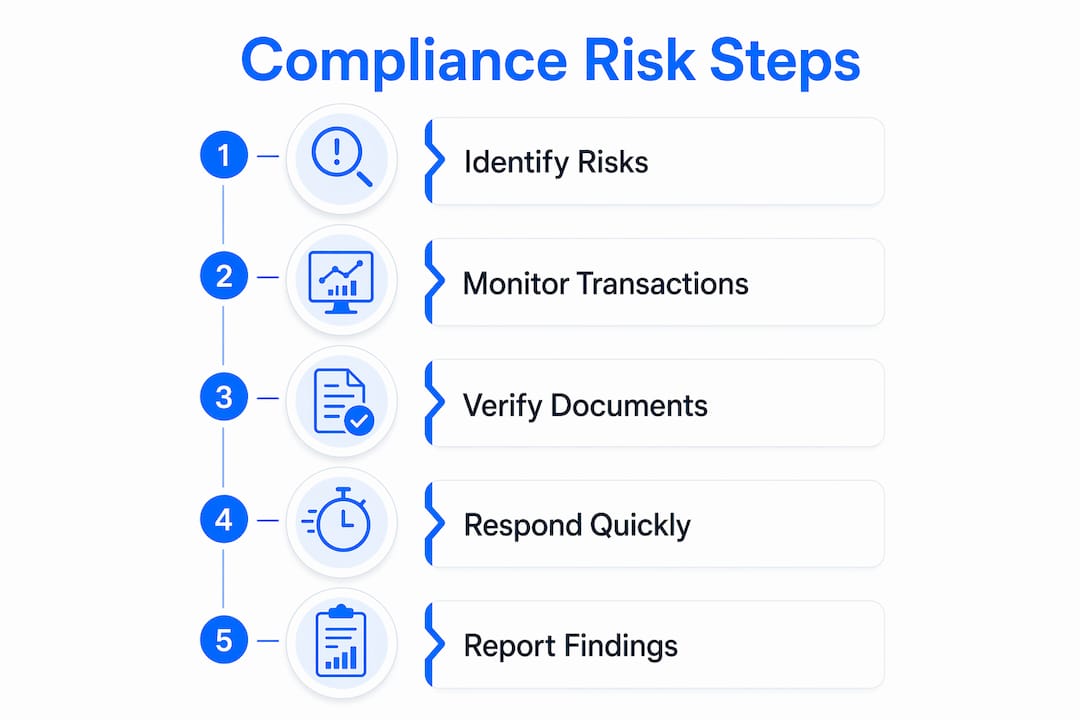
A corridor-aware compliance framework treats every transaction as a two-sided event. The sender's jurisdiction determines which CDD rules apply at origination. The beneficiary's jurisdiction determines what screening and recordkeeping obligations apply at the payout end. Both sets of rules must appear in the same compliance file.
One canonical compliance record for each transaction should include the sender's identity and jurisdiction, the beneficiary's identity and jurisdiction, the payment event details, sanctions screening results, any exceptions granted, and complaint handling notes. This structure makes the file reconstructible during an audit without requiring staff to pull data from multiple disconnected systems.

Jurisdiction-aware workflows are the operational mechanism that makes this work. Your compliance system should fork automatically based on the sender and beneficiary country pair. A transfer from Germany to Serbia triggers a different control set than a transfer from France to Poland. Automated jurisdiction overlays align your controls with the actual legal surface of each corridor, not a one-size-fits-all rulebook.
Pro Tip: Build your correspondent banking compliance checklist around corridor pairs, not individual countries. A Germany-to-Serbia corridor has a specific legal profile that differs from Germany-to-Croatia, even though both involve the same sending country.
Operational transparency is the final requirement. Every exception, every sanctions screening override, and every complaint must be logged in the same timeline as the transaction itself. Regulators do not just review whether controls exist. They review whether those controls were applied consistently and whether the evidence proves it.
What tools and processes drive effective dynamic compliance risk management?
Static checklists fail in money transfer compliance because risk is not static. Risk-based monitoring that maps controls to velocity, geography, and transaction patterns outperforms rule sets built around fixed thresholds alone. The distinction matters because structuring, the practice of breaking large transactions into smaller ones to avoid detection, exploits static rules by design.
Effective dynamic monitoring requires four operational capabilities:
- Rolling threshold aggregation. Your system must aggregate transaction values across a rolling 12-month window per customer, not per calendar year. A customer who sends 900 EUR in january, 900 EUR in june, and 900 EUR in december has technically never triggered the 1,000 EUR threshold per transaction. Rolling aggregation catches that pattern.
- Connected transaction detection. Behavioral data including IP addresses and device IDs links transactions that appear unrelated on paper. Two customers sending from the same device to the same beneficiary account is a structuring signal, not a coincidence.
- Automated customer promotion. When a customer crosses the 3-in-12-months threshold, your system must automatically promote them to full CDD status and trigger a review workflow. Manual promotion creates gaps that regulators treat as control failures.
- Regular operational effectiveness testing. Controls must be tested for whether they actually catch risk, not just whether they are designed correctly. Operational effectiveness reviews should happen at least annually, with findings documented and remediation tracked.
Staff training is not optional in this framework. Compliance officers need to understand why the rules exist, not just what the rules say. A team that understands structuring as a behavior will catch patterns that a team following a checklist will miss.
Pro Tip: Map your transaction monitoring rules to specific risk drivers, such as corridor velocity or geographic exposure, rather than to generic dollar amounts. This approach makes your AML compliance program defensible during regulatory review because you can explain exactly why each rule exists.
Document verification is the foundation that makes all monitoring meaningful. Transaction data is only as reliable as the identity data behind it. Automated document verification at onboarding reduces the risk that your monitoring system is tracking a fraudulent identity rather than a real customer.
How do upcoming AML regulations change compliance risk management for money transfers?
The EU AML Regulation takes full effect on July 10, 2027, replacing fragmented national AML laws with a single, uniform regulatory regime across the EU. Until that date, national acts such as the Czech AML Act and the Hungarian AML Act remain in force. Compliance teams must run parallel programs during the transition period, which starts now.
The AML Authority (AMLA) introduces direct supervision for the highest-risk entities. AMLA will directly supervise approximately 40 high-risk cross-border groups from 2028, replacing multiple national supervisory relationships with a single EU oversight structure. For businesses in that category, the cost of compliance gaps rises significantly because penalties will be linked to company revenue and applied uniformly across jurisdictions.
The practical implications for compliance teams are significant:
- CDD, recordkeeping, and sanctions screening standards will be harmonized across all EU member states, removing the current patchwork of national rules.
- Businesses that currently benefit from lighter national supervision will face the full weight of AMLR standards.
- Consolidated licensing requirements will reduce regulatory arbitrage opportunities that some firms have used to operate under less demanding national regimes.
- The shift to centralized enforcement means that a compliance failure in one jurisdiction will be visible to the central authority, not just the local regulator.
- Compliance evidence packs must be structured to meet AMLA's standards, not just national ones.
The firms that prepare early will have a structural advantage. Compliance evidence packs built with clear flow-of-funds mapping, corridor-specific monitoring records, and indexed policies reduce review time and rejection risk. Building that structure now, under current national rules, means you are not rebuilding from scratch in 2027.
Key Takeaways
Reducing compliance risk in money transfers requires corridor-specific controls, dynamic transaction monitoring, and a unified compliance evidence file that meets both current national rules and the incoming EU AMLR standards.
| Point | Details |
|---|---|
| Apply the 1,000 EUR CDD threshold | Wire transfers trigger CDD at 1,000 EUR, not the general 10,000 EUR limit. |
| Build corridor-aware compliance files | Each transaction needs one reconstructible record covering sender, beneficiary, and partner data. |
| Use rolling aggregation for monitoring | Track cumulative transaction values over 12 months to catch structuring before it crosses static thresholds. |
| Prepare for AMLR transition by 2027 | National AML acts remain in force until July 10, 2027; parallel compliance programs are required now. |
| Test controls for operational effectiveness | Design compliance is not enough; controls must be tested against real-world risk patterns annually. |
The compliance gap nobody talks about
After working with financial institutions across multiple corridors, the pattern I see most often is not a failure of policy. It is a failure of integration. Firms have a CDD policy, a sanctions screening tool, and a transaction monitoring system. None of them talk to each other in real time, and none of them produce a single, coherent compliance file that a regulator can follow from start to finish.
The checklist mentality is the root cause. Teams treat compliance as a series of boxes to check rather than a continuous risk management process. When an FIU inquiry arrives, they scramble to reconstruct a timeline from three different systems. That scramble is itself a compliance failure, because it signals that the controls were not actually integrated into the business flow.
The AMLR transition is the forcing function that will expose this gap at scale. Firms that have been operating under lighter national supervision will face AMLA's standards without the infrastructure to meet them. The time to build that infrastructure is before the deadline, not after the first enforcement action.
My strongest recommendation is to start with your payout partner relationships. Map every corridor, identify every partner, and build a compliance file structure that captures both ends of every transaction. That single change will do more to reduce your regulatory exposure than any policy update or training program.
— Bartas
Currexchanger's approach to money transfer compliance
Financial institutions managing multiple corridors need software that keeps compliance data connected, not siloed across spreadsheets and separate tools. Currexchanger is built specifically for currency exchange operators and financial businesses that handle cross-border transactions at scale.

Currexchanger's platform integrates AML/KYC compliance, real-time transaction monitoring, and document verification into one system. It supports the corridor-specific workflows and rolling threshold tracking that the EU AMLR demands. For businesses preparing for the 2027 regulatory transition, Currexchanger provides the compliance management infrastructure that makes evidence packs auditable and partner data traceable. The platform scales from single offices to multi-branch networks, so your compliance architecture grows with your business.
FAQ
What is the CDD threshold for money transfer wire transactions?
The CDD threshold for wire transfer transactions under EU Regulation (EU) 2024/1624 is 1,000 EUR. This is significantly lower than the general 10,000 EUR threshold that applies to most other financial transactions.
What triggers an ongoing business relationship in money transfer compliance?
Three transactions within a 12-month period from the same customer trigger an ongoing business relationship under AMLR rules. That status requires full CDD, enhanced monitoring, and periodic review of the customer's risk profile.
When does the EU AML Regulation replace national AML laws?
The EU AMLR takes full effect on July 10, 2027, replacing fragmented national laws with a single EU-wide regime. Until then, national acts such as the Czech AML Act and Hungarian AML Act remain enforceable.
How quickly must a business respond to an FIU inquiry?
Standard FIU inquiries require a response within 5 working days. Urgent requests must be answered in under 24 hours, which means documented escalation procedures are a compliance requirement, not a best practice.
What is AMLA and why does it matter for money transfer businesses?
AMLA is the EU's AML Authority, which will directly supervise approximately 40 high-risk cross-border groups from 2028. It replaces multiple national supervisory relationships with centralized EU enforcement and applies revenue-linked penalties for compliance failures.