
The fastest way to get control of your currency operations is to centralize transaction logging, automate AML/KYC screening, and add real-time inventory monitoring in a single connected system. That combination cuts manual reconciliation errors, keeps your audit trail intact, and shortens customer throughput time at the counter. Platforms like Currexchanger are built specifically for this: they unify the modules Central European operators need under one roof, from sanction screening against EU and UN lists to banknote verification and CNB-compliant reporting.
Three things this approach delivers immediately:
- Audit-readiness from day one. Every transaction is logged digitally, timestamped, and retrievable without manual reconstruction.
- AML compliance without extra headcount. Automated PEP and sanctions screening runs on every customer, not just the ones a teller flags.
- Faster customer service. When rates, inventory, and compliance checks run in parallel, counter time drops.
Pro Tip: Pick one process to automate this week. Transaction logging is the highest-leverage starting point because every other module, from reconciliation to reporting, depends on clean transaction data.
Table of Contents
- What does a five-step checklist to start look like?
- Which operational modules actually move the needle?
- How do you build a compliance-first control framework?
- Which integrations matter most for your technology stack?
- What does a realistic implementation roadmap look like?
- Which KPIs should every operator track in real time?
- How do you evaluate vendors before signing anything?
- What does a typical Central Europe deployment look like in practice?
- Key Takeaways
- Why compliance-first is the only strategy that actually scales
- Currexchanger gives you the control room your operations need
- Useful sources for Central Europe operators
- FAQ
What does a five-step checklist to start look like?
- Map your workflows first. List every branch, POS terminal, and manual log. You cannot automate what you have not scoped.
- Rank automation targets. Transaction logging, AML/KYC screening, inventory reconciliation, and rate updates deliver the most measurable return. Prioritize in that order.
- Run a single-feed pilot. Connect one live data source, either a real-time FX rate feed or an AML screening API, before touching anything else. A narrow pilot surfaces integration problems cheaply.
- Map your compliance checkpoints. Poland's GIFI framework requires reporting on transactions above EUR 15,000 and five-year document retention. Czech operators face quarterly CNB submissions. Your pilot must capture the data each regulator requires before you go live.
- Train staff and review the first audit trail. A new workflow fails if tellers revert to paper. Schedule the first audit trail review within two weeks of go-live.
Pro Tip: Do not wait for a perfect system before training staff. Run a tabletop walkthrough of the new workflow on day one of the pilot. Early familiarity prevents the backsliding that kills most rollouts.
Which operational modules actually move the needle?
Currency exchange systems designed for money services businesses automate transaction logging, KYC onboarding, inventory monitoring, and regulatory reporting to reduce manual error and maintain audit-ready records. Here is how each module maps to the failure modes it prevents:

| Module | Primary function | Mandatory integrations |
|---|---|---|
| Transaction ledger | Logs every buy/sell with timestamp and teller ID | Accounting/ERP, audit log |
| Centralized rate engine | Pushes live rates to all branches simultaneously | FX rate feed API |
| Cash/inventory monitoring | Tracks denomination-level stock in real time | Banknote validator, POS |
| KYC onboarding | Captures and verifies customer identity documents | Document verification API |
| Sanction/PEP screening | Checks customers against EU, UN, and national lists | AML provider API |
| Reporting and audit log | Generates tamper-evident records for regulators | All modules above |
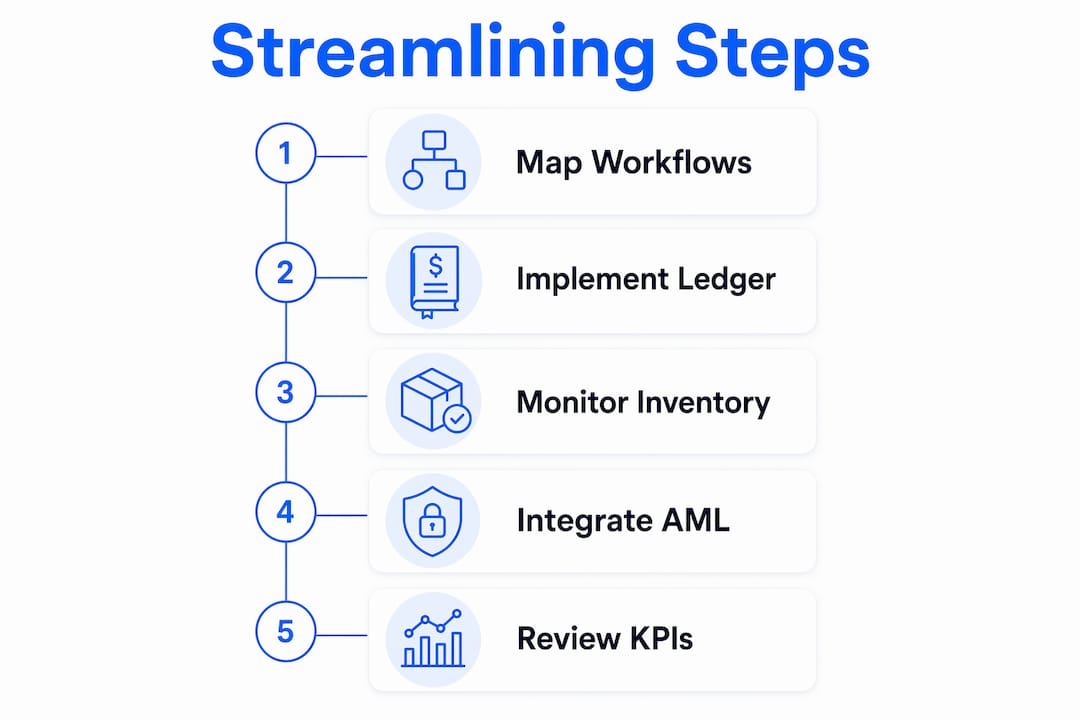
The two modules to implement first are the transaction ledger and real-time inventory monitoring. Together they eliminate the two most common failure modes: missing audit trails and undetected cash discrepancies. Everything else, including AML screening and rate management, depends on clean transactional and inventory data underneath.
Pro Tip: Start inventory monitoring at denomination level, not just currency level. HMRC guidance flags that operators are frequently exploited to convert small-denomination notes into large ones. Denomination-level tracking makes those patterns visible automatically.
How do you build a compliance-first control framework?
Automated reporting systems are the difference between a compliance team that manages risk and one that just files paperwork. A risk-based AML program needs these controls embedded in the platform, not bolted on afterward:
- Automated sanction and PEP screening on every transaction, checked against EU, UN, and national lists
- Risk-based customer profiles with configurable thresholds by currency, destination, and transaction size
- Transaction alerts that fire when amounts approach or exceed reporting thresholds (e.g., EUR 15,000 under GIFI)
- Daily automated reconciliation with tamper-evident end-of-day logs
- Digital record retention for the full statutory period (five years in Poland; confirm your jurisdiction)
- MFA on all operator accounts, IP/geographic restrictions, and detailed activity logs for every user action
Staff training and independent audits are non-negotiable parts of any AML program, not optional add-ons. The software creates the audit trail; trained staff and periodic independent reviews confirm the controls actually work.
"Managing physical currency channels requires balancing security, availability, and cost. Unified suites help control operating expenditure while improving the customer experience." — Helena Müller, cited in connection with Diebold Nixdorf's branch automation solutions
The same logic applies to software: a single platform with a unified audit log is far easier to defend in a regulatory review than three disconnected tools with separate logs. For a deeper look at building your AML program, the AML compliance guide for exchange offices covers the step-by-step process.
Which integrations matter most for your technology stack?
Priority integrations, ranked by operational impact:
- Real-time FX rate feeds — rates pushed to all branches simultaneously, no manual entry
- AML/KYC screening APIs — sanctions, PEP, and watchlist checks on every customer
- Banknote verification hardware — feeds denomination data directly into inventory and flags exceptions
- Accounting/ERP — closes the loop between counter transactions and financial records
- Banking and settlement APIs — automates end-of-day settlement and reduces float risk
- POS/terminal systems — captures transaction data at the point of exchange without re-keying
API capabilities to require from any vendor:
- Webhooks for real-time transaction events (reconciliation triggers)
- Role-based access control with granular permissions per branch and user type
- Single sign-on (SSO) support for enterprise environments
- Encrypted transport (TLS 1.2 minimum) for all data in transit
- Activity logging at the API level, not just the UI level
Banknote validators deserve a specific note. When integrated properly, they do not just verify authenticity; they feed denomination counts into the inventory module automatically. That closes the gap between physical cash and the system record without a manual count step, which is where most shrinkage originates.
Security requirements apply to every integration point: MFA on all admin access, IP restrictions for sensitive endpoints, and full activity logs that capture who called what API and when.
What does a realistic implementation roadmap look like?
| Phase | Timeline | Key deliverables |
|---|---|---|
| Discovery | Weeks 1–2 | Workflow map, compliance checklist, integration inventory |
| Pilot (1–2 locations) | Weeks 3–6 | Live transaction logging, one AML feed, staff training session |
| Full rollout | — | All branches live, rate engine connected, reporting templates configured |
| Validation and audit | Weeks 13–16 | First audit trail review, CNB/GIFI report export tested, KPIs baselined |
Primary cost drivers to budget:
- Per-branch licensing fees
- AML/KYC provider API costs (usually per-check or monthly volume tiers)
- Banknote validator hardware (one-time capital cost per branch)
- FX rate data feed subscriptions
- Custom module development if your workflow requires non-standard features
- Staff training and change management time (often underestimated)
Involve IT (integration ownership), compliance (control sign-off), and branch managers (workflow validation) from discovery onward. Decisions made without branch managers in the room almost always require rework during the pilot.
Czech operators should confirm their CNB quarterly reporting requirements early in discovery so the reporting templates are configured before go-live, not after.
Which KPIs should every operator track in real time?
| KPI | What it tells you | Red-flag threshold |
|---|---|---|
| Liquidity by currency | Whether you can meet demand without emergency purchases | Below minimum stock level |
| Daily over/short (shrinkage) | Cash discrepancy between system and physical count | Any non-zero variance |
| Exception rate (alerts per transactions) | Frequency of compliance or inventory anomalies | Rising trend over recent days |
| Sanctions alert rate | Volume of customer matches requiring review | Spike above baseline |
| Time-to-reconcile | How long end-of-day close takes | Over 30 minutes |
| Customer wait time | Counter throughput efficiency | Branch-specific target |
Structure dashboards by role. Operations managers need the cash-position heatmap and shrinkage figures front and center. Compliance officers need the sanctions alert panel and exception queue. Finance teams need the reconciliation status and settlement confirmation. Giving everyone the same view creates noise; role-specific dashboards surface the right exceptions to the right person. For liquidity tracking specifics, this guide covers the mechanics in detail.
How do you evaluate vendors before signing anything?
Evaluation checklist:
- Native AML/KYC screening with EU, UN, and national list coverage
- Real-time inventory tracking at denomination level
- Configurable reporting templates for GIFI, CNB, and NBS submissions
- MFA, IP restrictions, and granular role-based permissions
- Documented SLAs for uptime and API response time
- Clear pricing for customization (per-feature vs. hourly)
- Data retention guarantees matching your jurisdiction's statutory period
Demo questions that separate deployable platforms from difficult integrations:
- Show a live sanction screening result, including the match reason and the override workflow.
- Demonstrate a daily reconciliation close and the audit log it produces.
- Export a sample audit packet in the format your regulator accepts.
- Show how a rate update propagates to all branches and how long it takes.
- Demonstrate what happens when a banknote validator flags a suspect note.
Procurement red flags: missing or read-only audit logs, manual-only reconciliation workflows, vague data retention answers, and no documented API for AML provider integration. Any one of these will create compliance exposure.
What does a typical Central Europe deployment look like in practice?
A mid-size operator running four branches in the Czech Republic and Poland might deploy like this: a customer arrives, the teller pulls a live rate from the centralized engine, the transaction is logged automatically with the customer's verified ID, the banknote validator confirms authenticity and updates denomination inventory, and the AML screening API checks the customer against EU, UN, and national lists before the transaction completes. The entire sequence takes under two minutes.
At end of day, the system generates a reconciliation report for each branch, flags any over/short, and queues the GIFI data for transactions above EUR 15,000. Quarterly, the compliance officer exports the CNB statement directly from the reporting module. Under Slovakia's foreign exchange framework, the same operator's Bratislava branch uses the same platform to meet NBS reporting obligations.
Measurable outcomes from a deployment like this:
- Reconciliation time cut from 45–60 minutes per branch to under 15 minutes
- Zero manual re-entry of transaction data into accounting
- Compliance exceptions caught before end-of-day close, not during a regulator review
- Full audit trail available for any transaction within seconds
Key Takeaways
Centralizing transaction logging, AML/KYC screening, and real-time inventory monitoring in a single platform is the most direct path to audit-ready, efficient foreign exchange operations in Central Europe.
| Point | Details |
|---|---|
| Start with transaction logging | Clean transaction data is the foundation every other module depends on. |
| Automate AML/KYC screening | Automated sanction and PEP checks on every customer reduce compliance exposure without adding headcount. |
| Monitor inventory in real time | Denomination-level tracking catches shrinkage and suspicious cash patterns before they become regulatory problems. |
| Know your reporting thresholds | Poland requires GIFI reporting on significant transactions with multi-year document retention; Czech operators face quarterly CNB submissions. |
| Currexchanger unifies all modules | The platform connects transaction automation, AML/KYC, inventory monitoring, and regional reporting in one system built for Central European operators. |
Why compliance-first is the only strategy that actually scales
The operators who treat compliance as a cost center tend to build two parallel systems: one for operations, one for regulators. That split creates exactly the manual overhead they were trying to avoid, and it compounds as they add branches.
The smarter framing is that a well-configured compliance layer is the operations layer. When AML screening, transaction logging, and inventory reconciliation run in the same system, the audit trail is a byproduct of normal operations, not a separate project. Helena Müller's point about unified suites controlling operating expenditure applies directly here: a single platform with one data model costs less to maintain, less to audit, and less to train staff on than three tools that need to be reconciled against each other.
The operators who scale past five branches without a compliance crisis are almost always the ones who built the control framework first and grew into it, rather than retrofitting controls onto a system that was never designed to carry them.
Currexchanger gives you the control room your operations need
Running a multi-branch currency exchange without a unified platform means your compliance officer is always one missed transaction away from a regulator conversation they did not want to have. Currexchanger changes that equation by putting transaction automation, AML/KYC screening, real-time inventory monitoring, and audit-ready reporting in one place, purpose-built for Central European operators.
The platform connects directly to AML providers, banknote validators, accounting systems, and FX rate feeds, so the integrations the checklist above requires are already mapped. Security controls include MFA, IP restrictions, and full activity logs. Reporting templates cover GIFI, CNB, and NBS submissions out of the box.
A 30–60 minute demo will show you a live sanction screening, a daily reconciliation close, and an audit packet export. Request a demo at Currexchanger and see exactly how the platform fits your branch count and compliance obligations.
Useful sources for Central Europe operators
- Poland GIFI reporting guidance (Ministry of Finance) — threshold reporting above EUR 15,000 and five-year retention rules for Polish operators
- CNB Decree 315 on bureau-de-change activity (Czech National Bank) — quarterly and annual statement requirements, submission forms, and deadlines
- NBS Foreign Exchange Act (Národná banka Slovenska) — licensing, reporting obligations, and permitted transaction channels for Slovak operators
- HMRC AML guidance for supervised businesses — red flags for cash-based laundering patterns, including denomination conversion
- Currency exchange reporting requirements 2026 — regional reporting rules and practical examples for Central European operators
- Importance of compliance in payments — broader compliance context for payments and FX businesses
FAQ
What is the first step to improve foreign exchange efficiency?
Map your current transaction and cash workflows across all branches before automating anything. Clean workflow documentation reveals where manual steps create the most error and delay, which tells you exactly where to start.
How does automated AML screening work in a currency exchange platform?
The platform checks each customer against EU, UN, and national sanctions and PEP lists via an API connection at the point of transaction. Matches are flagged for compliance review before the exchange completes, creating a documented audit trail automatically.
What reporting thresholds apply to Central European currency exchange operators?
Poland requires GIFI reporting on transactions above EUR 15,000 with five-year document retention. Czech operators must file quarterly statements with the CNB via its internet application. Slovak operators follow NBS foreign exchange reporting obligations under the national foreign exchange act.
How long does it take to implement a currency exchange management platform?
A phased rollout typically runs 13–16 weeks: two weeks for discovery, four weeks for a pilot at one or two locations, six weeks for full rollout, and a final validation phase covering audit trail review and regulatory report testing.
Does Currexchanger support multi-branch operations in Central Europe?
Currexchanger is built for multi-branch operators and scales from a single office to a full network. It supports GIFI, CNB, and NBS reporting templates and connects to regional AML providers, banknote validators, and accounting systems.