
The top retention levers for currency exchange operators are transparent pricing, progressive verification, consistent in-branch operations, and retention-focused technology. Get those four right and repeat business follows. Miss any one of them and even competitive rates won't save you from churn.
Immediate action checklist:
- Next 30 days: Add a persistent rate bar to every transaction screen and receipt; display the mid-market rate, your margin, and the final amount side by side.
- Next 90 days: Deploy a reservation/hold system and reorder your onboarding flow so customers see a live rate before any KYC prompt.
- Next 180 days: Integrate a CRM with cohort dashboards tracking second-deposit rate, churn by corridor, and NPS.
TL;DR: Operators who combine GDPR-compliant progressive verification with real-time rate transparency and a CRM-backed loyalty layer — tools Currexchanger is built to support — consistently outperform those competing on price alone.
Table of Contents
- What currency exchange customer retention strategies actually work?
- How to onboard customers without losing them to KYC friction
- In-branch reliability and staff training that reduce churn
- Which technology features actually move retention numbers?
- How to design AML/KYC and GDPR flows that build trust
- Loyalty programs that produce repeat behavior, not just points
- What to measure and how to build a retention dashboard
- A practical rollout plan for Central European operators
- Key Takeaways
- What actually moves the needle in Central European operations
- Currexchanger supports every tactic in this playbook
- Useful sources and regulatory references
- FAQ
What currency exchange customer retention strategies actually work?
Transparent pricing is a first-order retention driver, often outweighing price itself. Customers who understand exactly what they're paying come back. Customers who feel surprised by a fee don't.
Under Regulation (EU) 2021/1230, currency conversion providers must display the total conversion charge as a percentage markup over the ECB reference rate before a transaction is initiated, and document both amounts on the receipt. That's a compliance floor, not a ceiling. Operators who treat it as a retention tool go further.
What to show at the decision moment:
- The mid-market (ECB) reference rate
- Your margin as a percentage
- The exact amount the customer receives
- A timestamp and rate expiry window (e.g., "rate valid for 10 minutes")
- Buy-back rate if applicable
For online booking pages, the same information belongs above the confirmation button, not buried in terms. For in-branch displays, a rate board that updates in real time removes the single most common objection: "Is this really the rate I'll get?"
Pro Tip: Save a timestamped receipt image in your transaction log. When a customer disputes a rate days later, a receipt showing the exact rate, margin, and expiry window resolves it in seconds — no argument, no refund.
How to onboard customers without losing them to KYC friction
Front-loading mandatory verification before a customer sees first value causes abandonment. Sequencing first-value delivery before heavy KYC recovers 20–35% of users who would otherwise drop off.
Preferred onboarding sequence:
- Customer arrives (branch or online) and sees a live rate immediately.
- They enter the amount and receive a full transaction summary: rate, fee, recipient amount.
- They reserve or quote-lock the transaction.
- Minimal identity capture (name, contact) for low-risk corridors.
- Transaction confirmed.
- Progressive KYC completion triggered only if transaction size, corridor risk, or repeat-customer flags require it.
Progressive verification triggers to configure:
- Transaction exceeds your AML threshold (set per corridor)
- Customer is new and the corridor carries elevated risk
- Repeat customer flagged for enhanced due diligence
- Document expiry detected in stored profile
Keep the rate, fee, and recipient amount visible throughout the entire flow. Institutional fragmentation — inconsistent UI or messaging across currency corridors — triggers churn by making the platform feel unreliable.
Pro Tip: Track abandonment by step. If drop-off spikes at the document upload screen, send an SMS or WhatsApp message within 15 minutes with a direct link back to the live rate. Recovery rates on warm leads are significantly higher than cold re-acquisition.
In-branch reliability and staff training that reduce churn
Consistent, trained staff and clear procedures materially reduce churn and generate word-of-mouth referrals. A customer who gets a different answer from two tellers about the buy-back policy won't return. One who gets the same clear answer every time will.
Front-counter procedure checklist:
- Confirm the displayed rate verbally before processing
- Issue a receipt with all required disclosure fields
- Explain the buy-back policy proactively on first visit
- Queue SLA target: no customer waits more than 5 minutes without acknowledgment
Staff training module topics:
- Rate explanation and margin disclosure (plain language)
- Fraud and counterfeit spotting
- Empathy scripts for complaints and disputes
- Digital reservation pickup and profile retrieval
Staff incentive models work best when tied to repeat-customer metrics rather than transaction volume alone. A teller rewarded only for throughput has no reason to take the extra 30 seconds to save a customer profile or note a preferred currency.
Pro Tip: Saved client profiles with preferred-currency flags take under a minute to create and dramatically increase perceived personalization. A returning customer who doesn't have to spell their name again notices.

Which technology features actually move retention numbers?
The minimum retention-focused tech stack: a real-time rate engine, a persistent transaction summary, a reservation/hold system, an integrated CRM, proactive notifications, and reusable KYC credentials. Each one addresses a specific churn point.
| Feature | Retention mechanism |
|---|---|
| Real-time rate engine | Removes rate-surprise churn at the decision moment |
| Reservation/hold system | Eliminates last-minute abandonment when rates shift |
| Integrated CRM | Enables targeted offers by corridor, frequency, and value |
| Proactive notifications | Rate alerts bring customers back before they shop elsewhere |
| Reusable KYC | Returning customers skip re-verification; friction drops sharply |
| Accounting API | Reconciliation accuracy builds operator trust in the system |
Currexchanger provides the core of this stack: real-time rate control, an online reservation system, AML/KYC integrations with external providers, CRM hooks, and customizable analytics dashboards — all within a single platform built for multi-branch operators in Central Europe.
Minimum vendor integration checklist: accounting API, AML/KYC provider, bank feed, POS, and banknote verification. For currency position tracking and liquidity monitoring, a direct feed from your bank is non-negotiable.
How to design AML/KYC and GDPR flows that build trust
Treat compliance as a guided experience. Progressive verification, clear status updates, and risk-based decisioning retain more customers than blunt, front-loaded checks. CX-first compliance shifts the framing from "prove you're not a criminal" to "let us confirm a few details so we can serve you."
Compliance UX rules:
- Explain why each document is needed ("We need your ID to meet EU AML requirements")
- Show a progress indicator with the next step visible
- Reuse verified credentials for returning customers wherever regulations permit
- Store GDPR consent logs in a durable, auditable format (database with timestamp and version)
- Never request more data than the risk tier requires
Under GDPR and the EU AML framework, Central European operators must retain transaction records and consent logs for at least five years. Store them in a system with access controls and an audit trail.
Vendor/integration checklist for KYC providers: real-time document checks, reusable credential support, API output for your analytics layer, and an audit log exportable for regulatory review.
Pro Tip: By 2027, eIDAS 2.0 requires EU financial institutions to support EUDI Wallet credentials at 'High' assurance level. Building your KYC flow to accept pre-verified digital credentials now means returning customers can skip manual scans entirely — a significant friction reduction.
Loyalty programs that produce repeat behavior, not just points
Tailored, behavior-driven loyalty outperforms one-size-fits-all points schemes. A frequent traveler on the PLN/EUR corridor responds to a rate alert and a buy-back guarantee. A business customer moving larger amounts responds to a dedicated account contact and priority processing.
Key segmentation axes: transaction frequency, second-deposit milestone, currency corridor, transaction size, and channel (branch vs. online).
| Segment | Campaign hook | KPI to measure lift |
|---|---|---|
| First-time customer | Reservation reminder + rate lock offer | Second-deposit rate |
| Frequent traveler (CEE corridors) | Corridor-specific rate alert + buy-back guarantee | Repeat visit frequency |
| High-value customer | Priority processing + dedicated contact | CLV, NPS |
| Lapsed customer (90+ days) | Personalized rate offer via SMS | Reactivation rate |
Nearly 63% of CEE travellers would consider switching providers for travel-related perks. That's the competitive pressure in Central Europe. Corridor-specific offers and travel-adjacent benefits aren't a nice extra — they're a retention defense.
What to measure and how to build a retention dashboard
Measure repeat rate (second-deposit rate), churn by cohort, customer lifetime value (CLV), NPS, and operational SLAs. Those five metrics tie directly to action.
Second-deposit rate is the strongest early indicator of long-term retention. A customer who transacts twice is far more likely to become a regular than one who transacted once, regardless of transaction size.
| KPI | Calculation | Reporting cadence |
|---|---|---|
| Second-deposit rate | % of first-time customers who transact again within 90 days | Weekly |
| Churn by cohort | % of customers inactive after 90/180 days, by acquisition month | Monthly |
| CLV | Average transaction value × average annual frequency × average tenure | Quarterly |
| NPS | % promoters minus % detractors from post-transaction survey | Monthly |
| Queue SLA compliance | % of customers served within 5-minute target | Daily |
A/B tests worth running:
- Rate-display wording: "ECB rate + 1.2% margin" vs. "You receive exactly X" — measure conversion and repeat rate.
- Reservation expiry timing: 10-minute vs. 30-minute holds — measure completion rate and abandonment.
- Progressive KYC prompt placement: after rate display vs. after reservation — measure drop-off by step.
A practical rollout plan for Central European operators
Prioritize low-friction wins first, then medium-term integrations, then long-term infrastructure.
Milestones:
- Days 1–30: Deploy persistent rate bar and receipt disclosure. Update in-branch displays. Train staff on rate explanation scripts. Success criterion: zero rate-dispute escalations per week.
- Days 31–90: Add reservation/hold system. Reorder onboarding flow (rate first, KYC second). Integrate AML/KYC provider API. Success criterion: measurable drop in onboarding abandonment.
- Days 91–180: Activate CRM with cohort dashboards. Launch first segmented campaign (corridor-specific rate alerts). Success criterion: second-deposit rate tracked and improving.
- Days 181–365: EUDI Wallet readiness assessment. Multi-branch reconciliation via accounting integration. Success criterion: reusable KYC live for returning customers.
Cost drivers to budget: software licensing (platform fee), AML/KYC provider API calls, hardware for in-branch rate displays, and staff training time. Integration costs vary by existing POS and accounting stack. For operators scaling across branches, a centralized platform with multi-branch support reduces per-branch integration cost significantly.
Key Takeaways
Second-deposit rate is the single leading indicator of retention health; operators who track it weekly and act on cohort data outperform those optimizing for first-transaction volume.
| Point | Details |
|---|---|
| Rate transparency first | Display mid-market rate, margin, and final amount before every transaction — it's both a legal requirement and your top retention tool. |
| Sequence onboarding correctly | Show the live rate before any KYC prompt; progressive verification recovers 20–35% of users who would otherwise abandon. |
| Track second-deposit rate | This is the leading retention KPI — measure it weekly by cohort to catch early-life churn before it compounds. |
| Segment loyalty campaigns | Corridor-specific rate alerts and buy-back guarantees outperform generic points programs for CEE travelers. |
| Currexchanger as your platform | Currexchanger provides real-time rate control, reservation systems, AML/KYC integrations, and cohort analytics in one platform built for multi-branch operators. |
What actually moves the needle in Central European operations
The operators I've seen struggle most aren't losing customers to better rates. They're losing them to friction: a KYC screen that appears before the customer sees what they're getting, a receipt that lists a rate but not the margin, a teller who gives a different buy-back answer than the one posted on the wall.
The compliance-as-experience framing matters more in Central Europe than operators typically expect. Customers in this market are increasingly familiar with digital financial services and have a low tolerance for processes that feel arbitrary or opaque. When you explain why a document is needed and show a progress bar, the experience shifts from interrogation to service.
The roadmap above is sequenced the way it is for a reason: rate transparency and onboarding flow changes cost almost nothing and deliver results within weeks. CRM and loyalty segmentation take longer but compound. EUDI Wallet readiness is a 2027 requirement, but operators who start the assessment now won't be scrambling later.
Currexchanger supports every tactic in this playbook
Running these retention strategies manually across multiple branches is where most operators stall. Currexchanger is built specifically for that gap: a single platform that handles real-time rate control, online reservations, AML/KYC integrations, multi-branch cash monitoring, and customizable retention dashboards — without requiring a separate tool for each function.
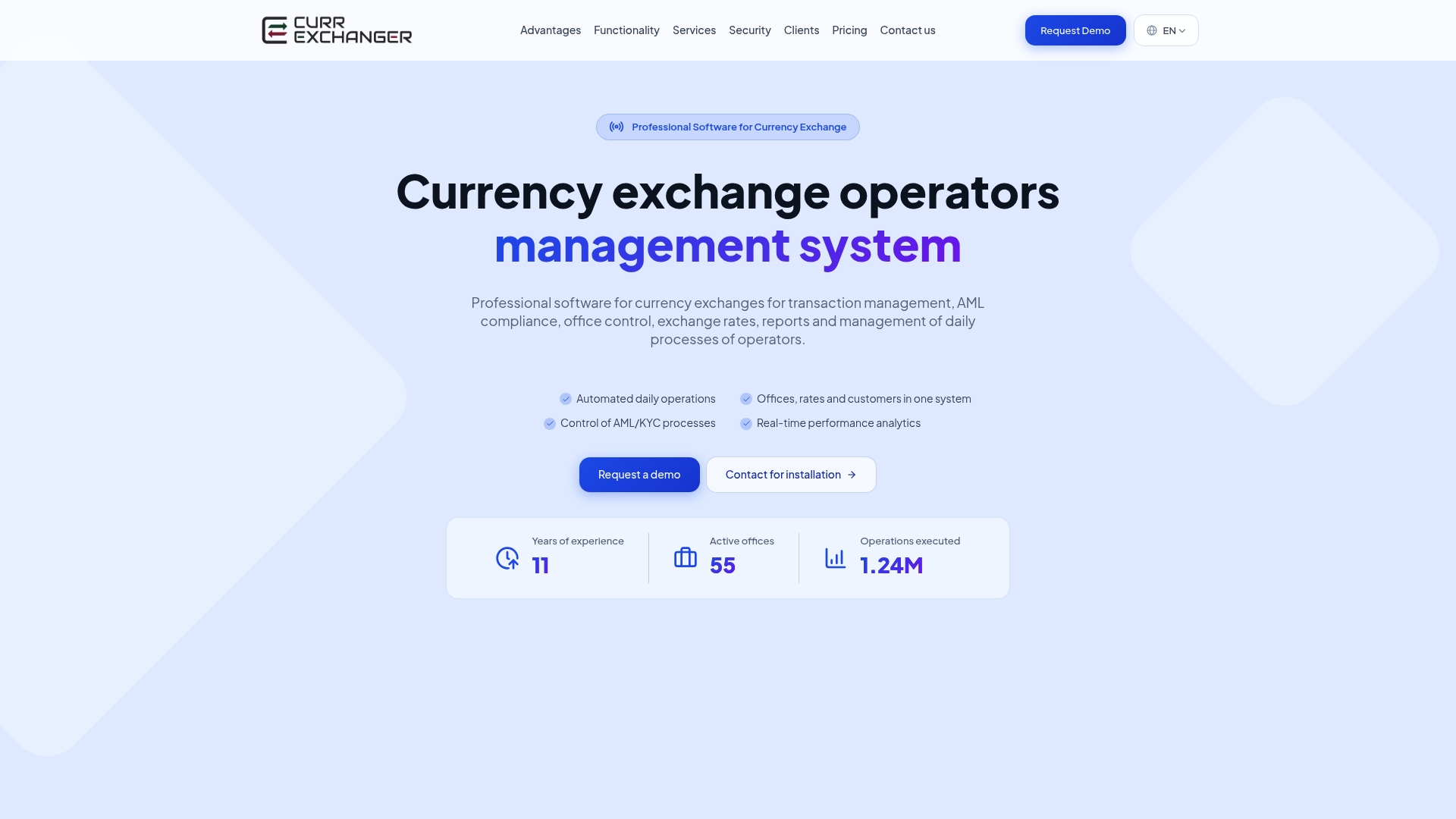
The practical fit: operators can deploy the rate transparency and reservation features in the first 30 days, connect an AML/KYC provider via API in the 90-day window, and activate cohort analytics for second-deposit tracking before the 180-day mark. Every feature maps directly to a tactic in this article.
For a pilot, start with the reservation system and rate display module. Set a 90-day success criterion (second-deposit rate improvement), measure it against your pre-pilot baseline, and expand from there. See the full platform to review features and request a demo.
Useful sources and regulatory references
- Regulation (EU) 2021/1230 — EUR-Lex: EU rules on cross-border payment transparency and currency conversion disclosure requirements.
- Customer loyalty in currency exchange — Money4Travel: Operator-focused analysis of trust and transparency as loyalty drivers.
- CX-first compliance — Transcom: How progressive verification and CX-focused AML/KYC design reduce abandonment.
- KYC UX best practices — Phenomenon Studio: Compliance UX case study with data on progressive disclosure and EUDI Wallet readiness.
- Forex retention lifecycle playbook — Track360: Second-deposit rate as the leading retention KPI and cohort analysis methodology.
- CEE traveller switching behavior — Visa/Mynewsdesk: Visa study on travel-related perks and switching behavior in Central and Eastern Europe.
- Currexchanger platform: Currency exchange management software for multi-branch operators.
FAQ
What is the most effective retention tactic for currency exchange operators?
Transparent pricing — displaying the mid-market rate, margin, and final recipient amount before every transaction — is the single highest-impact retention tactic, often outweighing rate competitiveness alone.
How does progressive verification improve customer retention?
Sequencing first-value delivery (showing a live rate or enabling a reservation) before heavy KYC prompts recovers 20–35% of users who would otherwise abandon the onboarding flow.
What KPI best predicts long-term customer retention in currency exchange?
Second-deposit rate is the strongest early indicator. Customers who transact a second time within 90 days are significantly more likely to become long-term regulars than those who transact once.
How does GDPR affect customer data practices for Central European operators?
GDPR requires operators to store transaction records and consent logs for at least five years in an auditable, access-controlled system, and to collect only the data the risk tier requires.
How does Currexchanger support retention strategy implementation?
Currexchanger provides real-time rate control, an online reservation system, AML/KYC integrations, and cohort analytics dashboards in one platform, covering the core technology requirements for the retention tactics in this article.