
Common multi-office compliance failures are repeated regulatory breakdowns that occur across multiple branches when fragmented oversight and inconsistent policy implementation go unchecked. For compliance officers managing currency exchange networks or other multi-location financial operations, these failures carry real consequences: in july 2026, ABN AMRO received an €8.5 million fine for structural AML monitoring deficiencies, and ING Belgium settled a €1.6 million criminal case the same year. The pattern is consistent across institutions. Structural gaps, not isolated mistakes, drive most enforcement actions. Recognizing where those gaps form is the first step toward closing them.
1. Common multi-office compliance failures start with monitoring gaps
The most damaging compliance failure in multi-office operations is the visibility gap between headquarters and individual branches. When central compliance teams cannot see what is happening at the branch level in real time, risk accumulates silently. AML red flags go undetected. Suspicious transaction patterns persist for months before anyone notices.
Fragmented monitoring is the direct cause of most structural AML deficiencies that regulators penalize. A branch operating with its own local logs and manual reporting creates a blind spot that no quarterly audit can fully correct. The ABN AMRO and ING Belgium cases both point to exactly this failure: monitoring systems that could not produce a unified, timely picture of client risk.
Centralized dashboards and real-time analytics eliminate that blind spot. When every branch feeds data into one system, compliance officers can detect anomalies as they emerge rather than weeks after the fact.
- Real-time transaction monitoring across all branches from one interface
- Automated alerts triggered by threshold breaches or unusual patterns
- Unified audit logs that regulators can review without branch-by-branch data requests
- Role-based access so branch managers see their data while central teams see everything
Pro Tip: Set automated escalation rules so that any branch-level alert unresolved within 24 hours routes directly to the central compliance officer. This prevents local teams from quietly dismissing flags that warrant group-level review.
2. Decentralized processes create cross-office compliance pitfalls
Inconsistent workflows across branches are the second most common source of regulatory failures. When each office develops its own local procedures, the group standard becomes theoretical. Staff follow what works locally, not what the compliance manual requires.

Balancing centralized standards with local adaptations is the core challenge in multi-location compliance management. Local legal requirements sometimes differ from group policy, and without a clear hierarchy, branch staff default to whichever rule feels more immediate. That inconsistency is exactly what regulators find during audits.
Automation reduces this risk significantly. Standardizing document workflows and metadata handling can reduce processing errors by 80–90%. That figure reflects what happens when human discretion is removed from routine compliance steps.
Key process failures to watch for across branches:
- Different KYC document checklists used by different offices
- Inconsistent transaction approval thresholds applied by branch managers
- Local workarounds that bypass central system controls
- Varying interpretation of sanction screening requirements
Standardizing these steps through a shared platform removes the opportunity for local variation to become a compliance liability.
3. Data management failures distort financial reporting
Inconsistent data handling across offices causes financial misstatements and audit delays. The root problem is almost always differing charts of accounts combined with poor data mapping between branch systems and the group consolidation layer.
Inconsistent charts of accounts and poor data mapping force finance teams into manual reconciliation cycles that introduce errors and slow reporting. Those delays are not just operational problems. Late or inaccurate consolidated reports are themselves a compliance failure under most financial regulatory frameworks.
Standardizing data at the source level is the only reliable fix. Waiting to clean data at the consolidation stage means the errors are already embedded in the record.
| Data failure type | Compliance consequence | Mitigation approach |
|---|---|---|
| Differing charts of accounts | Misclassified transactions in consolidated reports | Mandate a single group chart of accounts |
| Poor data mapping | Manual reconciliation errors and audit delays | Implement validated data pipelines from branch to group |
| Inconsistent transaction codes | Inaccurate regulatory filings | Standardize codes at the branch system level |
| Missing metadata fields | Incomplete audit trails for regulators | Enforce mandatory field completion at point of entry |
Anomalies in financial data are signals that require context-sensitive follow-up, not immediate conclusions. A branch showing unusual cash balances may reflect a legitimate currency demand spike or a data entry error. Either way, the investigation process must be documented.
4. Inadequate staff training drives compliance errors in branches
Branch-level variation in training is a direct cause of compliance errors in distributed financial operations. When staff in one office receive thorough AML and KYC instruction and staff in another receive a one-time onboarding session, the group's compliance posture is only as strong as the weakest location.
Branch-level training gaps and the absence of ongoing compliance reinforcement increase error rates across distributed teams. Remote or international branches face the added challenge of time zone differences and language barriers that make centralized training harder to deliver consistently.
Common human errors that stem from training failures:
- Accepting incomplete KYC documentation because staff do not know the full checklist
- Failing to file suspicious activity reports within required timeframes
- Applying incorrect exchange rate controls due to misunderstood procedures
- Skipping sanction screening steps under time pressure
Ongoing training, not just initial onboarding, is what keeps compliance behavior consistent. Quarterly refreshers tied to recent regulatory updates give branch staff the context they need to apply rules correctly.
Pro Tip: Run a short monthly compliance scenario exercise with branch teams. Present one real-world case (anonymized) and ask staff how they would handle it. This builds judgment, not just rule memorization.
5. Coordination failures between branches and headquarters
Siloed systems and poor coordination between branch and corporate functions are a structural cause of multi-location compliance pitfalls. When branch IT systems do not communicate with the central compliance platform, risk detection depends on manual reporting. Manual reporting is slow, inconsistent, and easy to delay.
Complex IT architectures and group interdependencies make routine compliance tasks significantly harder without centralized coordination. Compliance and auditing in large groups must be managed as projects with dedicated resources, not treated as ongoing background functions. That distinction matters because project management brings timelines, owners, and control points that background functions rarely have.
The table below contrasts two coordination approaches and their compliance outcomes:
| Coordination model | System integration | Risk detection speed | Audit readiness |
|---|---|---|---|
| Siloed branch systems | No central data feed | Days to weeks | Manual, slow |
| Centralized platform | Real-time data from all branches | Minutes to hours | Automated, audit-ready |
Integrated compliance software integration eliminates the lag between a branch-level event and a central compliance response. That lag is where regulatory risk lives.
6. Rollout failures create lasting compliance inconsistencies
Many financial groups implement new compliance systems branch by branch without a deployment map or defined control points. Firms that roll out systems without centralized planning face scalability problems and persistent inconsistencies that compound over time. Each branch ends up on a slightly different version of the process, and those differences accumulate into material compliance gaps.
A phased rollout with a central project owner, defined milestones, and mandatory sign-off at each stage prevents this. The compliance officer must be involved from the deployment planning stage, not brought in after the system is live.
Document verification automation is one area where rollout inconsistency causes immediate problems. If some branches use automated verification and others rely on manual checks, the group cannot make a consistent claim about its KYC standards to regulators.
Mandating central procedures without accounting for local regulatory and cultural contexts creates its own compliance gaps. The solution is a tiered policy structure: non-negotiable group minimums with documented local adaptations that require central approval.
7. Analytical blind spots in risk detection
Compliance officers in multi-office operations often treat anomaly detection as a binary process. A transaction either triggers an alert or it does not. That framing misses the most important compliance signals.
Anomalies require contextual investigation before any conclusion about manipulation or fraud. A branch showing a sudden spike in large cash transactions may be responding to a local event, serving a new corporate client, or experiencing a genuine AML risk. The alert is the beginning of the process, not the finding.
Building context-sensitive review workflows into the compliance process is what separates effective multi-office programs from checkbox operations. Each alert should trigger a structured investigation that documents the context, the evidence reviewed, and the conclusion reached. That documentation is what regulators examine during enforcement reviews.
Key Takeaways
The most effective defense against multi-office regulatory risk is centralized oversight combined with standardized processes at every branch level.
| Point | Details |
|---|---|
| Monitoring gaps are the top risk | Real-time centralized dashboards prevent the visibility failures that drive AML enforcement actions. |
| Process standardization reduces errors | Automating document workflows and KYC steps removes the local variation that creates compliance drift. |
| Data quality determines report accuracy | Standardizing charts of accounts and data mapping at the source prevents consolidation errors and audit delays. |
| Training must be ongoing | Quarterly scenario-based training keeps branch staff current and reduces human error across locations. |
| Rollout planning is a compliance function | Deploying systems without a central plan creates lasting inconsistencies that regulators will find. |
What I've learned from watching multi-office compliance break down
The compliance failures I see most often are not caused by bad intentions. They are caused by good intentions applied inconsistently. A compliance officer at headquarters writes a thorough policy. Branch managers read it once, adapt it to what feels practical locally, and move on. Six months later, the group has ten versions of the same procedure.
The instinct to give branches autonomy is not wrong. Local teams do understand their markets better than headquarters does. The mistake is treating compliance policy as something that can be locally interpreted. It cannot. The floor must be non-negotiable. Everything above the floor can flex.
Technology helps, but only if it is deployed uniformly. I have seen organizations invest in excellent compliance platforms and then allow individual branches to opt out of specific modules because implementation felt disruptive. That defeats the purpose entirely. A centralized system with gaps is not a centralized system.
The 2026 enforcement actions against major European institutions confirm what practitioners already know: regulators are not impressed by policy documents. They look at whether the monitoring actually worked. That means the question compliance officers should ask every quarter is not "Do we have a policy?" but "Can we prove the policy ran?"
— Bartas
How Currexchanger addresses multi-office compliance management
Multi-office compliance management requires a platform built for the specific complexity of branch networks, not a generic financial tool adapted after the fact.
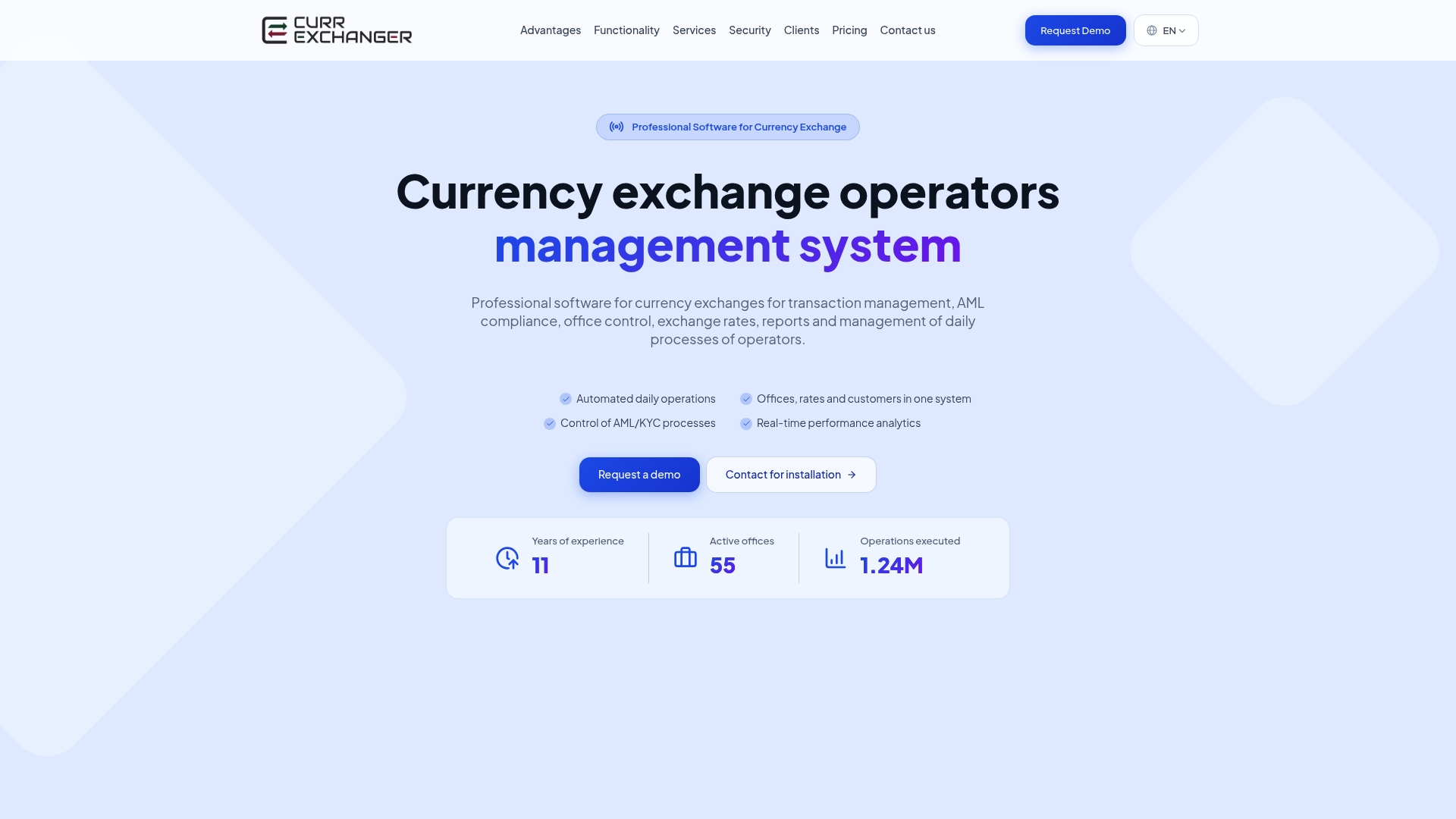
Currexchanger is designed for currency exchange operators managing multiple offices. Its centralized dashboard gives compliance officers real-time visibility across every branch, with automated AML and KYC workflows, unified transaction logs, and role-based access controls. The platform connects to external AML and KYC providers, supports API integration with accounting systems, and enforces consistent document verification across all locations. Compliance officers can review branch activity, generate audit-ready reports, and set automated alert thresholds without relying on manual branch reporting. Explore Currexchanger's compliance platform to see how it addresses the structural failures that drive regulatory risk in multi-location operations.
FAQ
What are the most common multi-office compliance failures?
The most common failures are monitoring gaps between headquarters and branches, inconsistent workflows, poor data quality, inadequate staff training, and siloed IT systems. Each failure stems from fragmented oversight rather than isolated mistakes.
How do AML failures in multi-office operations lead to penalties?
Regulators penalize structural AML deficiencies, not just individual transactions. ABN AMRO's €8.5 million fine in july 2026 resulted from systemic monitoring failures across its operations, not a single compliance breach.
What is the fastest way to fix compliance drift across branches?
Centralizing compliance monitoring through a shared platform with real-time data feeds from all branches is the fastest structural fix. Standardizing workflows and mandatory training reinforcement address the human factors that technology alone cannot resolve.
How does data quality affect compliance in multi-location firms?
Inconsistent charts of accounts and poor data mapping between branch and group systems cause manual reconciliation errors and delayed regulatory reporting. Standardizing data at the source level prevents most financial reporting compliance failures.
Why does staff training matter for branch compliance?
Branch-level training gaps directly increase error rates in KYC documentation, suspicious activity reporting, and sanction screening. Ongoing scenario-based training, not just initial onboarding, keeps compliance behavior consistent across distributed teams.