
Automated reconciliation pulls transaction data from every source your finance team touches, applies configurable matching rules, and routes unmatched items to the right person for resolution — all without a spreadsheet in sight. The mechanism is straightforward: continuous data ingestion feeds a normalization layer, a matching engine works through deterministic then probabilistic rules, and exceptions surface in a structured workflow rather than an inbox. For finance teams, the immediate, measurable outcomes look like this:
- Close cycles that compress significantly from multiple days to a much shorter timeframe
- Match rates of 70–95% straight-through processing without manual intervention
- Exception backlogs that shrink because items are routed to the right owner automatically
- Audit trails generated in real time, not reconstructed after the fact
- Substantial reduction in FTE hours spent on reconciliation, freeing analysts for judgment work
A Gartner survey found that a significant share of accountants make several errors per week because of capacity constraints. Automation doesn't just speed things up, it removes the systemic quality problem that overloaded teams create.
Key Takeaways
Automated reconciliation delivers 70–95% straight-through processing, 30–40% fewer FTE hours per cycle, and close cycles compressed by 60–80% — with audit trails generated in real time rather than reconstructed after the fact.
| Point | Details |
|---|---|
| STP rate is the core KPI | Target 70–95% straight-through processing; any drop signals a data or rule problem to investigate. |
| Data normalization drives match rate | Consistent reference fields and canonical ledger formats matter more than the matching engine itself. |
| Humans handle exceptions, not matching | Automation replaces line-by-line comparison; analysts focus on resolution judgment and escalation. |
| Audit trail must be exportable | Require immutable, structured audit logs as a contract term — not a nice-to-have feature. |
| Currexchanger fits currency operators | Multi-branch, multicurrency reconciliation with API integrations and compliance controls built in. |
Table of Contents
- What automated reconciliation covers in finance
- How the automated reconciliation process works, step by step
- Manual vs. automated reconciliation: what actually changes
- Tangible benefits and measurable impact
- Common use cases, including currency-exchange and Central Europe operations
- Implementation checklist for Central Europe finance teams
- How AI and machine learning improve reconciliation
- KPIs, dashboards, and audit readiness
- How to evaluate and select a reconciliation solution
- A practical perspective on implementation
- Currexchanger handles reconciliation for currency operators
- Sources
- FAQ
What automated reconciliation covers in finance
Automated reconciliation is the use of software to compare and confirm that two or more sets of financial records agree, replacing the manual process of line-by-line comparison with rules-driven matching and exception routing. The core functions are ingestion, matching, exception surfacing, and audit trail generation.
The technology typically handles bank reconciliation (statement vs. general ledger), cash reconciliation, accounts receivable and payable matching, intercompany netting, payroll reconciliation, card and merchant settlement, and FX settlement. For Central Europe operations, IBAN and SEPA file formats are a practical reality: reconciliation logic must parse ISO 20022 XML messages, handle SEPA Credit Transfer and Direct Debit structures, and accommodate multicurrency FX settlement timing across EUR, CZK, PLN, HUF, and other regional currencies. Cross-border payment service provider formats add another layer, since a single transaction may carry different reference fields depending on whether it routes through a local PSP or a pan-European rail.
How the automated reconciliation process works, step by step
The full flow runs from raw data ingestion through to a closed, auditable ledger entry — and each stage has a direct effect on match rate and exception volume.
-
Data ingestion. Connectors pull data from bank feeds (MT940, CAMT.053), ERPs, payment processors, card networks, and internal ledgers. Forrester's payment fabric research shows that systems reading multiple payment rails through a normalized model outperform those built around a single source. Frequency matters: real-time or near-real-time ingestion catches timing differences before they become exception backlogs.
-
Normalization. Raw records arrive in different formats, currencies, date conventions, and reference field structures. The normalization layer converts everything to a canonical ledger format — consistent date stamps, a common currency base for cross-currency items, and standardized reference fields. This is where ISO 20022 parsing and SEPA-specific field mapping happen for Central Europe teams.
-
Deterministic matching. The engine first applies exact-match rules: one-to-one (single debit matches single credit), one-to-many (one payment against multiple invoices), many-to-many (batch settlement against multiple line items). Reference numbers, amounts, value dates, and counterparty identifiers are the primary keys. Match confidence is high and no human review is needed.
-
Probabilistic matching. Items that don't clear deterministic rules go through a scoring model. The engine evaluates partial amounts, near-date matches, fuzzy reference strings, and cross-currency equivalents (accounting for FX rate tolerance bands). A scored match above a configurable threshold is auto-accepted; below threshold, it queues for review.
-
Exception classification and routing. Unmatched items are categorized — missing reference, partial settlement, timing difference, currency rounding, duplicate, or genuine discrepancy — and routed to the owner best placed to resolve each type. A missing IBAN reference goes to the payments team; a timing difference waits for the next settlement cycle; a genuine discrepancy escalates to a controller.
-
Resolution and learning loop. When a human resolves an exception, the system records the resolution logic. ML-assisted engines use that history to improve probabilistic scores over time, reducing repeat exceptions for the same counterparty or payment type.
For transaction management systems that handle high-volume currency operations, steps 3 and 4 are where most of the efficiency gain lives.
Pro Tip: Set your deterministic match rules to cover at least 80% of expected transaction volume before going live. Teams that skip this calibration step and rely on probabilistic matching from day one see exception rates two to three times higher in the first month, which erodes confidence in the system before it has a chance to learn.
Manual vs. automated reconciliation: what actually changes
Automation replaces repetitive matching work. Humans remain essential for exception resolution, judgment calls on ambiguous items, and governance sign-off. The operational difference between the two approaches is significant across every dimension that matters to a finance leader.
| Dimension | Manual reconciliation | Automated reconciliation |
|---|---|---|
| Speed | Days to weeks per cycle | Hours to one day per cycle |
| Error rate | High — capacity-driven errors weekly | Low — rules applied consistently |
| Audit trail | Reconstructed from spreadsheets | Generated in real time, immutable |
| Scalability | Degrades with volume | Scales linearly with transaction count |
| Staffing impact | FTE-intensive, bottlenecks at month-end | FTEs shift to exception review and analysis |
| Exception handling | Ad hoc, email-based | Structured routing with SLAs |
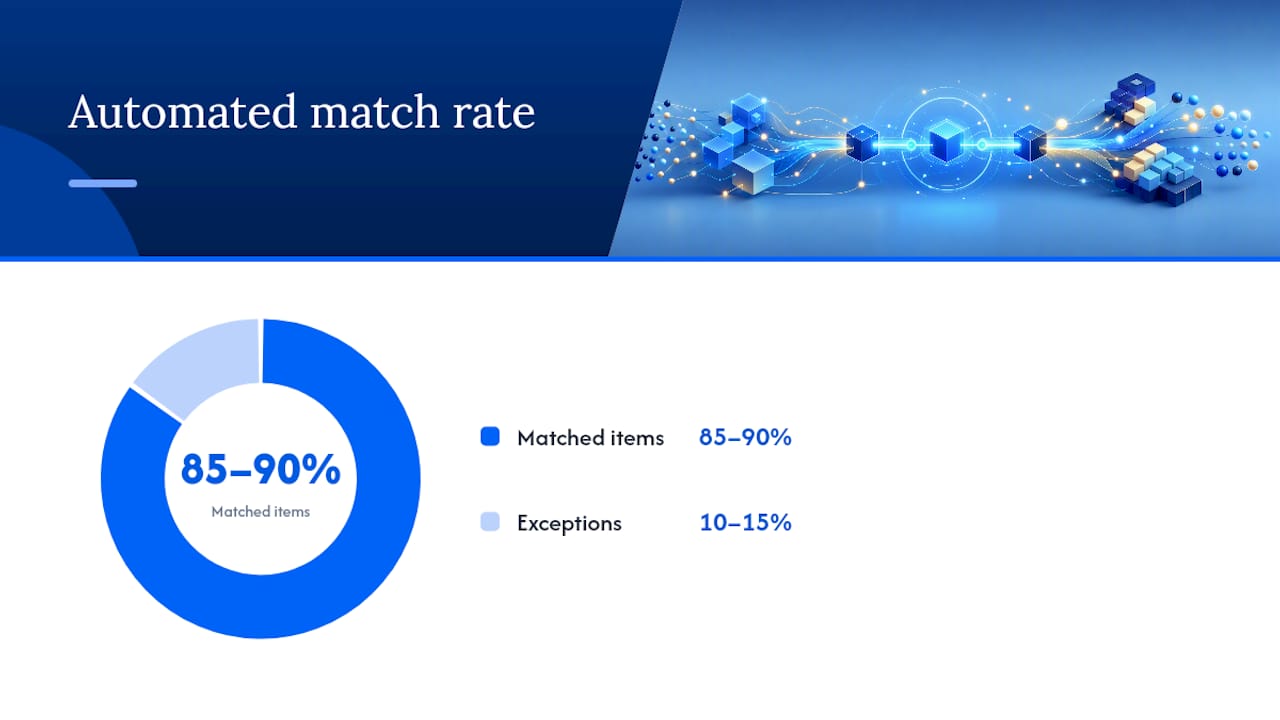
Two scenarios show the contrast clearly. At month-end close, a manual team spends two to three days pulling bank statements, cross-referencing the general ledger, and chasing down unmatched items by email. An automated system has already matched 85–90% of items continuously throughout the month; the close-day task is reviewing the exception queue, not starting from scratch. For a high-volume e-commerce settlement operation processing thousands of card transactions daily, manual reconciliation is simply not viable — the volume exceeds what any team can handle line by line. Automation handles the matching; analysts handle the edge cases.
The residual human role is real and worth stating plainly. Automated systems surface exceptions; people decide what to do with them. That judgment layer is where finance expertise still earns its keep.
Tangible benefits and measurable impact
The top benefits of automated reconciliation are accuracy, speed, auditability, and the ability to scale without adding headcount. Each is measurable, which matters when you're presenting a business case to leadership.
According to NAYA's reconciliation automation framework, deployments across fintech and high-volume operations consistently show 70–95% straight-through processing rates, 30–40% reductions in FTE hours, and 60–80% faster close cycles. Those aren't theoretical — they reflect measured outcomes from production environments.
| Metric | Pre-automation typical range | Post-automation typical range |
|---|---|---|
| Straight-through processing rate | 30–40% | 70–95% |
| Close-cycle duration | Multiple days | Short duration |
| FTE hours per reconciliation cycle | High baseline | 30–40% reduction |
| Exception rate reaching downstream | Elevated | Reduced |
Beyond the numbers, real-time reporting changes how finance teams operate day to day. Cash visibility improves because reconciliation runs continuously, not once a month. Audit readiness becomes a standing state rather than a scramble before an audit date. And the error-rate reduction addresses the systemic quality problem that capacity-constrained teams face — the same problem the Gartner survey quantified.

Common use cases, including currency-exchange and Central Europe operations
The highest-impact use cases are bank and cash reconciliation, merchant settlement, intercompany netting, and FX settlement — with currency-exchange desks representing one of the most demanding reconciliation environments in Central Europe.
Key use cases by sector and process:
- Bank and cash reconciliation: Daily matching of bank statements against the general ledger, handling CAMT.053 and MT940 formats common across Central European banking.
- Card and merchant settlement: Matching card network payouts against sales records, accounting for processing fees, chargebacks, and settlement timing lags.
- Intercompany netting: Reconciling intercompany balances across entities, particularly relevant for multi-branch operators managing EUR, CZK, PLN, and HUF positions simultaneously.
- Payroll reconciliation: Confirming payroll disbursements match payroll records and GL postings. Payroll reconciliation adds complexity when payroll runs across multiple currencies or legal entities.
- FX settlement and cash positioning: For currency exchange desks, every transaction involves a buy and a sell leg in different currencies. Reconciliation must confirm both legs settled, at the correct rate, within the agreed value date.
- Cross-border PSP formats: Central Europe operations frequently deal with multiple PSP formats simultaneously. Normalization must handle local banking formats alongside SEPA rails.
A practical currency-exchange example: a desk in Warsaw processes EUR/PLN and USD/PLN transactions throughout the day. At end of day, the reconciliation engine ingests the cash position report, the transaction log, and the bank's CAMT.053 file. It matches each buy and sell leg by transaction reference and value date, flags any rate discrepancy above the configured tolerance, and routes currency rounding differences below a materiality threshold to auto-accept. The controller reviews only the three items that exceeded tolerance — not 400 transactions.
Implementation checklist for Central Europe finance teams
A well-scoped implementation typically runs 8–16 weeks from discovery to go-live, with payback measurable within the first full close cycle. The timeline stretches when data quality is poor or source systems use inconsistent reference fields.
- Discovery and process mapping. Document every reconciliation type, data source, volume, and current exception rate. Identify which accounts are highest-volume and lowest-exception — those are your pilot candidates.
- Connector setup. Configure integrations to bank feeds (CAMT.053/MT940), ERP, payment processors, and any local PSPs. For Central Europe, confirm SEPA and IBAN format support before signing a contract.
- Data normalization design. Define the canonical ledger format: date convention, currency base, reference field hierarchy. This step determines match rate more than any other.
- Rule authoring. Write deterministic rules first (exact amount + reference + date). Add probabilistic rules only after deterministic coverage is confirmed.
- Pilot run. Run the engine against 30–60 days of historical data. Measure STP rate, exception rate, and false-positive matches. Adjust rules before touching live data.
- Exception workflow design. Map each exception category to an owner, define resolution SLAs, and configure escalation paths. This is where most implementations underinvest.
- Training. Train reconciliation analysts on exception review, not on matching — the system handles matching. Focus training on resolution logic and escalation judgment.
- Go-live and monitoring. Run parallel with manual processes for two to four weeks. Track STP rate daily; investigate any drop above two percentage points.
Cost factors to budget for: data complexity, number of source systems, volume of historical cleanup required, and custom connector development for legacy or local banking formats.
Red flags that signal hidden effort: inconsistent use of reference fields across systems (the single biggest cause of low match rates), legacy flat-file formats with no API alternative, and multiple local banking formats that require custom parsers.
How AI and machine learning improve reconciliation
ML improves match rates and reduces repeat exceptions — but it requires governance controls to be useful in an audit context.
Where ML adds real value:
- Probabilistic inference: Scoring partial matches, fuzzy references, and near-date items that deterministic rules miss, without requiring a human to review every borderline case.
- Anomaly detection: Flagging transactions that deviate from counterparty patterns — an amount 3x the usual settlement, a new bank account for a known vendor — before they clear.
- Auto-suggestions for journal entries: Proposing the correct GL code and cost center for matched items based on historical resolution patterns.
- Prioritized exception routing: Ranking the exception queue by materiality and age, so controllers see the highest-risk items first rather than working chronologically.
A practical example: a split payment arrives from a counterparty who routinely pays one invoice in two installments. Deterministic rules can't match it because neither installment equals the invoice amount. An ML model trained on that counterparty's history recognizes the pattern, scores the two installments as a combined match against the invoice, and auto-accepts above the confidence threshold. The analyst never sees it.
Governance matters here. ML match decisions need explainable rationale stored in the audit log — not just "matched by model" but the specific features that drove the score. Human-in-the-loop requirements should be defined by materiality: auto-accept below a threshold, require approval above it. Testing datasets must include edge cases, not just clean historical data. And activity logs must capture every model decision alongside human overrides, so auditors can reconstruct the full decision chain.
KPIs, dashboards, and audit readiness
The single most important KPI for operational control is the straight-through processing rate — the percentage of transactions that match and close without human intervention. Everything else is context for that number.
KPIs to track on your reconciliation dashboard:
- STP rate (target: 70–95% depending on transaction type and data quality)
- Exception backlog (total open items and age distribution)
- Mean time to resolve exception (by category — timing differences resolve faster than genuine discrepancies)
- Close-cycle duration (calendar days from period end to signed-off reconciliation)
- FTE hours per cycle (track before and after automation to quantify savings)
- Error rate reaching downstream systems (items that cleared reconciliation but caused downstream issues)
For audit readiness, the evidence package auditors expect includes: immutable activity logs with timestamps and user IDs for every action, match rationale records showing which rules or model scores drove each match, user approval records for exceptions resolved manually, change logs for any rule modifications, and timestamped links to the source files used in each reconciliation run. A system that can't export all of this in a structured format is a liability at audit time, regardless of how good its match rate is.
How to evaluate and select a reconciliation solution
Prioritize matching architecture, multi-source ingestion, exception routing, audit trail completeness, and integration APIs. Everything else is secondary.
Questions to ask in vendor demos:
- What integration types do you support natively? (CAMT.053, MT940, SEPA XML, REST API, flat file)
- How does the matching engine work — deterministic first, then probabilistic, or purely ML?
- What is your SLA for connector updates when a bank changes its file format?
- Can exception workflows be customized by category, amount, and counterparty?
- Are audit logs immutable and exportable in a structured format?
- What security controls are in place — MFA, IP restrictions, role-based access?
- Do you support SEPA and IBAN formats natively, or through a third-party parser?
- How do you handle multicurrency reconciliation and FX rate tolerance settings?
Red flags to watch for:
- Matching logic described as a "black box" with no explainability in the audit log
- Audit trails that exist in the UI but can't be exported or are mutable
- No API or webhook support — file-only integrations create manual steps that defeat the purpose
- Limited currency support or no native handling of Central European banking formats
- Vague answers about how the system handles split payments or partial settlements
Currexchanger maps directly to this checklist. The platform supports API integrations with accounting systems, payment processors, and AML/KYC providers; includes detailed, immutable activity logs; enforces MFA and IP-based access controls; and is built for multicurrency, multi-branch operations — the exact configuration most Central Europe currency operators run. Currency exchange accounting integration is a core design assumption, not an afterthought.
A practical perspective on implementation
The teams that get the most from reconciliation automation are the ones that invest in data hygiene before they invest in software.
Start with your highest-volume, lowest-exception account — typically a main operating bank account with clean IBAN references. Get that account to 85%+ STP before expanding to more complex sources. The discipline this builds (consistent reference fields, agreed normalization rules, documented exception ownership) transfers directly to every subsequent account you onboard.
The second step most teams skip: codify your reference field standards across every system that feeds the reconciliation engine. If your ERP uses one invoice numbering format and your payment processor uses another, the matching engine will spend most of its probabilistic budget on a problem that a one-time data governance decision could eliminate. Fix the reference field first; the match rate improvement is immediate and permanent.
Currexchanger handles reconciliation for currency operators
Currency exchange operators running multi-branch networks face a reconciliation challenge most generic finance tools aren't designed for: multicurrency cash positions, FX settlement legs, AML/KYC transaction flags, and branch-level reporting all need to reconcile simultaneously, across formats that vary by country and banking partner.
Currexchanger is built specifically for this environment. The platform connects to accounting systems, payment processors, and AML/KYC providers via API; generates immutable activity logs that satisfy audit and compliance requirements; enforces MFA and IP-based access controls at the user level; and supports multi-branch, multicurrency reconciliation from a single dashboard. Exception workflows, rate tolerance settings, and reporting modules can be tailored to local requirements — including SEPA/IBAN formats and Central European banking rails. For operators who need custom module development, that's available too.
See how Currexchanger fits your operation: Currexchanger and bring your current reconciliation volume and source-system list to the conversation.
Sources
- Gartner survey shows that a third of accountants make several error per week due to capacity constraints
- Simplicity underpins future payment fabric and the future of payments (Forrester blog)
- Automated reconciliation: Everything you need to know
This article is general information, not a substitute for advice from a qualified financial advisor. Consult a qualified financial professional about your own circumstances before acting on anything here.
FAQ
What is automated reconciliation and how does it work?
Automated reconciliation uses software to ingest transaction data from multiple sources, apply matching rules to confirm records agree, and route unmatched items to the right owner for resolution. The process runs continuously rather than at period-end, generating an audit trail in real time.
How does reconciliation work in finance?
Reconciliation in finance confirms that two sets of records — typically a bank statement and a general ledger — show the same balances and transactions. Automated systems handle the comparison and flagging; finance staff resolve the exceptions the system can't auto-match.
How do you automate the reconciliation process?
Start by mapping your data sources and volumes, then configure connectors and normalization rules before authoring matching logic. Run a pilot against historical data to calibrate STP rate, then design exception workflows before going live — the implementation checklist above covers each step in order.
Can AI perform bank reconciliation?
AI improves bank reconciliation by scoring probabilistic matches that deterministic rules miss — split payments, fuzzy references, near-date items — and by prioritizing the exception queue by materiality. It doesn't replace human judgment for genuine discrepancies, and every AI-driven match decision should be logged with explainable rationale for audit purposes.