
Financial data governance is the system of policies, ownership, and controls that turns raw transaction data into accurate, auditable numbers finance leaders can act on without double checking. Done well, it produces three concrete outcomes: decision-grade reports that hold up under scrutiny, audit defensibility built on documented lineage rather than tribal knowledge, and faster close cycles because reconciliation happens by rule instead of by hand. The concept borrows heavily from banking supervision frameworks like BCBS 239, which pushed institutions to name data owners and prioritize their most critical elements.
- Decision-grade data: numbers management can act on without manual re-verification
- Audit defensibility: clear ownership, lineage, and change history for every reported figure
- Operational speed: fewer manual reconciliations and shorter month-end cycles
Key Takeaways
Financial data governance works when named owners, documented definitions, and repeatable validation checks turn raw transaction data into numbers finance can defend to auditors and regulators.
| Point | Details |
|---|---|
| Start with a definition | Financial data governance is the policy and accountability layer that produces decision-grade, auditable data. |
| Prioritize CDEs first | Rank data fields by reporting impact, error likelihood, and regulatory sensitivity before building controls. |
| Name real owners | Accountability must sit with specific people, not shared departments or vague policy documents. |
| Build controls before buying tools | Prove manual validation and reconciliation processes work before automating them with technology. |
| Track outcome-linked KPIs | Monitor CDE ownership rates, validation exceptions, and close times to prove governance delivers value. |
This article is general information, not a substitute for advice from a qualified financial advisor. Consult a qualified financial professional about your own circumstances before acting on anything here.
Table of Contents
- What Is Financial Data Governance, Exactly?
- Core Components Of A Financial Data Governance Framework
- Why Financial Data Governance Matters For Decision-Makers
- What Do Regulators And Auditors Expect From Financial Data Governance?
- How Do You Identify And Prioritize Critical Data Elements?
- Who Owns Financial Data Governance?
- How Do You Actually Implement Financial Data Governance?
- What Technology Supports Financial Data Governance?
- Which KPIs Prove Financial Data Governance Is Working?
- Common Governance Pitfalls And The Role Of AI
- Where Financial Data Governance Shows Up In Daily Work
- How Platform Capabilities Map To Governance Needs
- Governance Is A Leadership Discipline, Not A Project
- Sources
- FAQ
What Is Financial Data Governance, Exactly?
Most finance teams already do fragments of governance. Someone owns the chart of accounts. Someone reconciles bank statements. Someone reviews access to the ERP. Financial data governance is what happens when those fragments become one accountable system instead of scattered habits that live in one analyst's head.
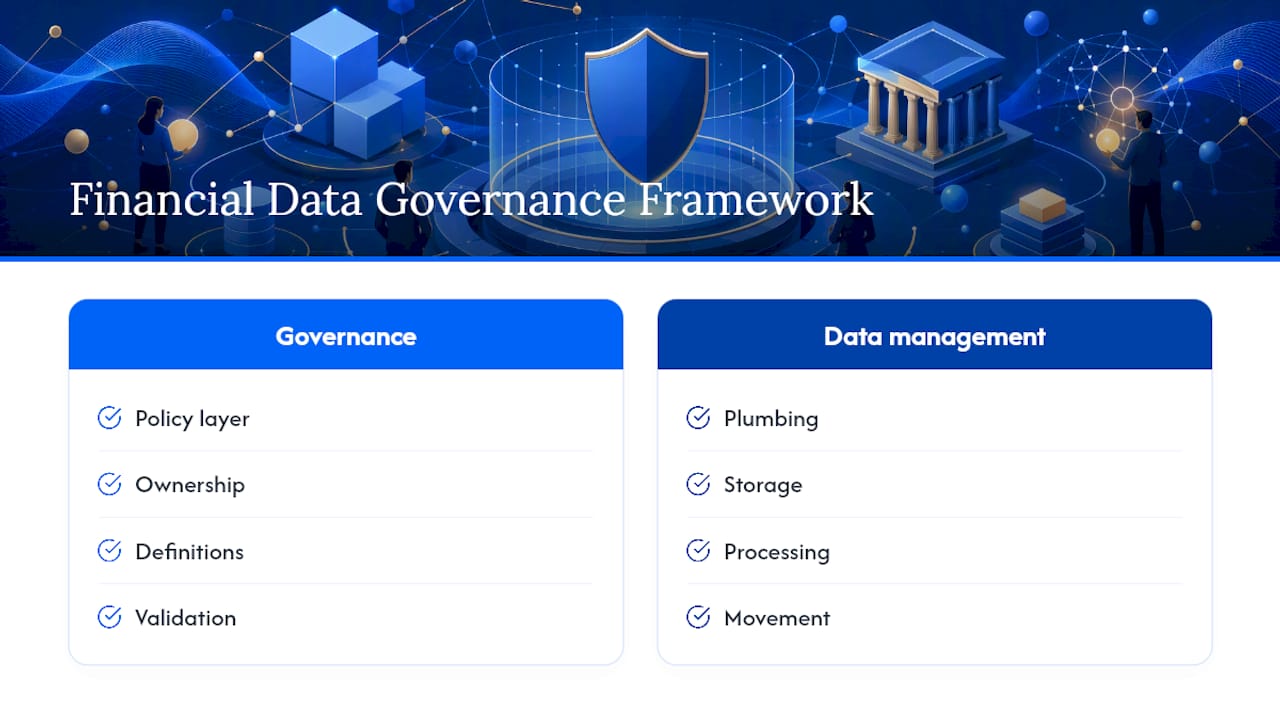
The Financial Data Governance Framework from Onetribe Advisory frames it as five dimensions working together: ownership, definitions, validation, reconciliation, and change control, layered across four maturity stages from ad hoc to fully governed. That framing matters because it separates governance from plain data management. Data management is the plumbing, storage, processing, and movement of information. Governance is the policy layer that decides who's accountable when a number looks wrong, and what standard that number has to meet before anyone reports it externally.
Core Components Of A Financial Data Governance Framework
A working framework rests on a handful of components, each with a distinct job:
- Policy and standards: the written rules defining what "accurate" and "complete" mean for financial data, not left to interpretation.
- Data owners: senior stakeholders accountable for a data domain's accuracy, even when they didn't create the data themselves.
- Data stewards: the people who actually maintain definitions, run quality checks, and fix issues day to day.
- Critical Data Elements (CDEs) and definitions: a documented shortlist of the fields that matter most for reporting and risk.
- Validation and reconciliation: repeatable checks that catch errors before they reach a report, not after.
- Lineage and source-of-truth: a record of where a number originated and every transformation it passed through.
- Access and retention: rules controlling who can view, edit, or delete financial records, and for how long.
Pro Tip: Don't try to govern every data field on day one. Pick five to ten CDEs tied to your riskiest reports, build a repeatable validation check for each, and expand from there. Trying to govern everything at once is the single fastest way to stall a governance program before it produces anything.
Why Financial Data Governance Matters For Decision-Makers
Practitioners at Guidehouse argue the biggest misconception in financial services is treating data quality as a back-office chore. Treated instead as a strategic asset, governance speeds up decisions, sharpens risk management, and improves how clients experience the business.
The benefits show up in specific places:
- Higher-confidence forecasts and board reports, because the underlying numbers have already been validated
- Stronger audit defensibility, with documented ownership and lineage instead of ad hoc explanations
- Regulatory readiness, since supervisors increasingly expect named accountability for critical data
- Fewer manual reconciliations, freeing analysts for actual analysis instead of chasing discrepancies
- Better client experience, since KYC and account data errors get caught before they cause friction
The pattern practitioners report is straightforward: institutions that treat governance as strategic infrastructure rather than compliance overhead see faster, more confident decisions and less friction with regulators and clients alike, according to Guidehouse's analysis. Real-time reporting tools compound that advantage, since visibility into live numbers shortens the gap between a problem occurring and someone noticing it.
What Do Regulators And Auditors Expect From Financial Data Governance?
Supervisors don't grade you on having a governance policy document. They look for evidence the policy actually functions. Guidance tied to BCBS 239 consistently points institutions toward prioritizing critical data elements first, with named owners and defined quality standards for anything feeding supervisory reports.
Enforcement trends back this up. Regulators increasingly treat weak account and client data controls as compliance failures in their own right, not just an operational nuisance. Denmark's data protection authority proposed a substantial fine against a major bank over data governance failures, a case the EDPB documented as an example of how seriously supervisors now weigh this.
An auditor reviewing your governance program typically looks for:
- A named owner for every critical data element, not a shared inbox
- Written definitions that don't change depending on who you ask
- Documented lineage from source system to final report
- Evidence of validation and reconciliation checks actually running
- A change control log showing who altered definitions or rules, and when
Regulators don't ask whether you have a governance policy. They ask whether you can prove, with evidence, that a specific number is right and who is accountable if it isn't.
Pro Tip: Regulatory expectations vary by jurisdiction and sector, and BCBS 239 was written for large banks, not every currency exchange operator. Treat these frameworks as the baseline standard and confirm your exact obligations with local regulatory guidance or reporting requirement research specific to your market.
How Do You Identify And Prioritize Critical Data Elements?
Not every data field deserves the same level of scrutiny. CDE prioritization is how you decide where limited governance resources go first.
- Rank by impact: start with fields that feed regulatory reports, external financial statements, or major business decisions.
- Weigh likelihood of error: fields fed by manual entry or multiple source systems carry higher risk than automated, single-source feeds.
- Factor regulatory sensitivity: anything tied to AML/KYC, sanctions screening, or supervisory submissions moves up the list automatically.
Common financial CDEs include revenue by channel, bank account balances, counterparty legal names, intercompany balances, and KYC risk ratings. Each one needs a short documentation record: its definition, its source system, its named owner, and the validation checks that confirm it's correct.
Who Owns Financial Data Governance?
Accountability has to sit with named people, not a policy binder. The core roles are an executive sponsor who funds and protects the program, a data owner accountable for a specific domain's accuracy, a data steward who does the daily maintenance, a data office or CDO coordinating standards across teams, and IT security plus second-line risk or compliance reviewing controls.
A mini-RACI for one CDE, say counterparty legal name, might read: the data owner approves the definition, the steward validates it against source records monthly, IT security controls who can edit it, and compliance signs off on any change.
- Finance should lead when the data feeds financial statements or regulatory filings.
- IT or the data office should coordinate when the scope spans multiple business lines.
- A hybrid model, with finance sponsoring and a central office coordinating, works well for most mid-market institutions, as the Journal of Accountancy notes about finance's natural accountability for reported numbers.
How Do You Actually Implement Financial Data Governance?
Governance programs fail most often when teams try to build the entire structure before proving any of it works. A phased rollout avoids that trap.
- Discovery and CDE prioritization: inventory your data domains and rank the highest-risk fields.
- Pilot: pick two or three CDEs, document owners and definitions, and build validation checks for just those.
- Remediation: fix the data quality issues the pilot surfaces before expanding scope.
- Automation: once checks are proven manually, automate reconciliation and monitoring where it makes sense.
- Operating model and scale: formalize the governance council, extend the framework to additional CDEs, and repeat.
After each phase, confirm:
- Definitions are documented and agreed, not just assumed
- Owners are named individuals, not departments
- Validation tests are running and logged
- Lineage evidence exists from source to report
Pro Tip: Skipping the foundational steps to buy a governance platform is the most common expensive mistake. Build the repeatable manual controls first. Technology should enforce a process you've already proven works, not replace the thinking behind it. Correspondent banking relationships often force this discipline early, and a compliance checklist built for that context translates well to broader CDE rollouts.
What Technology Supports Financial Data Governance?
Tools don't create governance, but the right ones make it enforceable at scale. Gartner's guidance is blunt on this point: catalogs, lineage tools, and quality monitors are enablers, and governance is the accountability layer that makes them actually work.
The minimum viable toolset includes:
- A metadata catalog documenting what each data field means and where it lives
- Lineage tracking showing a number's path from source to report
- Quality monitoring that flags anomalies automatically instead of relying on someone noticing
- A reconciliation engine matching records across systems
- Role-based access controls and activity logs recording who touched what
- Versioning and change control for definitions and business rules
Early in a program, keep validation checks manual so the team understands the logic before automating it. Once a check has run reliably for a few cycles, automate it and redirect that time to the next CDE. For teams handling payment card data, standards from the PCI Security Standards Council should inform access and retention rules from the start.
Which KPIs Prove Financial Data Governance Is Working?
Governance investments need measurable proof, not just a policy document nobody reads. Track a small set of KPIs monthly:
- Percentage of CDEs with a named owner and documented definition
- Number of validation exceptions per reporting cycle
- Time to close month-end
- Reconciliation backlog size
- Audit exceptions raised by internal or external auditors
- Duplicate record rates across systems
Each metric maps directly to something leadership cares about. Fewer validation exceptions means less risk reaching a report. A shrinking reconciliation backlog means faster closes. Share CDE ownership and exception counts with the governance council monthly, and reserve audit exception trends for quarterly reviews with the board or audit committee. A controller's role often includes owning several of these KPIs directly, since controllers sit closest to the numbers being reported.
Common Governance Pitfalls And The Role Of AI
The most frequent mistakes are predictable: ownership gaps where no one actually owns a critical field, definitions that shift depending on who's asked, skipped reconciliation because "the numbers usually match," and buying a tool while skipping the process it's supposed to enforce.
A persistent misconception is that governance is purely an IT project, or that cleaning up a dataset once counts as governance. It doesn't. Cleaning is a one-time fix; governance is the ongoing system that keeps data clean.
Will AI replace data governance? No. AI can flag anomalies and accelerate validation, but it doesn't assign accountability or interpret regulatory nuance. Someone still has to own the answer when a number is wrong.
Where Financial Data Governance Shows Up In Daily Work
- Reporting and consolidation: governance ensures every subsidiary uses the same chart of accounts and definitions before numbers roll up.
- Bank reconciliation: named owners and automated matching catch discrepancies before they reach a close report.
- FX and currency exchange workflows: rate feeds and settlement records need lineage and reconciliation cadence, since transaction monitoring depends on trustworthy source data.
- KYC and account onboarding: risk ratings and identity data need validation checks auditors can inspect on demand.
- Intercompany reconciliation: shared definitions across entities prevent the classic mismatch between what one subsidiary books and what another reports.
How Platform Capabilities Map To Governance Needs
Governance principles only matter once they're operational, and that's where platform choice comes in. Take one illustrative example: a currency exchange operator managing multiple branches needs activity logs to prove who touched a transaction record, role-based access and MFA to enforce the access-control principle, and real-time analytics to catch reconciliation gaps before month-end instead of after.

Currexchanger was built around exactly those governance needs, pairing audit trails and API integrations with accounting systems so lineage doesn't depend on someone's memory. This is one example of governance principles mapped to real features, not a product review; any vendor should be evaluated against the same checklist: does it log activity, enforce access rules, and produce lineage evidence an auditor could actually use? Teams evaluating liquidity tracking across currencies will recognize the same governance logic applied to a specific operational problem.
Governance Is A Leadership Discipline, Not A Project
Financial data governance fails when it's treated as a one-time IT initiative instead of an ongoing leadership responsibility. The finance leaders who get this right don't wait for a perfect framework. They name owners, define a handful of CDEs, and hold people accountable for outcomes, then let the program mature from there.
Sources
- An essential data governance framework for financial institutions (Guidehouse)
- Data governance: How finance builds trust in the numbers (Journal of Accountancy)
- The Financial Data Governance Framework (Onetribe Advisory)
FAQ
What Does Financial Governance Mean?
Financial governance refers to the policies, roles, and controls organizations use to ensure financial data and processes are accurate, accountable, and compliant with regulatory expectations.
What Is Data Governance In Simple Terms?
Data governance is the system that decides who owns a piece of data, what it means, and how its accuracy gets checked before anyone relies on it.
Will AI Replace Data Governance?
No. AI can automate validation checks and flag anomalies faster than a person could, but it cannot assign accountability or make judgment calls that regulators expect a named human to own.
What Is An Example Of Data Governance?
A bank naming a specific data owner for "customer legal name," documenting its definition, and running monthly validation checks against source records is a concrete example of data governance in action.
How Do You Start Implementing Financial Data Governance?
Start by identifying a handful of critical data elements tied to your highest-risk reports, assign named owners, document definitions, and build validation checks before expanding to additional data domains.