
Revenue tracking in currency companies is defined as the systematic recording, aggregation, and analysis of foreign exchange transactions to derive actual net income, separate from gross volume flows. Currency exchange professionals rely on three interlocking disciplines: transaction-level accounting, multi-currency accounting standards, and compliance with regulatory frameworks such as EU AML Regulation and CESOP VAT reporting. Understanding how currency companies track revenue is not optional. Regulators, auditors, and acquirers all scrutinize the integrity of this process. Currexchanger builds its reporting infrastructure around exactly these requirements, giving operators a single platform where transaction data, compliance records, and financial analytics converge.
How currency companies track revenue: primary methods and systems
Currency firms measure income through two distinct layers: gross transaction volume and net revenue margin. Gross volume is the total face value of currency exchanged. Net revenue is the spread earned on each transaction after accounting for the buy and sell rates applied. Auditors flag high gross flows with thin margins that lack settlement documentation as a layering risk, which means the two figures must always be tracked and reported separately.
The core operational tools that support this separation include:
- Transaction counters and aggregation logic. Currency exchange offices must count transactions systematically to identify linked or repetitive transactions as required by Article 19(9) of the EU AML Regulation. At least three transactions within a rolling 12-month period signal repetition, and detection uses a rolling one-month aggregation window.
- Multi-currency accounting modules. Every transaction is recorded at the rate applied on the transaction date. Open foreign currency positions are revalued at period-end closing rates. This produces both realized and unrealized exchange differences, each treated differently in the profit and loss statement.
- Real-time transaction management systems. These systems capture rate, volume, counterparty, and timestamp at the point of exchange. They feed directly into accounting ledgers and compliance dashboards, eliminating manual re-entry errors.
- Supervisory account charts. Statutory accounting records must divide institutional funds, safeguarded client balances, and operational fees into distinct account categories. Regulators require this separation to verify that client money is not commingled with operating revenue.
Pro Tip: Set your transaction management system to flag any transaction that falls just below your AML reporting threshold. Structuring, the practice of splitting transactions to avoid detection, is one of the first patterns regulators look for when reviewing revenue records.
How do multi-currency accounting standards influence revenue tracking accuracy?
Multi-currency accounting standards determine whether a currency firm's financial statements reflect actual economic performance or a distorted picture driven by rate fluctuations. The core rule is straightforward: record each transaction at the exchange rate in effect on the transaction date, or at a valid period average rate if permitted by the applicable accounting standard.
Year-end revaluation is where most firms introduce errors. Open foreign currency positions, meaning currency held in inventory or receivables denominated in a foreign currency, must be revalued at the closing rate on the last day of the reporting period. The difference between the carrying value and the revalued amount is an unrealized exchange difference. It appears in the profit and loss statement but does not represent cash received. Realized differences, by contrast, arise when a position is actually settled.
The table below shows how the two types of exchange differences are treated in financial reporting:
| Exchange difference type | When it arises | P&L treatment | Cash impact |
|---|---|---|---|
| Realized | Position settled at a different rate than recorded | Recognized immediately | Yes |
| Unrealized | Open position revalued at period-end closing rate | Recognized in current period | No |
| Translation difference | Prior period revenue restated at current rates | Reported separately | No |
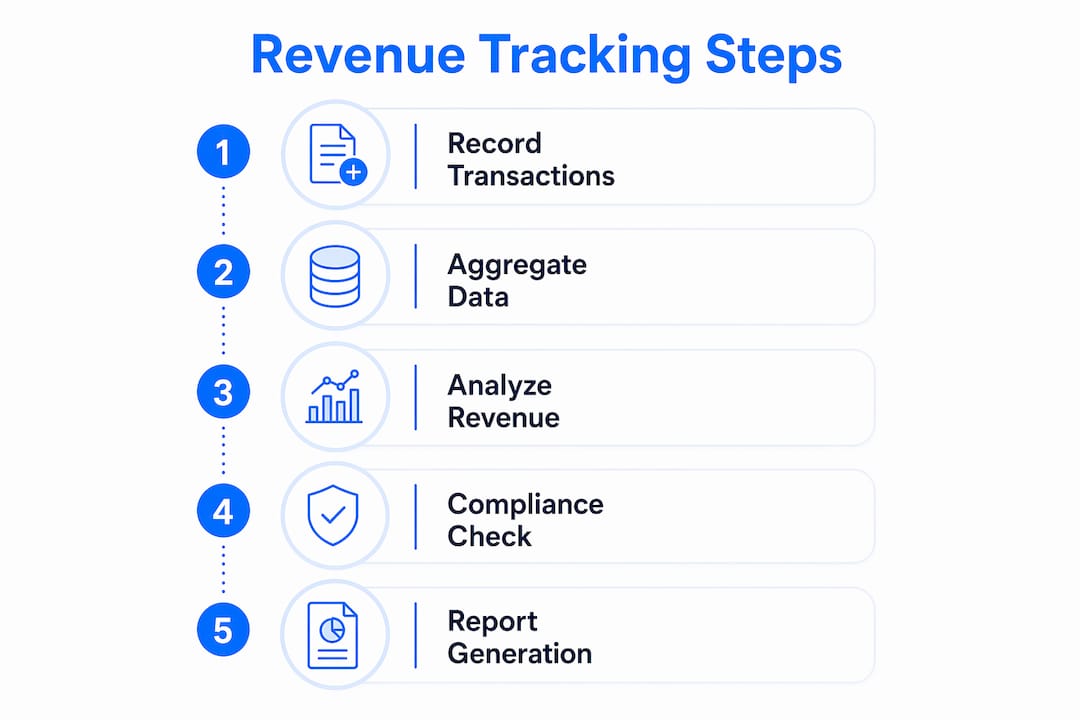
A common pitfall is applying a single blended rate across the entire profit and loss statement for the period. This approach masks the actual margin earned on individual transactions and fails audit scrutiny. Currency exchange platforms often use their own conversion rates that differ from central bank reference rates. Those differences must be reconciled or documented to avoid discrepancies during regulatory review.
Pro Tip: Reconcile your internal conversion rates against the European Central Bank reference rates at least weekly. A documented reconciliation log is far easier to produce during an audit than a retroactive explanation.
What regulatory and compliance requirements affect revenue reporting?
Regulatory obligations shape how currency firms design their entire revenue tracking architecture. Three frameworks carry the most operational weight for exchange operators in 2026.
- EU AML Regulation, Article 19(9). Currency exchange offices must maintain transaction counters that identify linked and repetitive transactions. The rolling aggregation period is one month, and three or more transactions within 12 months establish a pattern of repetition. This requirement directly affects how revenue data is structured in the underlying database.
- CESOP reporting. Payment service providers must retain cross-border payment records for five years to comply with CESOP. The regulation targets VAT fraud detection across the EU. Every foreign-currency transaction must be recorded at the transaction date rate and revalued annually at closing rates, creating a direct link between VAT compliance and multi-currency accounting.
- Ongoing monitoring frameworks. Compliance is shifting from periodic checks to continuous customer lifecycle monitoring that integrates transaction monitoring, KYC reviews, and risk triggers. Non-siloed systems with a unified compliance architecture are the standard. Siloed systems create structural vulnerabilities that regulators treat as control failures.
The documentation standard has also changed. Regulators such as the FCA and CySEC now require currency firms to maintain living compliance records that show active monitoring and documented interventions, not static files.
"Documentation must show the rationale and action taken on identified anomalies. Static compliance files are inadequate. Forex and currency operators must demonstrate that their systems detect, flag, and respond to suspicious patterns in real time."
This expectation means that revenue tracking and compliance monitoring can no longer be separate functions. The transaction record that generates a revenue entry must also carry enough metadata to satisfy an audit trail review by a supervisory authority.
How does reporting infrastructure improve operational efficiency in currency firms?
Strong reporting infrastructure converts raw transaction data into income analysis that operators can actually use. The most effective setups share four characteristics.
First, they integrate directly with ERP and accounting systems. This eliminates the manual export and re-import cycle that introduces reconciliation errors. When a transaction posts in the exchange management system, it simultaneously updates the accounting ledger at the correct transaction date rate.

Second, they map customer locations and transaction types at the point of onboarding. Early mapping of customer locations and transaction types greatly reduces compliance risk and reporting burdens. A firm that knows from day one whether a customer triggers CESOP cross-border reporting avoids costly retroactive corrections.
Third, they use constant-currency revenue analysis to separate operational performance from FX translation effects. Constant-currency comparison recalculates prior period revenues at current exchange rates. This isolates whether the business grew because it processed more transactions or simply because the currencies it holds appreciated. That distinction matters to both management and external auditors.
Fourth, they support real-time anomaly detection. A unified compliance architecture flags unusual transaction patterns as they occur, not at month-end. This protects revenue integrity by catching errors and suspicious activity before they compound into larger reporting problems. Currexchanger's transaction management tools are built around this principle, connecting rate control, transaction recording, and compliance monitoring in one system.
Pro Tip: Build your reporting infrastructure as a permanent asset, not a compliance cost. Acquirers and investors evaluate systemic integrity when assessing currency businesses. A clean, auditable revenue record is a direct input to your firm's valuation.
Key Takeaways
Accurate revenue tracking in currency companies requires separating gross volume from net margin, applying multi-currency accounting standards consistently, and maintaining living compliance records that satisfy AML, CESOP, and supervisory audit requirements.
| Point | Details |
|---|---|
| Separate gross and net revenue | Always track gross volume and net margin independently to satisfy auditors and avoid layering risk flags. |
| Apply transaction-date rates | Record every transaction at the rate in effect on the transaction date, then revalue open positions at period-end closing rates. |
| Meet CESOP retention rules | Retain all cross-border payment records for five years and link them to the correct accounting rate at the time of the transaction. |
| Build living compliance records | Replace static compliance files with active monitoring logs that document anomalies and the actions taken in response. |
| Use constant-currency analysis | Recalculate prior period revenues at current rates to isolate operational growth from FX translation effects. |
Revenue tracking is an infrastructure problem, not an accounting one
Most currency operators I speak with treat revenue tracking as a bookkeeping task. They assign it to an accountant, run a monthly report, and move on. That approach works until a regulator asks for a transaction-level audit trail covering the past five years, or an acquirer wants to verify that gross flows and net margins reconcile cleanly across every branch.
The firms that pass those reviews without disruption are the ones that built their tracking infrastructure before they needed it. They did not retrofit compliance onto an existing system. They designed the system so that every transaction carries the data needed for both financial reporting and regulatory review from the moment it is recorded.
The distinction between gross volume and net revenue is the clearest example of where this matters. A currency office processing $10 million in monthly volume might earn $80,000 in net margin. If the accounting system only records the gross flow, the firm looks like a high-volume operation with no visible income. That pattern triggers AML scrutiny. The fix is not a new report. It is a system that records both figures at the transaction level, every time.
I also see firms underestimate the cost of static compliance files. Regulators do not want to see a folder of KYC documents. They want to see evidence that the firm monitored those customers continuously, updated risk scores when behavior changed, and acted on anomalies. That evidence only exists if the system generates it automatically.
The practical advice is simple: treat your reporting infrastructure the same way you treat your exchange rate feed. It needs to be live, accurate, and always on.
— Bartas
Currexchanger's approach to compliant revenue tracking
Currency exchange operators who need to connect transaction recording, compliance monitoring, and financial reporting in one place will find that Currexchanger is built specifically for that requirement.

Currexchanger automates transaction counters for linked and repetitive transaction detection under EU AML Regulation Article 19(9), records each transaction at the applied exchange rate, and feeds data directly into accounting integrations for multi-currency reconciliation. The platform's real-time dashboards give operators visibility into gross volume, net margin, and compliance status simultaneously. For firms managing currency exchange operations across multiple branches, Currexchanger centralizes the revenue data that auditors and regulators require, without manual consolidation. Operators can also review how Currexchanger supports liquidity tracking across currencies as a complement to revenue reporting.
FAQ
What is the difference between gross volume and net revenue in currency exchange?
Gross volume is the total face value of currency exchanged in a transaction. Net revenue is the margin earned from the spread between the buy and sell rates applied to that transaction.
How long must currency companies retain transaction records?
Payment service providers must retain cross-border payment records for five years under CESOP to support VAT fraud detection and regulatory review.
What does Article 19(9) of the EU AML Regulation require for revenue tracking?
Article 19(9) requires currency exchange offices to maintain transaction counters that identify linked or repetitive transactions, using a rolling one-month aggregation period and a 12-month repetition threshold.
What is constant-currency revenue analysis?
Constant-currency analysis recalculates prior period revenues at current exchange rates to separate genuine operational growth from changes caused by currency translation effects.
Why are static compliance files no longer sufficient for currency firms?
Regulators such as the FCA and CySEC require living compliance records that document active monitoring and specific interventions taken on identified anomalies, not just stored customer documents.