
For Central European retail currency-exchange networks, the right approach is a real-time, branch-aware dashboard that pulls from teller/POS systems, bank statement feeds, cash counters, and AML/KYC providers, then surfaces alerts and KPIs at the branch and network level. That single architecture covers the three outcomes operators care about most:
- Faster incident response: Teller shortfalls and suspicious transactions trigger alerts within seconds, not at end-of-day reconciliation.
- Optimized float: Live cash and banknote inventory data lets you redistribute currency across branches before a shortage affects service.
- Simplified compliance reporting: Immutable audit logs and scheduled AML exports replace manual spreadsheet assembly.
Real-time dashboards shift operations from reactive reconciliation to proactive incident avoidance, directly reducing branch shortfalls and speeding compliance reporting for multi-branch networks.
Currexchanger is built for exactly this use case. If you manage three or more branches in Central Europe, request a pilot before scoping a custom build.
Table of Contents
- What KPIs and widgets does a retail FX performance dashboard need?
- How do you set KPI formulas, thresholds, and branch alert rules?
- What data sources and integrations does your dashboard actually require?
- What compliance and security controls does a multi-branch dashboard need?
- How do you roll out a dashboard across multiple branches?
- What do effective dashboard templates look like?
- How do you measure ROI from a monitoring dashboard?
- Why does Currexchanger fit Central Europe multi-branch FX operations?
- What should your vendor RFP checklist cover?
- Key Takeaways
- The dashboard gap most operators don't see until it's too late
- Currexchanger's pilot program for retail FX networks
- Useful sources for Central Europe operators
- FAQ
What KPIs and widgets does a retail FX performance dashboard need?
Every retail FX monitoring dashboard should organize its widgets into six functional groups. The table below maps each group to its core KPIs and the data fields required to calculate them.
| Widget Group | Core KPIs | Required Data Fields |
|---|---|---|
| Executive overview | Total transactions, net service margin, network cash position | Transaction count, fee revenue, drawer balances |
| Branch roll-up | Completed transaction %, branch vs. peer median throughput | Attempted vs. completed transactions per branch |
| Teller queue & throughput | Avg. service time, transactions per shift | Teller ID, timestamp, transaction duration |
| Cash/float & banknote inventory | Drawer balance by denomination, reorder alerts | Cash-counter exports, denomination-level counts |
| Exchange-rate control panel | Spread vs. ECB/NBP reference, rate update lag | Rate feed timestamps, posted rates, reference rates |
| Compliance summary | Open AML alerts, SAR-threshold breaches, audit log entries | AML provider results, transaction flags, log records |
Power BI forex dashboard templates typically include five analytical pages covering overview, branch analysis, channel analysis, customer segmentation, and monthly trends, which maps closely to this structure.
Refresh cadence matters as much as the KPIs themselves. Teller metrics need true real-time feeds (sub-60-second latency). Cash balances and rate panels work well on a 15-minute near-real-time cycle. Reconciliation and P&L figures can run as daily batch jobs, but they must complete before the branch opens.
How do you set KPI formulas, thresholds, and branch alert rules?
Precise formulas prevent disputes between branches and head office. Two to anchor your setup:
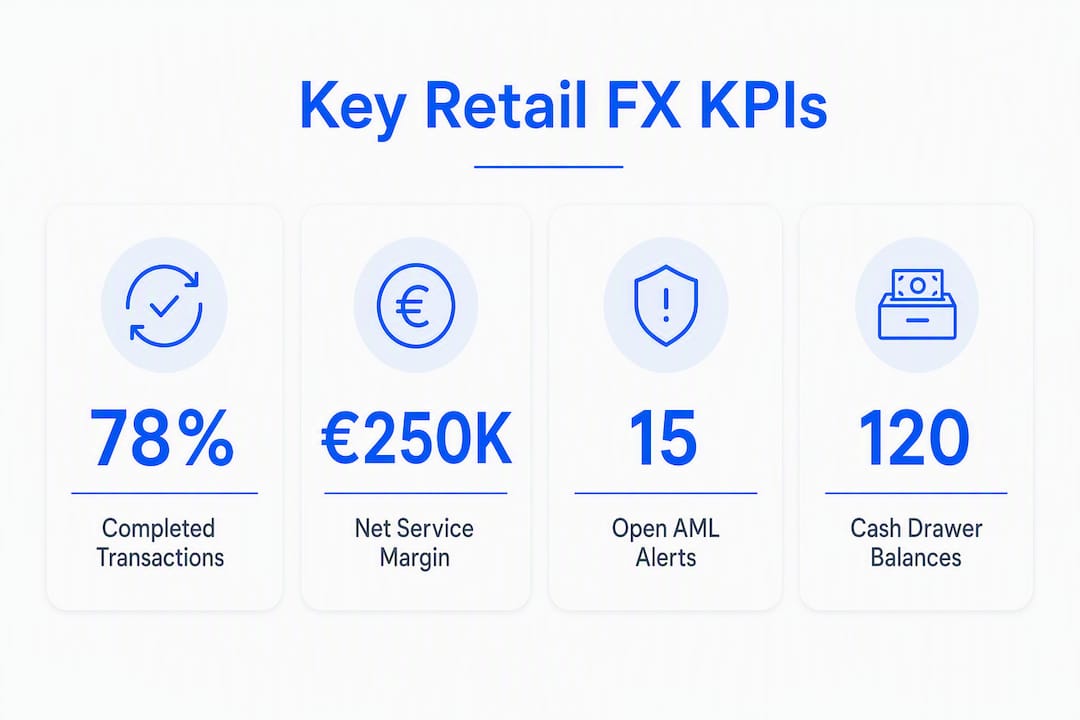
- Completed transaction % = completed transactions ÷ attempted transactions × 100
- Net service margin = total service fees ÷ total converted amount × 100
Threshold types fall into three categories. Absolute thresholds catch hard operational failures (a drawer balance below a fixed floor). Relative thresholds compare a branch to its peer median, which catches underperformance that absolute limits miss. Trend-based thresholds flag a 7-day declining pattern before it becomes a crisis.
A practical escalation workflow: a teller drawer shortfall triggers an in-app alert to the branch manager within 60 seconds. If unacknowledged for 15 minutes, it escalates to the operations desk. If unresolved within an hour, it enters the incident log for compliance review.
Pro Tip: Use rolling 7-day windows and peer-branch baselining to set relative thresholds. A branch in a tourist corridor will naturally run higher transaction volumes than a suburban office. Flat network-wide thresholds create alert fatigue; peer-adjusted ones surface real anomalies. For retail FX, a cash drawer shortfall threshold of a small percentage of expected float or a modest euro amount (whichever is lower) and a high-value conversion flag at €5,000+ are practical starting points.
What data sources and integrations does your dashboard actually require?
The data layer is where most implementations stall. Here is the integration checklist, with required fields and recommended cadence for each source:
| Source | Required Fields | Cadence |
|---|---|---|
| Teller/POS | Transaction ID, branch ID, teller ID, currency pair, amount, fee, timestamp, status | Real-time |
| Cash counters | Denomination, count, branch ID, timestamp | Per-session or 15-min |
| Bank statement / MT940 feed | Account ID, value date, amount, reference, currency | Daily or API push |
| ECB / NBP rate feed | Currency pair, rate, timestamp, source | 15-min or on-change |
| AML/KYC provider | Customer ID, check result, risk score, timestamp | Per-transaction |
| Banknote verifier | Serial range, denomination, verification result, branch ID | Per-session |
| Accounting / GL | Journal entry, account code, branch ID, posting date | Daily batch |
Automated exchange-rate tools that integrate with ECB and NBP feeds log failed updates for audit purposes, which is a non-negotiable requirement for Central European operators who need to prove correct pricing at any point in time.
For integration patterns, direct REST APIs are preferred for teller/POS and AML providers. Bank feeds often arrive via SFTP/MT940 flat files, which need an ingestion layer with duplicate-detection on transaction IDs. A canonical data model for multi-branch aggregation should include a universal branch ID, a UTC-normalized timestamp, and a transaction UUID that survives the full pipeline from POS to dashboard.
Accounting integration reduces reconciliation errors and creates a single source of truth for P&L reporting across branches.
What compliance and security controls does a multi-branch dashboard need?
Compliance checklist for Central Europe:
- Suspicious-pattern detection (rapid-repeat transactions, sudden high-value conversions)
- SAR threshold monitoring with configurable limits per currency and customer type
- Immutable audit logs with tamper-evidence (append-only, hash-chained entries)
- Scheduled regulatory exports in formats required by local financial intelligence units
- Role-based access control (RBAC) so tellers see only their branch; managers see their region
Security controls:
- Multi-factor authentication (MFA) for all dashboard logins
- IP or geofence restrictions that limit branch logins to known office locations
- Encryption at rest and in transit (TLS 1.2+ minimum)
- Activity logs capturing every login, export, and configuration change
AML alert examples: flag any single cash conversion above €5,000, flag multiple conversions from the same customer ID within a short timeframe, and flag any branch where the ratio of high-denomination banknotes jumps significantly in a single shift. Each alert should route to a named investigator with a documented response SLA. Central Europe risk-management guidance covers how to map these rules to regional AML reporting formats.
How do you roll out a dashboard across multiple branches?
A staged rollout reduces risk and produces a tuned system before you commit the full network.
| Stage | Duration | Stakeholders | Acceptance Criteria |
|---|---|---|---|
| Discovery & data readiness | several weeks | IT, Operations, Compliance | All source systems inventoried; data quality baseline documented |
| Pilot (a few branches) | multiple weeks | Branch managers, IT, Compliance | Stable POS-to-dashboard feed; <2% transaction mismatch vs. POS logs |
| Iterate & stabilize | several weeks | Operations, IT | Alert false-positive rate <1 per 1,000 transactions; UX sign-off from branch managers |
| Cohort rollout | several weeks | All branch managers, IT | Each cohort meets pilot acceptance criteria before next cohort starts |
| Full network cutover & BAU | a couple of weeks | All stakeholders | Support SLA active; training complete; incident-response workflow documented |

Pilot projects limited to a small number of representative branches with focused KPIs accelerate tuning and user acceptance before large-scale rollout. Scaling guidance for multi-branch operators recommends locking integration patterns and alert logic during the pilot before adding branches.
What do effective dashboard templates look like?
Four templates cover the main use cases for retail FX networks:
- Executive overview: Network-level KPI cards (total transactions, net margin, cash position), branch status heatmap, top-5 alerts, and a 30-day trend sparkline.
- Branch operations page: Per-branch KPI cards, teller throughput table, cash drawer status by denomination, rate spread vs. reference, and open alerts.
- Teller shift view: Personal transaction count, current drawer balance, shift service time average, and a single alert banner for anything requiring immediate action.
- Compliance/alerts dashboard: Open AML alerts by severity, SAR threshold proximity gauges, audit log activity feed, and scheduled export status.
Design rules that actually matter: use status-first KPI cards (green/amber/red) so a manager scanning 20 branches can spot a problem in under three seconds. Build drill-down flows from network to branch to teller, not the other way around. Keep the mobile view to five KPIs maximum, since branch managers checking their phone between customers need a summary, not a spreadsheet.
Pro Tip: Use small-multiple branch panels (a grid of identical mini-dashboards, one per branch) with sparklines for the past 7 days. A raw number tells you where a branch is; a sparkline tells you where it's going. That context is what separates a dashboard that drives decisions from one that just displays data.
How do you measure ROI from a monitoring dashboard?
- Float optimization: Calculate average idle cash per branch before implementation. A modest reduction in idle cash across a multi-branch network can free significant working capital.
- Shrinkage reduction: Track monthly cash shortfall incidents pre/post. Multiply incident count by average shortfall value to annualize savings.
- Reconciliation time saved: Log manual reconciliation hours per branch per week before go-live. Post-implementation, real-time reporting typically cuts this significantly. Multiply hours saved by fully-loaded staff cost.
- Compliance cost avoidance: Count compliance incidents requiring manual investigation pre/post. Avoiding such incidents can save investigator time and reduce regulatory risk exposure.
| Outcome | Pre-Implementation Baseline | Post-Implementation Target | Measurement Method |
|---|---|---|---|
| Float optimization | Avg. idle cash per branch | Reduction in idle cash | Cash-counter daily snapshots |
| Shrinkage incidents | Monthly shortfall count | Reduction in incidents | Incident log comparison |
| Reconciliation hours | Hours per branch per week | Hours saved per branch | Timesheet or system log |
| Compliance incidents | Manual investigations per quarter | Reduction in investigations | Compliance log |
Set these baselines during the discovery stage. Without a pre-implementation baseline, ROI claims are unverifiable and vendor proposals are impossible to compare fairly.
Why does Currexchanger fit Central Europe multi-branch FX operations?
Currexchanger maps directly to the requirements this article has laid out:
- Real-time analytics covering transactions, cash/float, and branch KPIs
- Teller/POS connectors with transaction-level data capture and drawer management
- Banknote verification integration for denomination-level inventory and fraud detection
- AML/KYC integrations with configurable thresholds, SAR monitoring, and audit-ready logs
- RBAC and MFA with IP/geofence restrictions for branch-level access control
- ECB and NBP rate feed support with logging of failed updates for audit compliance
- Data residency and reporting formats aligned to Central European regulatory requirements
Currexchanger's architecture is designed for networks that need to grow from three branches to thirty without rebuilding their data layer or compliance controls from scratch.
Exchange-rate control mechanics and regional reporting requirements are both covered in Currexchanger's documentation, which matters when you're scoping integrations for a Central European network.
What should your vendor RFP checklist cover?
Must-have criteria:
- Real-time teller/POS feed with <60-second latency
- Native support for ECB and NBP rate feeds with failed-update logging
- AML/KYC integration with at least one Central European provider
- Immutable audit logs with scheduled export in regulator-accepted formats
- RBAC with branch-level and network-level permission tiers
- MFA and IP/geofence restrictions
- Documented data residency (EU-hosted or compliant equivalent)
RFP questions to copy into procurement:
- What is the integration lead time for our teller/POS system?
- Which bank statement formats do you support (MT940, CAMT.053, API)?
- Can audit logs be exported on a scheduled basis in a format accepted by our local FIU?
- Do you offer a sandbox or demo environment with sample multi-branch data?
- How is pricing structured: per module, per branch, per transaction, or a combination?
Red flags in demos: a vendor who cannot show a live multi-branch drill-down, cannot name their data residency location, or prices exclusively per transaction (which creates cost unpredictability at scale) deserves a harder follow-up before any contract discussion.
Key Takeaways
A real-time, branch-aware dashboard built on integrated teller, cash, rate, and AML data is the single most effective tool for reducing shortfalls, cutting reconciliation time, and maintaining compliance across a Central European retail FX network.
| Point | Details |
|---|---|
| Start with a 3-branch pilot | Validate integrations and alert logic before committing the full network. |
| Map all data sources first | Teller/POS, cash counters, bank feeds, ECB/NBP rates, and AML providers must all be inventoried before go-live. |
| Set peer-adjusted alert thresholds | Use rolling 7-day windows and branch peer medians to avoid alert fatigue across diverse branch types. |
| Measure ROI with pre-implementation baselines | Track idle cash, shortfall incidents, and reconciliation hours before go-live to make savings verifiable. |
| Currexchanger for Central Europe | Currexchanger covers real-time analytics, AML/KYC integrations, banknote verification, RBAC, and ECB/NBP rate feeds in one platform built for multi-branch retail FX operators. |
The dashboard gap most operators don't see until it's too late
Most multi-branch FX operators I've analyzed make the same mistake: they build a reporting dashboard and call it a monitoring dashboard. The difference is not cosmetic. A reporting dashboard tells you what happened. A monitoring dashboard tells you what is happening and what is about to go wrong.
The practical consequence shows up in cash float management. Operators running batch-refresh dashboards discover a denomination shortage at end-of-day, when redistribution is logistically difficult and customer service has already suffered. Operators running real-time inventory feeds catch the same shortage mid-shift and can act on it.
The second underestimated issue is alert calibration. Most teams set thresholds once during implementation and never revisit them. Six months later, alert fatigue has set in, and the operations desk is ignoring half the notifications. The fix is a quarterly alert review: pull the false-positive rate, compare it against the 1-per-1,000-transaction benchmark, and adjust peer baselines as branch volumes change. That discipline is what keeps a monitoring system useful rather than decorative.
Currexchanger's pilot program for retail FX networks
Running a 3-branch pilot is the lowest-risk way to validate that a dashboard platform fits your specific data environment, branch structure, and compliance requirements before you commit to a full network rollout.
A Currexchanger pilot covers the full stack: data connectors for your teller/POS and bank feeds, pre-built dashboard templates for the executive overview and branch operations views, AML alert configuration, and a training session for branch managers and your operations team. The expected pilot outcome is a tuned, live dashboard across three branches with documented alert logic and a clear integration map for the remaining network.
To get started, request a demo at Currexchanger.com and specify your branch count, current POS system, and the AML/KYC provider you use. The team will scope the pilot and confirm data residency options for your Central European operation.
Useful sources for Central Europe operators
- ECB exchange rate reference data — official daily reference rates for EUR pairs; required for rate-spread monitoring and audit compliance.
- NBP exchange rate tables — National Bank of Poland official rates; essential for PLN-denominated operations.
- Exchange rates up to date and under control — technical whitepaper on integrating ECB/NBP feeds with logging and KPI tiles.
- How Currency Networks Manage Risk: 2026 Guide — Central Europe AML mapping and data residency guidance.
- Currency Exchange Reporting Requirements 2026 — regional reporting formats and operator obligations.
- How to Scale Currency Exchange Operations Effectively — rollout sequencing and integration patterns for multi-branch deployments.
FAQ
What KPIs should a retail FX dashboard show first?
Start with completed transaction %, net service margin, cash drawer balance by denomination, and open AML alerts. These four cover operational throughput, profitability, liquidity, and compliance in a single screen.
How often should dashboard data refresh for branch operations?
Teller and transaction data should refresh in real time (under 60 seconds). Cash balances work on a 15-minute cycle. Reconciliation and P&L figures run as daily batch jobs completed before branch opening.
What alert thresholds are standard for retail FX operations?
A cash drawer shortfall threshold of a small percentage of expected float or a modest euro amount (whichever is lower), a high-value conversion flag at €5,000 or above, and a rapid-repeat flag when the same customer ID completes more than five conversions within 24 hours are practical starting points.
Does Currexchanger support ECB and NBP rate feeds?
Yes. Currexchanger supports ECB and NBP rate feed integration with failed-update logging, which satisfies both operational pricing accuracy and audit trail requirements for Central European regulators.
How long does a 3-branch pilot typically take?
Discovery and data readiness takes several weeks, followed by a multiple-week pilot phase. The full pilot-to-stabilization cycle runs over several weeks before cohort rollout begins.