
Currexchanger is the recommended alternative to windsorafrica.com for Central European currency exchange operators who need audit-ready compliance, centralized multi-branch controls, and automated AML/KYC integrations aligned to AMLA and AMLD6.
- TL;DR: Currexchanger delivers the compliance-first, multi-branch architecture Central European operators need right now. Request a demo and export your current transaction logs to begin a migration assessment.
Table of Contents
- What are the best windsorafrica.com alternatives for Central Europe?
- How do the alternatives compare across the dimensions Central European operators care about?
- What do Central European regulators expect from exchange office systems?
- How do you migrate from your current provider without losing audit continuity?
- What questions should you ask vendors, and what red flags should you watch for?
- Why Currexchanger is the right choice for Central European operators
- Key Takeaways
- The case for compliance-first software is stronger than most operators realize
- Currexchanger: built for the compliance demands Central European operators face
- Useful sources and regulatory references
- FAQ
What are the best windsorafrica.com alternatives for Central Europe?
The table below maps the four practical option categories against the dimensions that matter most during procurement. Generic labels replace vendor names to keep the comparison objective.
| Option category | Best for | AML/CFT readiness | Multi-branch support | Immediate action |
|---|---|---|---|---|
| Currexchanger (recommended) | Compliance-first operators, 1+ branches | Automated KYC/AML, immutable logs, sanction screening | Centralized rate control, reconciliation, group policies | Request a demo |
| Centralized SaaS platforms | Mid-size networks needing fast deployment | Varies; confirm audit log immutability | Usually strong; verify data residency | Trial or pilot |
| Modular on-premises systems | Operators with strict local data requirements | Manual updates common; higher maintenance burden | Requires custom integration per branch | Integration proof-of-concept |
| Integration-first stacks | Operators with existing core systems | Depends on connected tools; fragmentation risk | Partial; central dashboard often missing | API compatibility test |
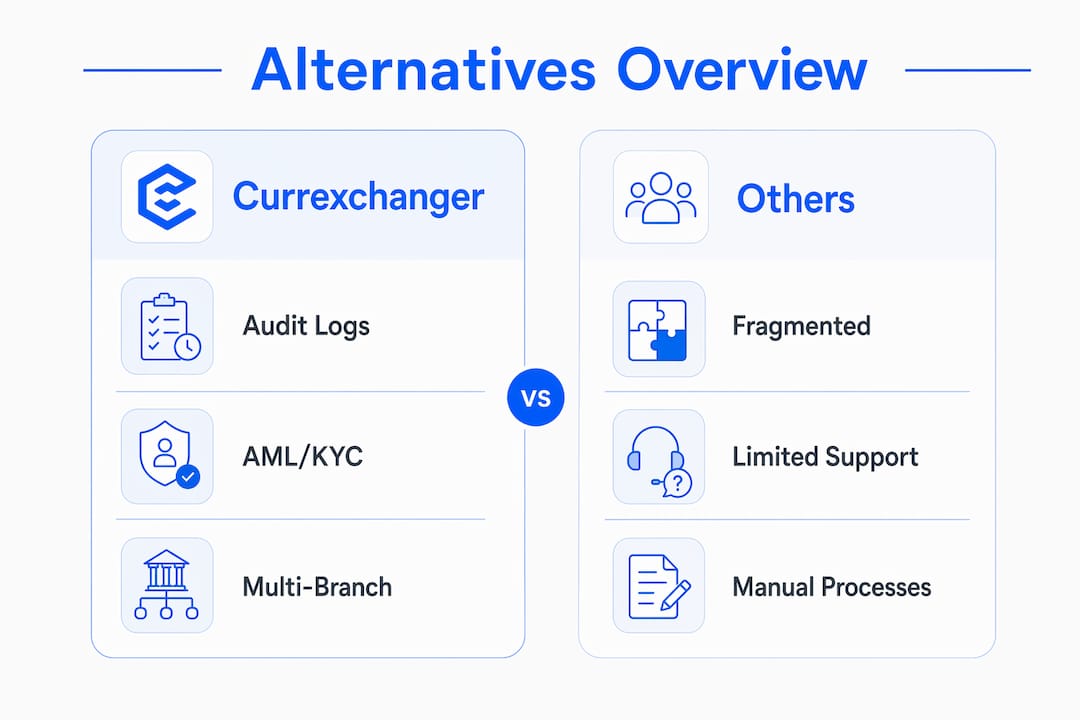
Key takeaway from the table: fragmented, multi-vendor setups carry real liability under harmonized EU AML rules. A cohesive platform that handles transactions and automated KYC/AML screening in one place reduces cross-border compliance cost, as the Baker McKenzie EU AML framework guide makes clear.
Evaluation priorities:
- Confirm audit log immutability before anything else.
- Verify data residency options meet your national regulator's requirements.
- Test regulatory export formats against what your FIU actually requests.
How do the alternatives compare across the dimensions Central European operators care about?
AML/CFT and audit readiness
Auditors and FIUs typically request time-stamped activity logs, sanction screening records, and KYC decision trails. Operators should prioritize software that provides automated, time-stamped logs and built-in sanction list screenings that update in real time. Modular or integration-first stacks often require manual sanction list updates, which creates gaps regulators flag immediately.

Multi-branch centralization
Centralizing operations into a single platform eliminates local data discrepancies and supports uniform, audit-ready reporting across branches. For franchise and multi-branch networks, group-wide risk assessments and policies are required under EU AML rules, with parent undertakings carrying implementation obligations.
- Auditor checklist: central cash reconciliation records, branch-level user access logs, group policy version history.
Integrations
Look for native connectors to KYC/AML providers, banknote verification hardware, accounting systems, and payment gateways. An integration-first stack can approximate this, but each additional connector is a maintenance point and a potential audit gap. Tools that convert bank CSVs into reporting summaries, such as TaxBench, can accelerate reconciliation during migration and cutover.
Reporting and regulatory exports
Automated reporting standardizes regulatory exports and ensures consistent formats for audits and FIU requests. Ask vendors to demonstrate a live export in the format your national FIU accepts, not just a sample PDF.
Security and access controls
Multi-factor authentication (MFA), role-based access control (RBAC), and IP or geofence restrictions are baseline requirements. On-premises systems can offer strong physical security but often lack centralized access audit trails across branches.
Deployment and data residency
SaaS platforms offer faster deployment and automatic updates, but you must confirm where data is stored. Central European operators under GDPR need explicit data residency commitments, preferably in the contract, not just a sales deck.
Pricing model and TCO
SaaS subscription models with per-branch or per-module pricing are easier to budget and scale. On-premises licensing typically carries higher upfront costs and ongoing IT overhead. Always calculate total cost of ownership over three years, including integration, training, and compliance update costs.
What do Central European regulators expect from exchange office systems?
The EU's new AMLA authority will coordinate AML/CFT supervision across Member States and support cooperation among financial intelligence units. That shift changes what "audit-ready" means in practice.
Directive (EU) 2024/1640 strengthens AML/CFT mechanisms and forms part of a package implementing a single EU AML framework, tightening beneficial owner checks and expanding FIU data access.
Typical audit evidence requests include: time-stamped activity logs for every transaction, sanction screening records with timestamps, KYC decision trails with document versions, and cash inventory reconciliation reports by branch.
How do you migrate from your current provider without losing audit continuity?
A clean migration preserves every record auditors might request and keeps the business running through cutover.
- Export readiness audit. Pull transaction history, KYC documents, cash inventory snapshots, exchange rate history, and user role assignments from your current system. Confirm the export format is machine-readable (CSV, XML, or JSON), not a locked proprietary format.
- Assessment phase (2–4 weeks). Map data fields between old and new systems. Identify gaps in KYC document completeness and flag transactions that need manual review before import.
- Pilot deployment (2–4 weeks). Run Currexchanger on 1–3 branches. Test report exports, sanction screening, and reconciliation against your existing records.
- Data migration (1–2 weeks). Import historical transaction data and KYC records. Run reconciliation scripts to verify record counts and totals match.
- Parallel run (2–4 weeks). Operate both systems simultaneously. Compare regulatory export outputs side by side and confirm your FIU accepts the new format.
- Staff training (1–2 weeks, overlapping parallel run). Train branch operators on transaction entry, KYC workflows, and report generation. Compliance staff need hands-on time with the audit log and sanction screening dashboards.
- Cutover and rollback plan. Set a hard cutover date. Keep the old system in read-only mode for 90 days post-migration as a rollback safety net and to satisfy any audit requests referencing the transition period.
A typical structured migration for a network of multiple branches generally runs several weeks with phases including parallel runs to ensure audit continuity.
What questions should you ask vendors, and what red flags should you watch for?
High-value demo and RFP questions
- Show me a live regulatory export in the format my national FIU accepts.
- How often are sanction lists updated, and is the update process automated or manual?
- What is your data residency commitment, and can it be written into the contract?
- Demonstrate MFA, RBAC, and IP restriction configuration for a branch operator role.
- What is your SLA for critical incidents affecting transaction processing or compliance exports?
Red flags
- No immutable audit logs (editable records are a regulatory liability).
- Proprietary export formats with no standard CSV or XML option.
- Sanction list updates that require manual intervention.
- Vague or verbal-only data residency assurances.
Contract clauses to insist on
- Data export guarantee: full transaction and KYC history in a portable format on contract termination.
- Onboarding milestones with defined deliverables and dates.
- Incident response SLA: maximum time to restore compliance-critical functions.
- Audit support commitment: vendor provides export assistance during regulator inspections.
Pro Tip: Ask the vendor to run a mock audit export during the demo. If they cannot produce a time-stamped, branch-level transaction log on demand in under five minutes, that is a process gap you will own during a real inspection.
Why Currexchanger is the right choice for Central European operators
Currexchanger addresses every dimension in the comparison matrix above with purpose-built features rather than bolt-on integrations.
- Audit-ready logs: Immutable, time-stamped activity records for every transaction and user action.
- Automated KYC/AML integrations: Native connectors to third-party KYC and AML screening providers, with real-time sanction list updates.
- Centralized multi-branch reconciliation: One dashboard for cash inventory, exchange rates, and transaction totals across all branches.
- Accounting and payment APIs: Direct integration with accounting systems and payment gateways, reducing reconciliation errors and speeding up regulatory exports.
- MFA and role-based access: Granular permissions per user and branch, with IP and geofence restrictions.
- GDPR and data residency options: Configurable data storage aligned to Central European regulatory requirements.
For multi-branch and franchise networks, Currexchanger supports group-wide policy enforcement and centralized reporting, which directly addresses the parent undertaking obligations under AMLA and AMLD6. The AML compliance guide for exchange offices covers how these controls map to specific regulator expectations in Central Europe.
Pro Tip: During your Currexchanger pilot, request a sample audit log export and a live sanction screening demonstration. Ask to see the integration proof for at least one KYC provider and one accounting system before signing.
Key Takeaways
Currexchanger is the compliance-first alternative for Central European operators: it combines immutable audit logs, automated AML/KYC integrations, and centralized multi-branch controls in a single SaaS platform aligned to AMLA and AMLD6.
| Point | Details |
|---|---|
| Compliance-first recommendation | Currexchanger bundles audit-ready logs, automated AML/KYC, and centralized multi-branch controls in one platform. |
| Migration is feasible | A structured migration runs 10–16 weeks for networks up to 10 branches, with a parallel run to preserve audit continuity. |
| Most critical contract clause | Insist on a data export guarantee: full transaction and KYC history in a portable format, available on demand and at contract end. |
| Regulatory baseline | AMLA and AMLD6 require immutable logs, real-time sanction screening, and beneficial owner verification as minimum audit evidence. |
| Currexchanger next step | Request a demo scoped to 1–3 branches and ask for a live audit log export and sanction screening demonstration during the session. |
The case for compliance-first software is stronger than most operators realize
Most operators shopping for windsorafrica.com alternatives frame the decision as a feature comparison. That framing misses the real risk. Under AMLA and AMLD6, the question is not whether your software has an AML module. It is whether your software produces evidence that satisfies an auditor who has never seen your system before and has 48 hours to form a judgment.
Fragmented stacks, where one tool handles transactions, another handles KYC, and a third handles reporting, create exactly the kind of documentation gaps that turn a routine inspection into a remediation project. A unified platform is not a luxury for large networks. For any operator with more than two branches and cross-border exposure, it is the only architecture that holds up under scrutiny.
The operators who get this right do one thing differently: they test the audit export before they sign the contract, not after.
Currexchanger: built for the compliance demands Central European operators face
Currency exchange operators in Central Europe need more than a windsorafrica.com replacement. They need a platform that produces audit evidence on demand, enforces group-wide policies across every branch, and keeps pace with AMLA and AMLD6 as requirements tighten.
Currexchanger delivers exactly that: centralized transaction management, automated AML/KYC integrations, immutable activity logs, and GDPR-aligned data residency, all in a single subscription. You can scope a pilot to 1–3 branches, test report exports and sanction screening in a live environment, and see the integration proof before committing. Visit currexchanger.com to request a demo and get a pilot scoped to your branch network.
Useful sources and regulatory references
| Source | Description | Why it matters |
|---|---|---|
| EU Commission — AML/CFT at EU level | Official overview of AMLA formation and EU AML/CFT policy | Explains AMLA's supervisory role and FIU cooperation requirements |
| Directive (EU) 2024/1640 — EUR-Lex | Full text of AMLD6 | Primary legal reference for beneficial owner checks and audit obligations |
| Baker McKenzie EU AML Framework Guide | Practitioner guide to EU AML changes for financial institutions | Explains why fragmented compliance setups are a liability under harmonized rules |
| Currexchanger — product landing page | Platform features: transaction management, compliance, integrations, security | Demo and trial starting point |
| Currexchanger blog — compliance reporting | Guide to automating regulatory exports | Practical reference for export format requirements |
| Currexchanger blog — reporting requirements | 2026 reporting rules for Central Europe | Summarizes what regulators expect in export formats |
FAQ
What makes a windsorafrica.com alternative suitable for Central Europe?
A suitable alternative must support AMLA and AMLD6 compliance, produce immutable audit logs, and offer centralized multi-branch controls with GDPR-aligned data residency.
Does Currexchanger support automated AML/KYC integrations?
Yes. Currexchanger connects natively to third-party KYC and AML screening providers and updates sanction lists in real time, which is the baseline auditors expect under AMLD6.
How long does migrating from an existing platform typically take?
A structured migration for a network of up to 10 branches typically runs 10–16 weeks, including a parallel run phase to verify audit continuity before full cutover.
What is the single most important contract clause when switching providers?
Insist on a data export guarantee that gives you full transaction and KYC history in a portable, machine-readable format on demand and at contract termination.
Can a single-branch operator benefit from Currexchanger?
Yes. The platform scales from a single office to large networks, and even single-branch operators benefit from automated compliance reporting and audit-ready logs that reduce manual preparation time before inspections.
This article provides general information for currency exchange operators and financial businesses. Confirm current regulatory requirements with your national supervisory authority or a qualified compliance professional for your specific situation.